
Home » Georgia » Demand Letters » Professional Services Dispute
Georgia Professional Services Demand Letter
Pursuant to Ga. Code Ann. § 9-3-33, claims arising from professional services in Georgia are subject to a four-year statute of limitations commencing from the date of breach or non-performance. A formal professional services demand letter Georgia constitutes the initial procedural step in seeking recovery for unpaid fees, substandard work, or contractual violations involving licensed professionals. Georgia law provides claimants with statutory remedies including compensatory damages, interest at the legal rate established under Ga. Code Ann. § 7-4-2, and recovery of litigation expenses in certain circumstances. The demand letter serves as documented evidence of the claimant’s good faith effort to resolve the dispute prior to initiating proceedings in Magistrate Court.
Statutory Framework: Professional Services Under Georgia Law
The legal foundation for professional services claims in Georgia derives primarily from Ga. Code Ann. § 9-3-33, which establishes the applicable limitations period for actions founded upon breach of contract or professional negligence. This statute mandates that all claims be brought within four years from the date the cause of action accrues. Failure to initiate proceedings within this statutory window results in permanent forfeiture of the right to recover.
| Code Section | Requirement | Deadline | Penalty |
|---|---|---|---|
| Ga. Code Ann. § 9-3-33 | Statute of limitations for contract claims | 4 years | Claim barred |
| Ga. Code Ann. § 7-4-2 | Legal interest rate on judgments | Upon judgment | 5.5% per annum |
| Ga. Code Ann. § 9-11-68 | Offer of settlement procedures | 30 days before trial | Attorney fee shifting |
| Ga. Code Ann. § 13-6-11 | Expenses of litigation recovery | Upon bad faith finding | Attorney fees awarded |
The interplay between these statutory provisions creates a comprehensive framework for professional services recovery. Under Ga. Code Ann. § 7-4-2, successful claimants are entitled to prejudgment interest at the rate of 5.5% per annum on liquidated damages. This provision significantly increases the total recoverable amount when the professional services provider has delayed payment or refused to remedy deficient work. Understanding how to write a professional services demand letter Georgia requires familiarity with these statutory provisions.
Additionally, Ga. Code Ann. § 13-6-11 permits recovery of litigation expenses, including attorney fees, where the opposing party has acted in bad faith or been stubbornly litigious. A properly drafted demand letter establishes the record necessary to invoke this provision should litigation become necessary.
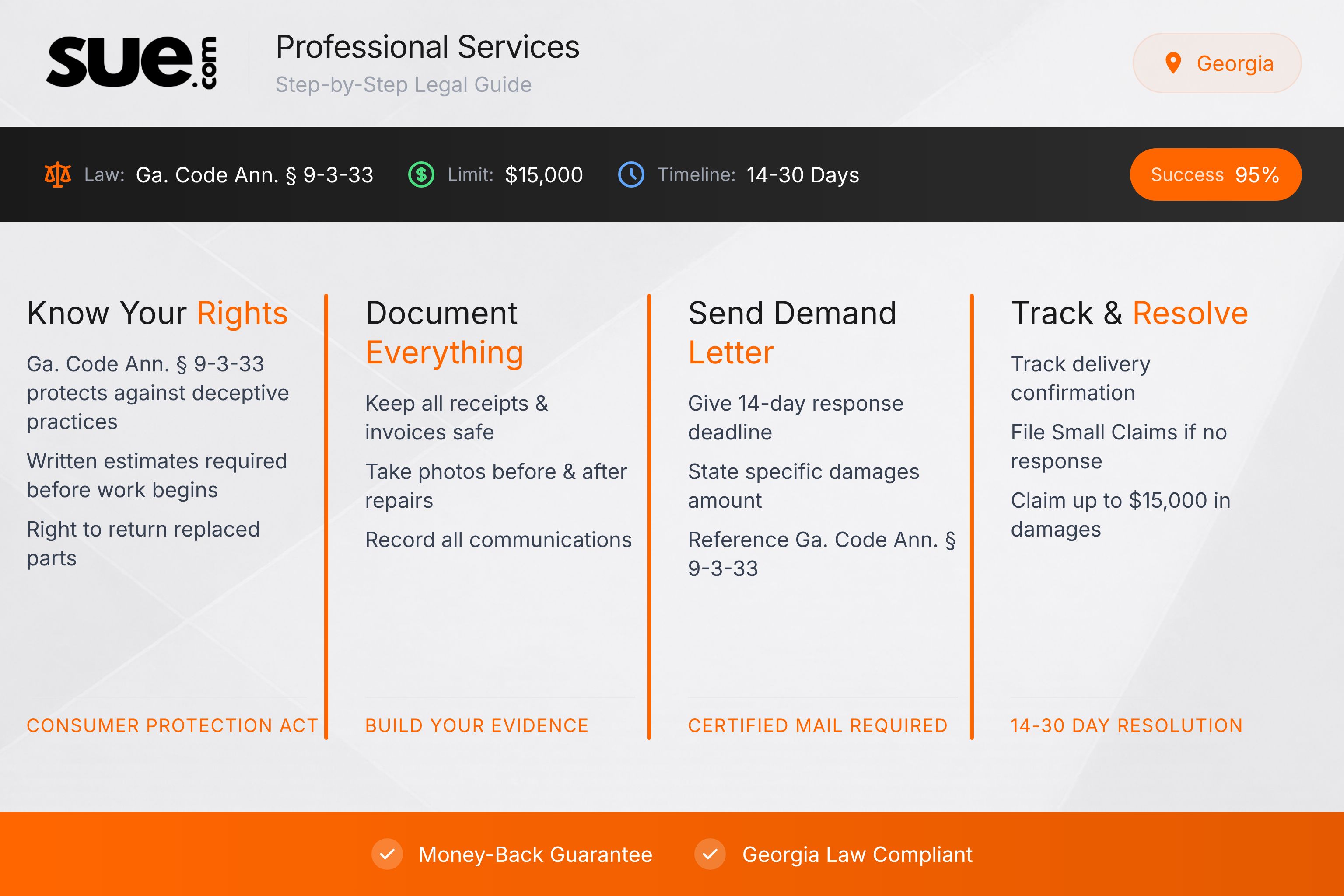
Legal Basis for a Formal Professional Services Demand in Georgia
The issuance of a formal demand letter prior to litigation serves multiple procedural and strategic functions under Georgia law. While no statute explicitly mandates pre-suit notice for professional services claims, the failure to provide such notice may prejudice the claimant’s ability to recover litigation expenses under Ga. Code Ann. § 13-6-11. Georgia courts have consistently held that a party who proceeds directly to litigation without affording the opposing party an opportunity to cure may be deemed to have acted unreasonably.
Consider the following: A homeowner in Fulton County engaged a licensed accountant to prepare corporate tax returns for $3,500. The accountant failed to file the returns by the deadline, resulting in $1,200 in IRS penalties assessed against the homeowner. The homeowner issued a formal demand letter citing Ga. Code Ann. § 9-3-33 and demanding reimbursement of the penalties plus the original fee. Within 14 days of receipt, the accountant tendered full payment to avoid litigation and potential disciplinary action with the Georgia State Board of Accountancy.
The demand letter functions as evidence of the claimant’s reasonable conduct. Pursuant to Georgia procedural requirements, documentation of pre-suit communication strengthens the claimant’s position should the matter proceed to Magistrate Court. Those seeking to recover Georgia landscaping costs via demand or pursue other professional services claims benefit from establishing this evidentiary foundation.
Procedural Requirements for a Georgia Professional Services Demand Letter
The preparation of a legally sufficient demand letter requires adherence to specific procedural steps. Each element contributes to the enforceability of the claim and the likelihood of pre-litigation resolution.
1. Documentation Assembly
All contracts, invoices, correspondence, and evidence of payment must be compiled prior to drafting. This includes written agreements specifying the scope of professional services, email communications documenting the dispute, photographs of deficient work product, and bank records confirming payments rendered.
2. Statutory Research
The applicable statutes must be identified and cited with precision. For professional services disputes in Georgia, this typically includes Ga. Code Ann. § 9-3-33 for the limitations period and Ga. Code Ann. § 7-4-2 for interest calculations. Professional licensing statutes specific to the trade involved may also apply.
3. Damages Calculation
All compensatory damages must be itemized with supporting documentation. Those seeking to understand how to demand interest in Georgia should note that interest accrues at 5.5% per annum from the date of breach.
4. Letter Drafting
The demand letter must be drafted in formal legal language with specific statutory citations. The following template demonstrates proper form:
Dear [Recipient]: Pursuant to Ga. Code Ann. § 9-3-33, this letter constitutes formal demand for $[amount] representing damages arising from your failure to perform professional services as contracted. Under Georgia law, you are obligated to tender payment within 14 days of receipt. Failure to comply may result in the filing of a civil action in Magistrate Court, wherein additional damages including prejudgment interest at 5.5% per annum and litigation expenses may be sought.
5. Service via Certified Mail
The demand must be transmitted via certified mail with return receipt requested. This method creates an official record of delivery admissible in subsequent proceedings.
Professional Professional Services Demand Letter Services for Georgia
The preparation of a legally compliant demand letter requires precision in statutory citation and procedural adherence. Sue.com’s Georgia demand letter hub provides access to attorney-drafted correspondence for $199, ensuring compliance with all applicable Georgia requirements.
- Attorney-drafted correspondence citing applicable Georgia statutes including Ga. Code Ann. § 9-3-33 and § 7-4-2
- Certified mail delivery with return receipt establishing proof of service
- Statutory compliance review ensuring all procedural prerequisites are satisfied
- Escalation path to Magistrate Court for claims up to $15,000
Should the demand letter fail to produce resolution, claimants retain the option to sue for professional services in Georgia through the Magistrate Court system. The demand letter and certified mail receipt serve as exhibits supporting the claim and demonstrating the claimant’s good faith efforts to resolve the matter without judicial intervention.
Step 1
Answer a Few Simple Questions
Tell us what happened — who owes you, how much, and why. Our system guides you step-by-step with no legal jargon.
Step 2
We Draft Your Georgia Demand Letter
Step 3
We Mail It for You

Ready to Send Your Georgia Demand Letter?
Need Assistance?
Need help?
Find answers
Got questions about how Sue.com works, what’s included in each package, or what happens after your letter is sent? We’ve got you covered — quick, clear answers to help you move forward with confidence.
1. Is a formal demand letter a legal prerequisite to filing a professional services claim in Georgia?
Georgia law does not impose a statutory requirement for pre-suit notice in most professional services disputes. However, the absence of a formal demand may prejudice the claimant’s ability to recover litigation expenses under Ga. Code Ann. § 13-6-11, which requires evidence of the opposing party’s bad faith refusal to resolve the matter.
2. Which Georgia statutes should be cited in a professional services demand letter?
The primary statute is Ga. Code Ann. § 9-3-33, establishing the four-year limitations period. Additional citations should include Ga. Code Ann. § 7-4-2 for interest calculations and Ga. Code Ann. § 13-6-11 for potential litigation expense recovery. Professional licensing statutes specific to the service provider’s trade may also apply.
3. What constitutes a reasonable response period under Georgia law?
Georgia courts generally consider 14 to 30 days a reasonable period for response to a formal demand. The demand letter should specify the deadline for compliance and state the consequences of non-response with particularity.
4. What legal remedies are available if the demand is not honored in Georgia?
Claimants may file suit in Magistrate Court for claims within the jurisdictional limit of $15,000. Recoverable damages include compensatory damages, prejudgment interest at 5.5% per annum, and potentially litigation expenses if bad faith is established.
5. What is the maximum recoverable amount for professional services claims in Georgia?
Magistrate Court jurisdiction extends to claims up to $15,000. Claims exceeding this amount must be filed in State Court or Superior Court. Statutory damages and interest are calculated in addition to the principal amount owed.