
Home » Georgia » Small Claims Court » Professional Services Dispute
Sue for Professional Services in Georgia Small Claims Court
Pursuant to Georgia small claims court professional services jurisdiction established under O.C.G.A. § 15-10-2, the Magistrate Court maintains exclusive authority over civil claims not exceeding $15,000, including disputes arising from professional service agreements. Under Ga. Code Ann. § 9-3-33, claims for breach of professional service contracts are subject to a four-year statute of limitations from the date the cause of action accrues. The claimant bears the burden of establishing by a preponderance of evidence that services were contracted, payment was rendered, and the professional failed to perform in accordance with the agreed terms. This guide sets forth the procedural requirements, evidentiary standards, and remedies available to claimants pursuing professional services disputes in Georgia Magistrate Court.
Statutory Basis: Professional Services Claims in Georgia Magistrate Court
The legal framework governing professional services disputes in Georgia derives from multiple statutory provisions that establish both the claimant’s rights and the professional’s obligations. Understanding How to sue for professional services in Georgia requires familiarity with the applicable code sections and their judicial interpretation.
| Code Section | Provision | Damages Available | Burden of Proof |
|---|---|---|---|
| Ga. Code Ann. § 9-3-33 | Statute of limitations for written contracts | Actual damages, consequential losses | Preponderance of evidence |
| O.C.G.A. § 13-6-11 | Expenses of litigation recovery | Attorney fees upon bad faith finding | Clear and convincing evidence |
| O.C.G.A. § 51-12-6 | Measure of damages in tort actions | Cost of completion or diminution in value | Preponderance of evidence |
| O.C.G.A. § 13-4-2 | Substantial performance doctrine | Contract price less cost to remedy defects | Preponderance of evidence |
To prevail on a professional services claim, the claimant must establish four elements: the existence of a valid contract or agreement for services, the claimant’s performance of all conditions precedent (typically payment), the professional’s material breach or failure to perform, and resulting damages proximately caused by the breach. Georgia courts apply the “benefit of the bargain” rule, entitling the claimant to recover damages sufficient to place them in the position they would have occupied had the contract been fully performed.
Pursuant to O.C.G.A. § 13-6-11, where the professional has acted in bad faith or been stubbornly litigious, the court may award expenses of litigation including reasonable attorney fees. This provision serves as a deterrent against professionals who refuse to honor legitimate refund requests or who contest claims without reasonable justification.
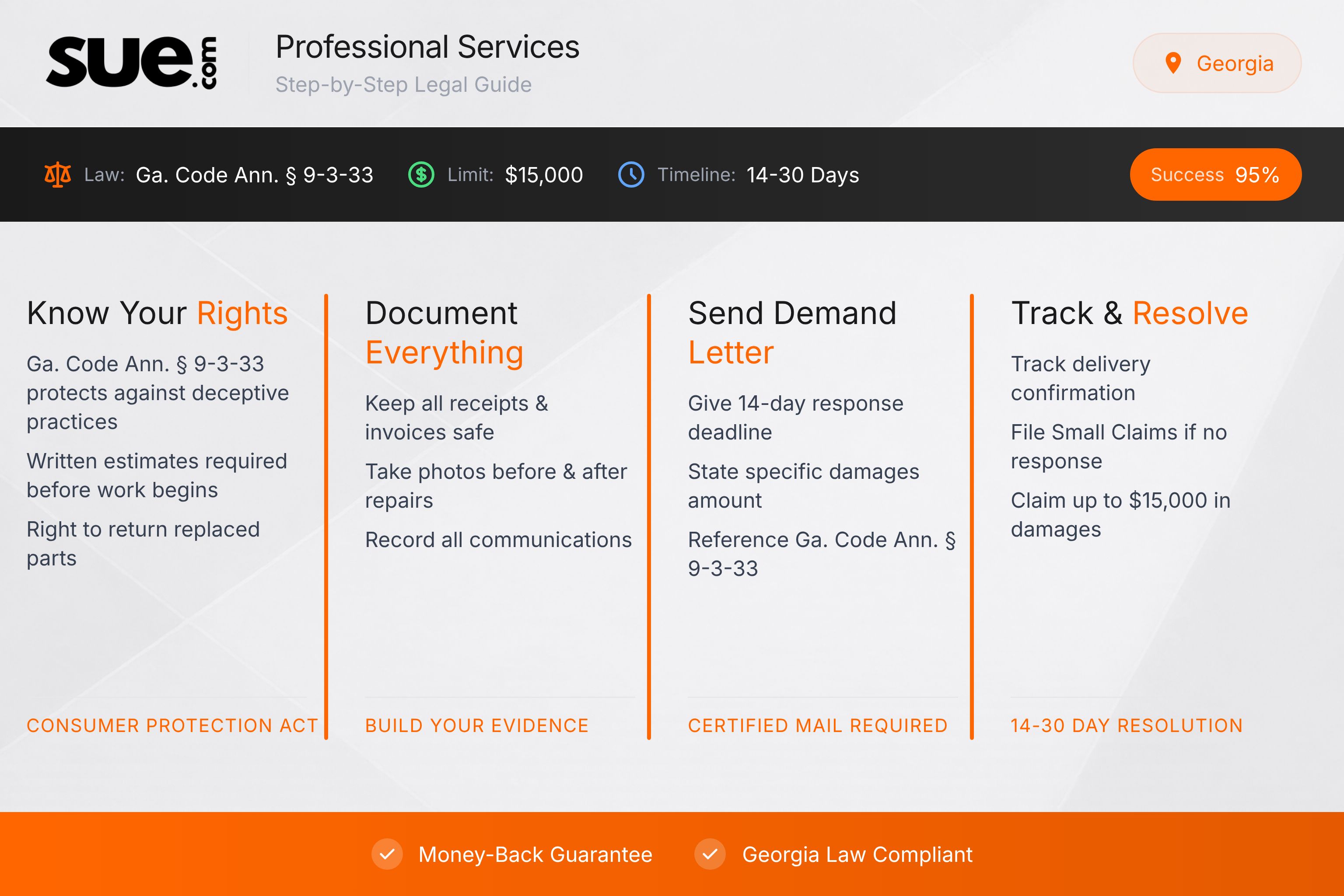
Filing Procedures: Professional Services in Georgia Magistrate Court
The procedural requirements for initiating a professional services claim in Georgia Magistrate Court are established under O.C.G.A. § 15-10-40 et seq. Strict compliance with jurisdictional and venue requirements is mandatory for the court to exercise authority over the dispute. For guidance on related matters such as Small claims Georgia landscaping dispute procedures, similar filing protocols apply across service categories.
- Court: Magistrate Court of the county where the professional resides or conducts business
- Jurisdictional limit: $15,000 exclusive of interest and costs
- Filing fee: $45 to $75 depending on county and claim amount
- Forms required: Statement of Claim form, Civil Case Filing Information Form
- Statute of limitations: Four years for written contracts; four years for oral agreements under O.C.G.A. § 9-3-26
- Venue: County where defendant resides, where services were to be performed, or where contract was executed
The Statement of Claim shall set forth with particularity the nature of the professional services contracted, the date of the agreement, the amount paid, the specific deficiencies in performance, and the damages sought. Service of process must be effectuated pursuant to O.C.G.A. § 9-11-4, typically through the county sheriff or certified mail with return receipt requested. The defendant is entitled to 30 days from service to file an answer or counterclaim.
Evidentiary Standards for Professional Services Claims in Georgia
The admissibility and weight of evidence in professional services disputes are governed by the Georgia Evidence Code and Magistrate Court procedural rules. Claimants must compile documentation sufficient to establish each element of their claim by a preponderance of evidence. Understanding How to present exhibits in Georgia court is essential to effective case presentation.
| Evidence Type | Purpose | Legal Basis |
|---|---|---|
| Written contract or service agreement | Establishes terms, scope, and price of services | O.C.G.A. § 24-8-801 (business records) |
| Payment receipts, bank statements, canceled checks | Proves consideration was rendered | O.C.G.A. § 24-9-901 (authentication) |
| Photographs of deficient work product | Documents failure to perform per specifications | O.C.G.A. § 24-9-901(b)(1) |
| Written communications (emails, text messages) | Establishes scope, complaints, and admissions | O.C.G.A. § 24-8-801(d) (admissions) |
| Expert testimony or repair estimates | Quantifies cost of completion or correction | O.C.G.A. § 24-7-702 |
Damages in professional services cases are calculated using either the cost of completion method or the diminution in value method, depending on which measure more accurately reflects the claimant’s actual loss. The cost of completion method awards the amount necessary to hire another professional to complete or correct the work. The diminution in value method awards the difference between the value of the services as promised and the value as actually delivered.
Claimants should obtain at least two written estimates from licensed professionals to establish the reasonable cost of remediation. All exhibits must be organized chronologically and copies provided to the court and opposing party at least five days prior to the hearing date. The Magistrate Court judge will evaluate the credibility of witnesses and the weight of documentary evidence in rendering judgment.
Professional Filing Services for Georgia Magistrate Court
The Sue.com Georgia legal filing hub provides comprehensive professional services claim preparation for Georgia Magistrate Court proceedings. For $249, claimants receive attorney-drafted documentation designed to satisfy Georgia evidentiary and procedural requirements.
- Attorney-drafted Demand letter for professional services refund Georgia citing applicable Georgia statutes
- Complete filing guide for Magistrate Court with county-specific instructions
- Court-ready Statement of Claim and Civil Case Filing Information forms
- Evidence checklist tailored to professional services disputes
- Damages calculation methodology with supporting documentation templates
- Hearing preparation materials including witness examination guidelines
The demand letter component frequently resolves disputes without court intervention, as professionals recognize the claimant’s preparation and legal knowledge. Where litigation becomes necessary, the filing package ensures compliance with all procedural requirements and maximizes the probability of a favorable judgment.
Step 1
Answer a Few Simple Questions
Tell us what happened — who owes you, how much, and why. Our system guides you step-by-step with no legal jargon.
Step 2
We Draft Your Georgia Demand Letter
Step 3
We Mail It for You

Ready to Send Your Georgia Demand Letter?
Need Assistance?
Need help?
Find answers
Got questions about how Sue.com works, what’s included in each package, or what happens after your letter is sent? We’ve got you covered — quick, clear answers to help you move forward with confidence.
1. What is the jurisdictional limit for Professional Services claims in Georgia Magistrate Court?
Pursuant to O.C.G.A. § 15-10-2, Georgia Magistrate Court exercises jurisdiction over civil claims not exceeding $15,000, exclusive of interest and court costs. Claims exceeding this amount must be filed in State Court or Superior Court.
2. What evidentiary standard applies to Professional Services claims in Georgia?
The claimant must prove each element of the claim by a preponderance of the evidence, meaning it is more likely than not that the facts alleged are true. Documentary evidence including contracts, payment records, and photographs of deficient work are essential to meeting this burden.
3. What is the applicable statute of limitations for Professional Services in Georgia?
Under Ga. Code Ann. § 9-3-33, claims arising from written professional service contracts must be filed within four years of the breach. Oral agreements are similarly subject to a four-year limitations period pursuant to O.C.G.A. § 9-3-26.
4. Is legal representation permitted in Georgia Magistrate Court?
Parties may appear pro se or retain legal counsel in Magistrate Court proceedings. However, the informal nature of Magistrate Court procedures is designed to accommodate self-represented litigants, and attorney fees are generally not recoverable absent a finding of bad faith.
5. What remedies are available upon judgment in a Georgia Professional Services case?
Upon entry of judgment, the prevailing party may pursue collection through wage garnishment, bank account levy, or property lien pursuant to O.C.G.A. § 9-12-80 et seq. Judgments bear interest at the legal rate of 7% per annum until satisfied.