
Home » Texas » Small Claims Court » Personal Injury Dispute
Sue for Personal Injury in Texas Small Claims Court
If someone’s negligence caused you physical harm, you have the right to seek compensation, and Texas makes this more accessible than you might think. Whether you were hurt in a slip and fall small claims Texas incident, a minor car accident, or another situation where someone else was at fault, Justice Court provides a straightforward path to recover your damages. We’ll walk you through the entire process together, from understanding your legal rights under Texas law to filing your claim and presenting your case. You can sue for up to $20,000 in Justice Court without needing an attorney, and this guide will show you exactly how to build a strong case for the compensation you deserve.
Personal Injury Laws That Help You Win in Texas
Understanding the legal foundation of your case helps you approach the process with confidence. Texas law provides clear protections for people who’ve been injured due to someone else’s carelessness, and knowing these rules puts you in a stronger position from the start.
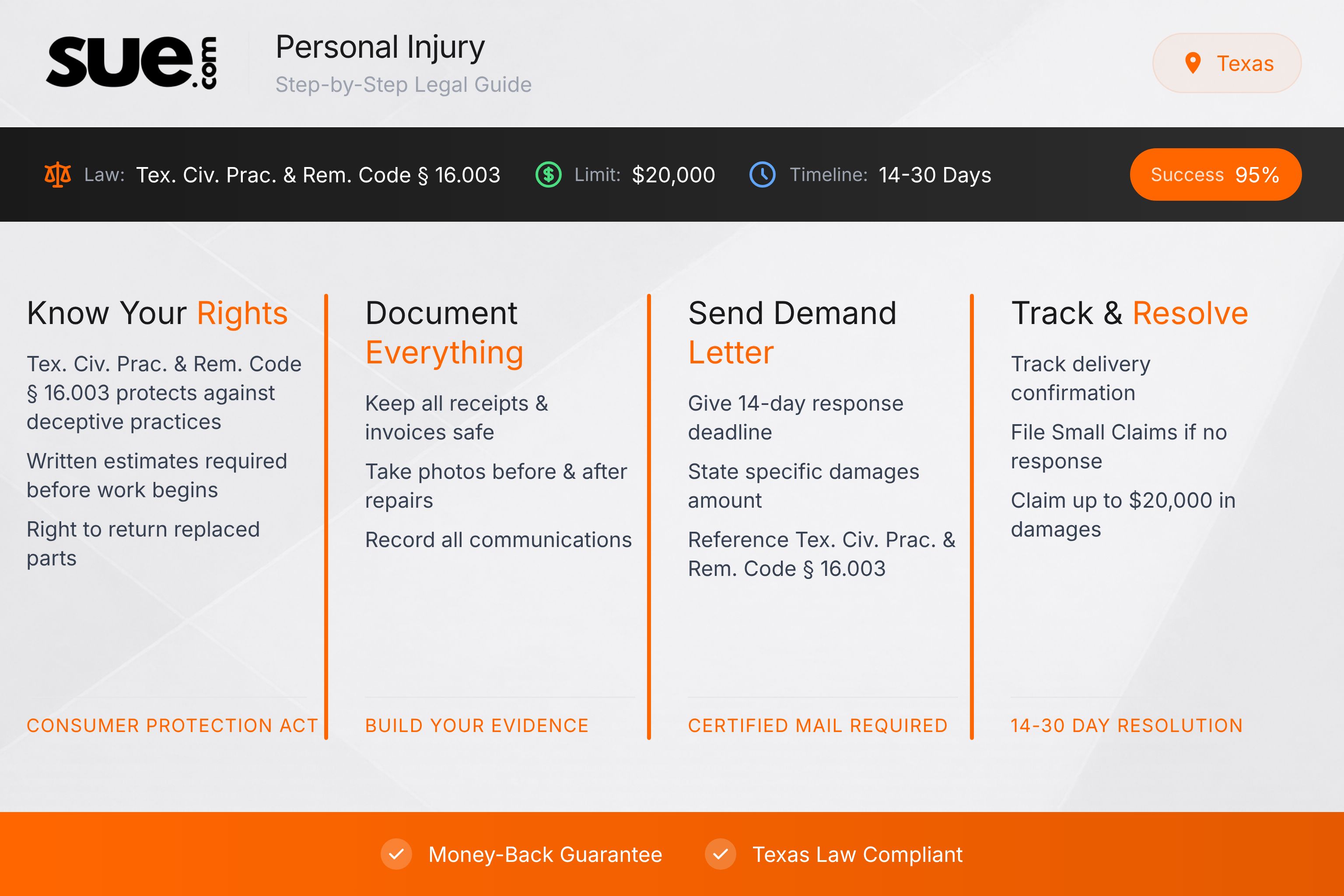
The most important law for your case is Tex. Civ. Prac. & Rem. Code § 16.003, which gives you two years from the date of your injury to file a personal injury claim. This is called the statute of limitations, and it exists to ensure cases are brought while evidence is still fresh and witnesses can still remember what happened. Two years might sound like plenty of time, but gathering evidence and preparing your case takes longer than most people expect, so it’s wise to start sooner rather than later.
- Your court: Justice Court (also called JP Court or Small Claims Court)
- Maximum claim: $20,000 for all damages combined
- Key law: Tex. Civ. Prac. & Rem. Code § 16.003 gives you 2 years to file from the injury date
- What you must show: The other person had a duty of care, they breached it, and that breach directly caused your injury and damages
- Good news: Texas allows you to recover medical bills, lost wages, pain and suffering, and property damage all in one claim
To win your case, you’ll need to demonstrate what lawyers call “negligence.” This simply means showing that the person who hurt you failed to act with reasonable care. For example, if a store owner knew about a wet floor but didn’t put up a warning sign, that’s a breach of their duty to keep customers safe. What counts as personal injury in Texas small claims? The answer includes any physical harm caused by another person’s carelessness, from dog bites to car accidents to injuries on someone else’s property. With this legal framework on your side, you’re ready to move forward with filing your claim.
How to File a Personal Injury Claim in Texas
Filing your claim is more straightforward than it might seem, and we’ll break it down into clear steps so you know exactly what to expect. The process begins at your local Justice Court, which handles cases up to $20,000 throughout Texas.
- First: Locate your local Justice Court and obtain the Small Claims Petition form (Form SC-100 in most counties)
- Next: Fill in your personal information, the defendant’s name and address, and a clear description of how they injured you
- Then: Calculate your total damages and enter that amount on the form (we’ll help with this in the next section)
- After that: File your petition and pay the filing fee, which typically ranges from $50 to $100 depending on your county and claim amount
- Finally: The court will issue a citation that must be served on the defendant, officially notifying them of your lawsuit
Many Texas counties now offer electronic filing through the eFileTexas system, which lets you submit your paperwork online without visiting the courthouse. This can save you time and make the process more convenient. Once you’ve filed, the court handles the file Texas court summons process by issuing the official citation. You’ll typically need to arrange for service of the citation on the defendant, either through a constable, private process server, or certified mail. The court clerk can explain which service methods are available in your county. With your filing complete, you’ll receive a hearing date, usually scheduled four to eight weeks out, giving you time to prepare your evidence.
Building Your Personal Injury Case in Texas
This is where your case comes together, and the evidence you gather now will determine your success at the hearing. Don’t worry if this sounds overwhelming. We’ll walk through exactly what you need and why each piece matters.
Your Evidence Checklist:
- Medical records and bills: These prove your injuries are real and document the treatment you needed. Request itemized statements from every healthcare provider you visited.
- Photos of your injuries: Take pictures as soon as possible after the incident and continue documenting your healing process. Visual evidence is powerful in court.
- Incident documentation: Police reports, accident reports, or incident reports from businesses establish the official record of what happened.
- Proof of lost income: Pay stubs, a letter from your employer, or tax returns showing your normal earnings help prove wages you lost while recovering.
- Witness information: Names and contact details for anyone who saw what happened. Their testimony can corroborate your version of events.
Understanding service of process rules for Texas ensures the defendant is properly notified and your case proceeds smoothly. Now let’s look at how to calculate what you’re owed. Here’s a sample breakdown:
| What You’re Claiming | Amount |
|---|---|
| Emergency room visit and treatment | $2,800 |
| Follow-up physical therapy (6 sessions) | $1,200 |
| Lost wages (2 weeks missed work) | $1,600 |
| Pain and suffering | $2,000 |
| Your total claim | $7,600 |
At your hearing, you’ll present this evidence to the judge, explain what happened, and show how you calculated your damages. The judge will ask questions and may let the defendant respond. This sounds more formal than it usually feels. Justice Court hearings are designed to be accessible to people without legal training, and judges are accustomed to guiding both parties through the process.
How Sue.com Walks You Through Your Texas Personal Injury Case
You don’t have to figure this out alone. Sue.com Texas court prep tools provide everything you need to pursue your personal injury claim with confidence. For $249, you get a complete package designed specifically for Texas Justice Court cases.
- A professionally written demand letter to send before filing, which often resolves cases without going to court
- A step-by-step filing guide customized for Texas Justice Court procedures
- All the forms you need, pre-identified so you’re not hunting through courthouse websites
- An evidence checklist tailored specifically to personal injury cases
- A damages calculation breakdown to help you claim everything you’re entitled to
- A hearing preparation guide so you know exactly what to expect and how to present your case
Starting with a demand letter makes sense for most personal injury cases. This official Texas injury settlement notice formally requests payment before you file suit, and many defendants choose to settle at this stage rather than face a court judgment. If they don’t respond or refuse to pay fairly, you’ll have everything ready to move forward with your Justice Court filing. With Sue.com guiding you through each step, you can approach your case knowing you have the tools and information you need to succeed.
Step 1
Answer a Few Simple Questions
Tell us what happened — who owes you, how much, and why. Our system guides you step-by-step with no legal jargon.
Step 2
We Draft Your Texas Demand Letter
Step 3
We Mail It for You

Ready to Send Your Texas Demand Letter?
Need Assistance?
Need help?
Find answers
Got questions about how Sue.com works, what’s included in each package, or what happens after your letter is sent? We’ve got you covered — quick, clear answers to help you move forward with confidence.
1. What is the small claims limit for Personal Injury in Texas?
You can sue for up to $20,000 in Texas Justice Court for personal injury claims. This limit covers all your damages combined, including medical bills, lost wages, pain and suffering, and any property damage. If your total damages exceed $20,000, you would need to file in a higher court, which typically requires an attorney.
2. What evidence do I need for a Personal Injury case in Texas?
The strongest cases include medical records and bills showing your treatment, photos documenting your injuries, any official incident or police reports, proof of lost income if you missed work, and contact information for witnesses. The more documentation you have connecting your injuries to the defendant’s actions, the stronger your case becomes.
3. How long does a Personal Injury case take in Texas?
Most Justice Court cases reach a hearing within four to eight weeks after filing. The entire process, from sending a demand letter through receiving a judgment, typically takes two to four months. Simpler cases with clear evidence often resolve faster, especially if the defendant agrees to settle after receiving your demand letter.
4. Do I need a lawyer for Personal Injury small claims in Texas?
No, Justice Court is specifically designed for people to represent themselves. The procedures are simplified, and judges are experienced in working with parties who don’t have legal training. Many Texans successfully handle their own personal injury claims with proper preparation and documentation.
5. What happens if I win but they don't pay?
If the defendant doesn’t pay voluntarily after you receive a judgment, Texas law provides several collection tools. You can request a Writ of Execution to have a constable seize the defendant’s non-exempt property, garnish their bank accounts, or place a lien on their real estate. The court clerk can provide the forms needed to begin the collection process.