
Home » Texas » Demand Letters » Personal Injury Dispute
Texas Personal Injury Demand Letter
If you’ve been injured due to someone else’s negligence in Texas, you’re likely feeling overwhelmed about what comes next. We’re here to help you understand your options and take meaningful action. A Texas personal injury demand letter is often the most effective first step toward recovering compensation for your medical bills, lost wages, and pain and suffering. Under Tex. Civ. Prac. & Rem. Code § 16.003, you have a specific window of time to pursue your claim, and this guide will walk you through everything you need to know to protect your rights.
Understanding Texas Personal Injury Law
Before we dive into the mechanics of writing your demand letter, let’s take a moment to understand the legal foundation that supports your claim. Texas law recognizes that when someone’s carelessness causes you harm, you deserve to be compensated. This principle, known as negligence, forms the basis of most personal injury claims in the state.
The most important statute you need to know is Tex. Civ. Prac. & Rem. Code § 16.003, which establishes the statute of limitations for personal injury claims. In plain terms, this law gives you two years from the date of your injury to file a lawsuit. While that might sound like plenty of time, the clock starts ticking immediately, and gathering evidence becomes harder as time passes. This is why sending a demand letter early in the process is so valuable.
Texas follows a modified comparative fault rule under Tex. Civ. Prac. & Rem. Code § 33.001. This means you can still recover damages even if you were partially at fault, as long as your responsibility doesn’t exceed 50 percent. Your compensation will be reduced by your percentage of fault, but you’re not automatically disqualified from seeking recovery.
- Your deadline: Two years from the date of injury to file a lawsuit
- Their obligation: The at-fault party must compensate you for damages caused by their negligence
- If they don’t comply: You can file a claim in Texas courts to enforce your rights
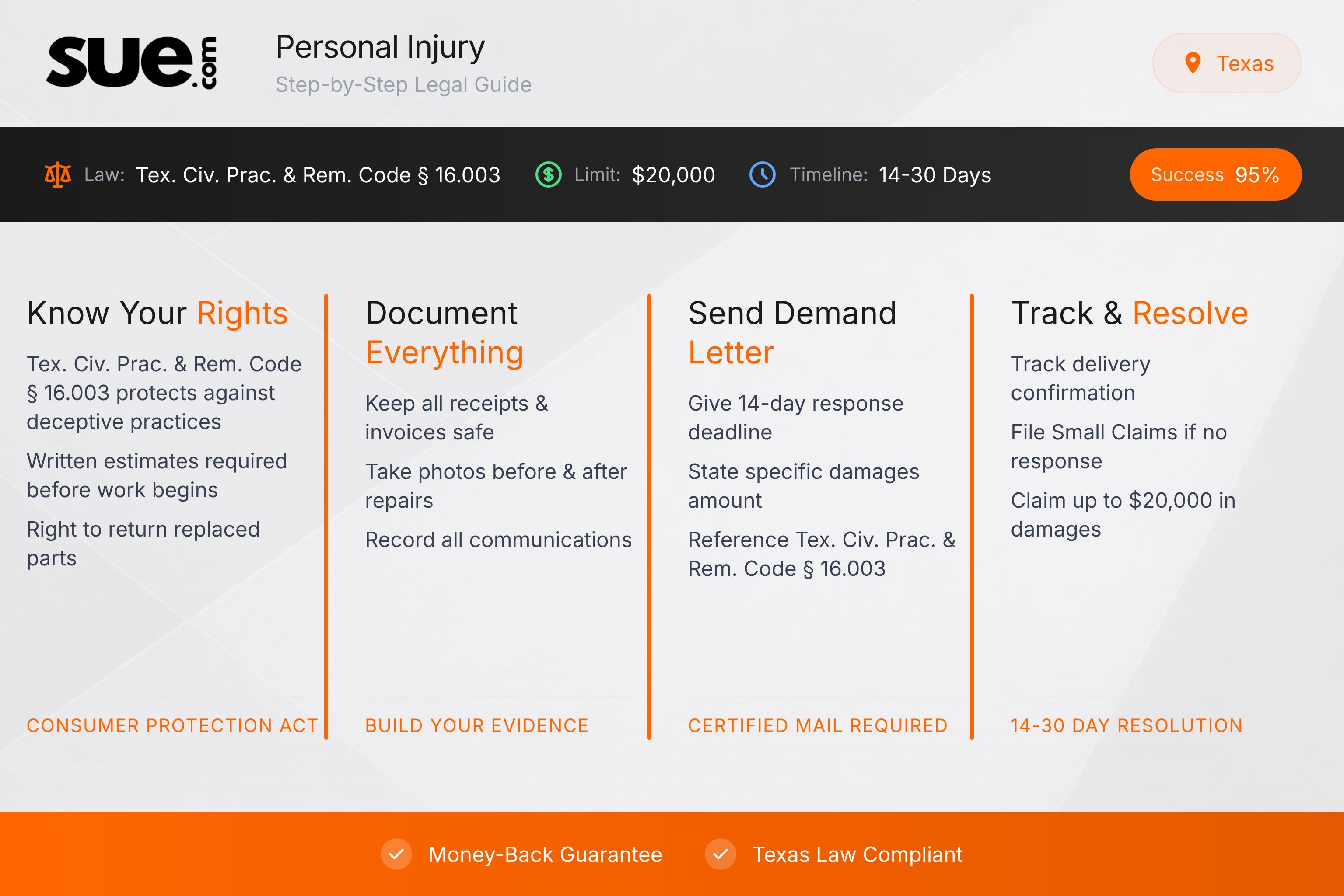
- Your maximum claim: $20,000 in Justice Court
- Important: Texas allows recovery for both economic damages (medical bills, lost wages) and non-economic damages (pain and suffering)
Understanding these basics puts you in a stronger position when you dispute an injury claim in Texas. With this foundation in place, you’re ready to see why a demand letter is such an effective tool.
Why a Demand Letter Is Your Best First Step in Texas
You might be wondering whether sending a demand letter actually makes a difference. The answer is yes, and here’s why. A well-crafted demand letter signals to the responsible party that you understand your rights and are prepared to take legal action if necessary. Most individuals and insurance companies would rather settle a legitimate claim than face the time, expense, and uncertainty of a courtroom battle.
A demand letter also creates an official paper trail. If your case eventually goes to Justice Court, you’ll have documented proof that you attempted to resolve the matter reasonably before filing suit. Texas judges appreciate seeing that plaintiffs made good-faith efforts to settle disputes outside of court.
- Week 1: You send the demand letter via certified mail
- Week 2-3: The other party receives and has time to respond
- Week 3-4: Most disputes resolve here
- If no response: You have a documented paper trail for Justice Court
Think of your Demand letter for Texas consumer fraud or personal injury claim as opening a formal conversation. You’re clearly stating what happened, what you’re owed, and what you expect. Many recipients respond positively simply because they realize the alternative is more costly and time-consuming for everyone involved.
How to Write Your Texas Personal Injury Demand Letter, Step by Step
Now let’s walk through the actual process of creating your demand letter. This might seem intimidating at first, but breaking it down into manageable steps makes it much more approachable. We’ll guide you through each part so you know exactly what to include.
Step 1: Gather your documentation. Before you write a single word, collect everything related to your injury. This includes medical records, hospital bills, prescription receipts, photographs of your injuries, police reports if applicable, and any correspondence with the at-fault party or their insurance company. The stronger your documentation, the more persuasive your demand letter will be.
Step 2: Research the Texas laws that apply. Your letter gains significant weight when it references specific statutes. For personal injury claims, Tex. Civ. Prac. & Rem. Code § 16.003 (statute of limitations) and § 33.001 (comparative fault) are essential. Including these citations shows you understand your legal position.
Step 3: Calculate what you’re owed. Texas allows you to recover economic damages like medical expenses, lost wages, and property damage. You can also claim non-economic damages for pain and suffering, emotional distress, and loss of enjoyment of life. Be specific with your numbers and show your math.
Step 4: Draft your letter with proper citations. Your letter should be professional, factual, and firm without being aggressive. State the facts clearly, reference the applicable laws, and specify your demand amount with a reasonable deadline for response.
Step 5: Send via certified mail. Always send your demand letter through certified mail with return receipt requested. This creates proof that the recipient received your letter and when they received it. Understanding the Legal weight of a signed Texas demand letter helps you appreciate why this documentation matters.
Dear [Name], I am writing regarding injuries I sustained on [date] due to your negligence at [location]. Under Tex. Civ. Prac. & Rem. Code § 16.003, I have the right to seek compensation for damages resulting from this incident. My medical expenses total $[amount], I have lost $[amount] in wages, and I am seeking $[amount] for pain and suffering. I am requesting a total of $[amount] to resolve this matter within 30 days of receipt of this letter.
With your letter drafted and sent, you’ve taken a significant step toward resolution.
How Sue.com Guides You Through Texas Personal Injury Demand Letters
We understand that even with a guide like this, writing a demand letter can feel daunting. That’s where our team comes in. For $199, Sue.com Texas court document tools connect you with an attorney who will craft a professional demand letter tailored to your specific situation.
- Attorney writes your letter citing Texas statutes
- Damages calculated based on your situation
- Sent via certified mail with return receipt
- If needed, guidance on next steps in Justice Court
Our attorneys have experience with Texas personal injury claims and know exactly how to frame your demand for maximum impact. They’ll ensure your letter includes all relevant documentation references and legal citations. If the other party doesn’t respond appropriately, you’ll be well-positioned to pursue your claim in Texas small claims court personal injury proceedings. You don’t have to navigate this process alone, and taking this step puts you on the path toward the compensation you deserve.
Step 1
Answer a Few Simple Questions
Tell us what happened — who owes you, how much, and why. Our system guides you step-by-step with no legal jargon.
Step 2
We Draft Your Texas Demand Letter
Step 3
We Mail It for You

Ready to Send Your Texas Demand Letter?
Need Assistance?
Need help?
Find answers
Got questions about how Sue.com works, what’s included in each package, or what happens after your letter is sent? We’ve got you covered — quick, clear answers to help you move forward with confidence.
1. Is a demand letter required before suing for Personal Injury in Texas?
Texas law doesn’t require you to send a demand letter before filing a lawsuit, but doing so is strongly recommended. A demand letter often resolves disputes faster and cheaper than going to court, and it demonstrates to a judge that you acted reasonably if litigation becomes necessary.
2. What Texas laws should I reference in my Personal Injury demand letter?
The most important statute is Tex. Civ. Prac. & Rem. Code § 16.003, which establishes your two-year deadline to file suit. You should also reference § 33.001 if comparative fault might be an issue, as this explains how Texas handles situations where both parties share some responsibility.
3. How long should I give them to respond to my demand letter?
A response deadline of 30 days is standard and reasonable for personal injury demands in Texas. This gives the recipient enough time to review your claim, consult with their insurance company, and prepare a response without creating unnecessary delays.
4. What happens if they ignore my Personal Injury demand letter in Texas?
If you don’t receive a response within your stated deadline, you have a clear path forward. Your documented demand letter becomes evidence that you attempted good-faith resolution, and you can proceed to file your claim in Justice Court for amounts up to $20,000.
5. How much can I recover for Personal Injury in Texas?
In Justice Court, you can claim up to $20,000. Your recovery can include economic damages like medical bills and lost wages, plus non-economic damages for pain and suffering. The specific amount depends on your documented losses and the strength of your evidence.