
Home » New York » Small Claims Court » Defective Product Dispute
Sue for Defective Product in New York Small Claims Court
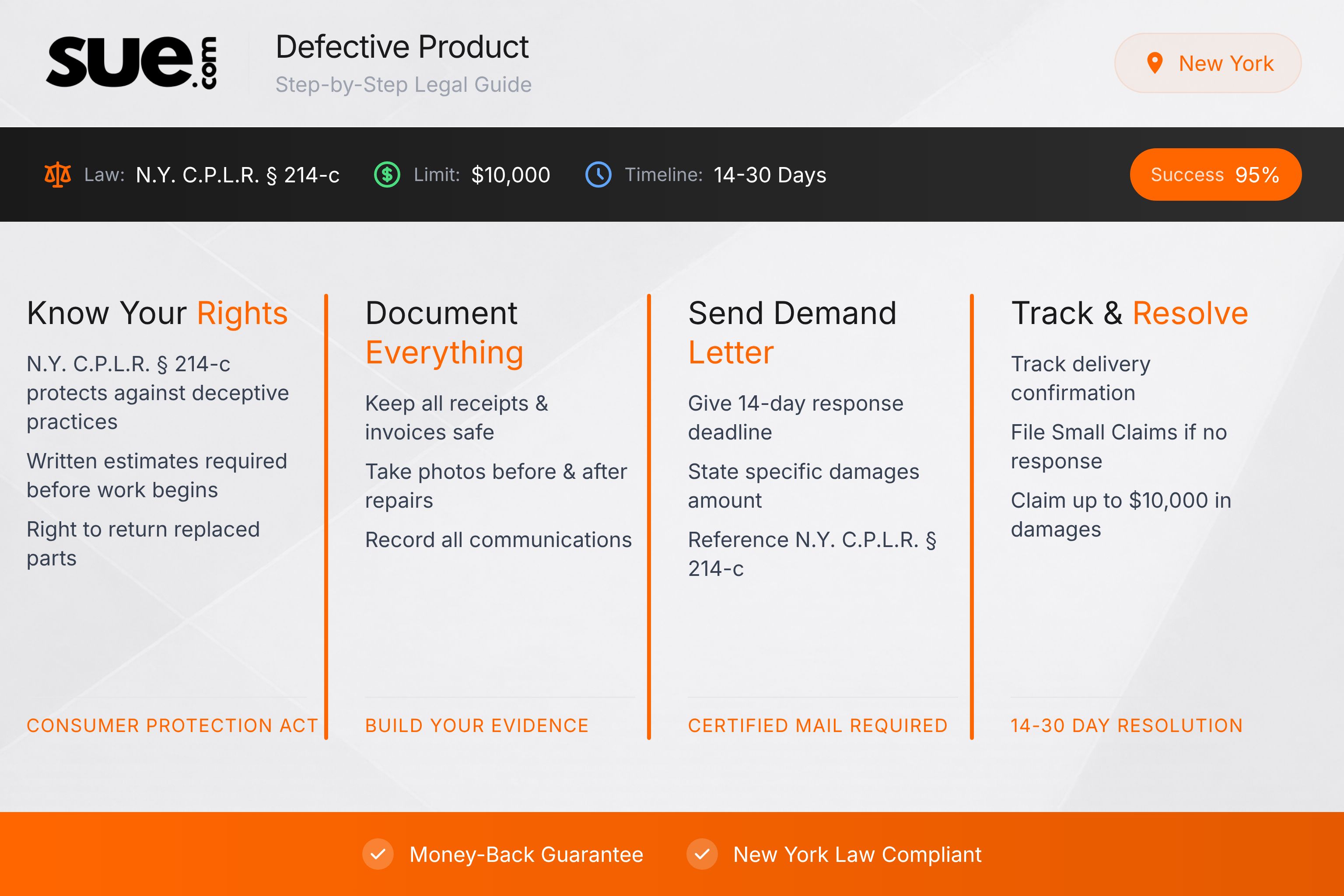
Pursuant to N.Y. C.P.L.R. § 214-c, consumers who have sustained injury or economic loss from defective products may seek recovery through the New York small claims court product refund process. The Small Claims Court maintains jurisdiction over claims not exceeding $10,000, providing an accessible forum for product liability matters without the procedural complexity of higher courts. Claims must be filed within the applicable statute of limitations period, and the claimant bears the burden of establishing that the product was defective at the time of sale or distribution. This guide sets forth the statutory framework, procedural requirements, and evidentiary standards governing defective product claims in New York Small Claims Court.
Statutory Basis: Defective Product Claims in New York Small Claims Court
Under New York law, defective product claims are governed by multiple statutory and common law provisions that establish liability standards and available remedies. The following table summarizes the primary legal authorities applicable to product defect claims in Small Claims Court:
| Code Section | Provision | Damages Available | Burden of Proof |
|---|---|---|---|
| N.Y. C.P.L.R. § 214-c | Discovery rule for latent defects | Actual damages, consequential losses | Preponderance of evidence |
| N.Y. U.C.C. § 2-314 | Implied warranty of merchantability | Purchase price, incidental damages | Product unfit for ordinary purpose |
| N.Y. U.C.C. § 2-315 | Implied warranty of fitness | Actual damages, replacement costs | Seller knew particular purpose |
| N.Y. Gen. Bus. Law § 349 | Deceptive trade practices | Actual damages or $50 minimum | Materially misleading conduct |
To establish a prima facie case for breach of implied warranty under N.Y. U.C.C. § 2-314, the claimant must demonstrate that the product was not merchantable at the time of sale. Merchantability requires that goods pass without objection in the trade, are fit for ordinary purposes, and conform to any promises made on the packaging or label. How to sue for defective product in New York requires documentation establishing the defect existed at the time of purchase rather than arising from misuse.
New York courts apply strict liability principles to manufacturing defects, meaning the claimant need not prove negligence if the product deviated from its intended design. For design defects, the risk-utility test governs, requiring proof that the product’s risks outweighed its benefits and a safer alternative design was feasible. Claims brought under N.Y. Gen. Bus. Law § 349 require proof of consumer-oriented conduct that is materially misleading and causes actual injury.
How to File a Defective Product Claim in New York
The procedural requirements for initiating a defective product claim in New York Small Claims Court are established by the New York City Civil Court Act and the Uniform District Court Act. The following specifications govern filing:
- Court: Small Claims Court (NYC Civil Court or District/City Court outside NYC)
- Jurisdictional limit: $10,000
- Filing fee: $15 to $20 for claims up to $1,000; $20 to $25 for claims over $1,000
- Forms required: Statement of Claim form, available at the clerk’s office
- Statute of limitations: 4 years for breach of warranty; 3 years for personal injury
- Venue: County where defendant resides or where transaction occurred
Jurisdiction in New York Small Claims Court is proper when the defendant resides, is employed, or has a place of business within the county where the action is filed. For corporate defendants, venue lies where the principal office is located or where the product was purchased. The Sue for New York moving damage process follows similar jurisdictional principles for property-related claims.
Filing may be accomplished in person at the Small Claims Clerk’s office or through NYSCEF (New York State Courts Electronic Filing) in participating courts. The Statement of Claim must identify the defendant by full legal name and address, state the amount claimed with specificity, and provide a brief description of the defective product and resulting damages. Service of process is effectuated by the court through certified mail, and the hearing date is typically scheduled within 30 to 60 days of filing.
Building Your Defective Product Case in New York
The evidentiary standards applicable to defective product claims require systematic documentation of the defect, causation, and damages. The following table specifies the evidence required to meet the claimant’s burden of proof:
| Evidence Type | Purpose | Legal Basis |
|---|---|---|
| Purchase receipt or invoice | Establishes privity and transaction date | N.Y. U.C.C. § 2-314 |
| Defective product (if available) | Demonstrates nature of defect | Common law product liability |
| Photographs of defect and damage | Visual documentation of condition | N.Y. C.P.L.R. § 4518 |
| Expert opinion or repair estimate | Quantifies damages and confirms defect | N.Y. C.P.L.R. § 4515 |
| Written correspondence with seller | Proves notice and opportunity to cure | N.Y. U.C.C. § 2-607 |
| Medical records (if injury occurred) | Documents personal injury damages | N.Y. C.P.L.R. § 214-c |
Damages in defective product cases are calculated by reference to the purchase price, cost of repair or replacement, consequential losses, and any personal injury sustained. A sample calculation demonstrates the methodology:
Purchase price of defective appliance: $650
Cost of repair attempt: $175
Replacement product cost: $725
Lost wages (time spent addressing defect): $200
Total claimed damages: $1,750
Pursuant to N.Y. U.C.C. § 2-607(3)(a), the buyer must notify the seller of the breach within a reasonable time after discovery. Failure to provide timely notice may bar recovery. The claimant should retain all written communications, including emails, text messages, and certified mail receipts. How to file electronically in New York court provides guidance on submitting documentary evidence through NYSCEF.
At the hearing, testimony shall be presented under oath. The claimant must be prepared to describe when and where the product was purchased, how the defect manifested, what damages resulted, and what efforts were made to resolve the matter with the seller. The court may question both parties and render judgment immediately or reserve decision.
Professional Defective Product Filing Services for New York Small Claims Court
Sue.com’s New York legal hub provides comprehensive filing assistance for defective product claims in Small Claims Court. The $249 service includes all materials necessary to pursue recovery under New York law.
- Attorney-drafted demand letter citing N.Y. U.C.C. § 2-314 and applicable warranty provisions
- Filing guide for Small Claims Court with court-specific instructions
- Court-ready Statement of Claim form and supporting documentation templates
- Evidence checklist tailored to defective product claims
- Damages calculation worksheet with statutory references
- Hearing preparation materials including testimony outline
Prior to filing suit, a formal demand letter is required to establish the defendant’s notice of the claim and opportunity to cure. The Demand letter for breach of warranty New York service provides a professionally drafted letter that satisfies the notice requirements of N.Y. U.C.C. § 2-607 and may facilitate pre-litigation settlement.
Step 1
Answer a Few Simple Questions
Tell us what happened — who owes you, how much, and why. Our system guides you step-by-step with no legal jargon.
Step 2
We Draft Your New York Demand Letter
Step 3
We Mail It for You

Ready to Send Your New York Demand Letter?
Need Assistance?
Need help?
Find answers
Got questions about how Sue.com works, what’s included in each package, or what happens after your letter is sent? We’ve got you covered — quick, clear answers to help you move forward with confidence.
1. What is the jurisdictional limit for Defective Product claims in New York Small Claims Court?
The Small Claims Court maintains jurisdiction over claims not exceeding $10,000. Claims for amounts greater than this limit must be filed in Civil Court or reduced to the jurisdictional maximum with a waiver of the excess.
2. What evidentiary standard applies to Defective Product claims in New York?
The claimant must prove the claim by a preponderance of the evidence, meaning it is more likely than not that the product was defective and caused the alleged damages. Documentary evidence, photographs, and the defective product itself constitute the primary evidentiary foundation.
3. What is the applicable statute of limitations for Defective Product in New York?
Pursuant to N.Y. U.C.C. § 2-725, claims for breach of warranty must be filed within 4 years from the date of delivery. Personal injury claims arising from defective products are subject to a 3-year statute of limitations under N.Y. C.P.L.R. § 214-c.
4. Is legal representation permitted in New York Small Claims Court?
Parties may appear pro se or retain legal counsel in Small Claims Court. However, the informal procedures are designed to accommodate self-represented litigants, and attorney fees are generally not recoverable as part of the judgment.
5. What remedies are available upon judgment in a New York Defective Product case?
Upon entry of judgment, the prevailing party may pursue collection through income execution, property execution, or bank account restraint pursuant to N.Y. C.P.L.R. Article 52. Judgments remain enforceable for 20 years and accrue interest at the statutory rate of 9% per annum.