
Home » New York » Small Claims Court » Breach of Contract Dispute
Sue for Breach of Contract in New York Small Claims Court
When someone breaks a promise they made to you in writing, it feels like a betrayal, and the financial sting makes it even worse. Whether a contractor walked away from your project, a business partner failed to deliver, or someone simply refused to pay what they owe, you deserve a straightforward path to justice. The New York small claims court breach of contract system was designed specifically for situations like yours, allowing you to recover up to $10,000 without hiring an attorney. This guide walks you through every step of filing your breach of contract claim in New York, from understanding the laws that protect you to preparing the evidence that wins cases.
Breach of Contract Laws That Help You Win in New York
We understand that the thought of navigating legal statutes probably feels overwhelming right now. The good news is that New York law provides clear protections for people in your exact situation, and once you understand the basics, you will feel much more confident about your case.
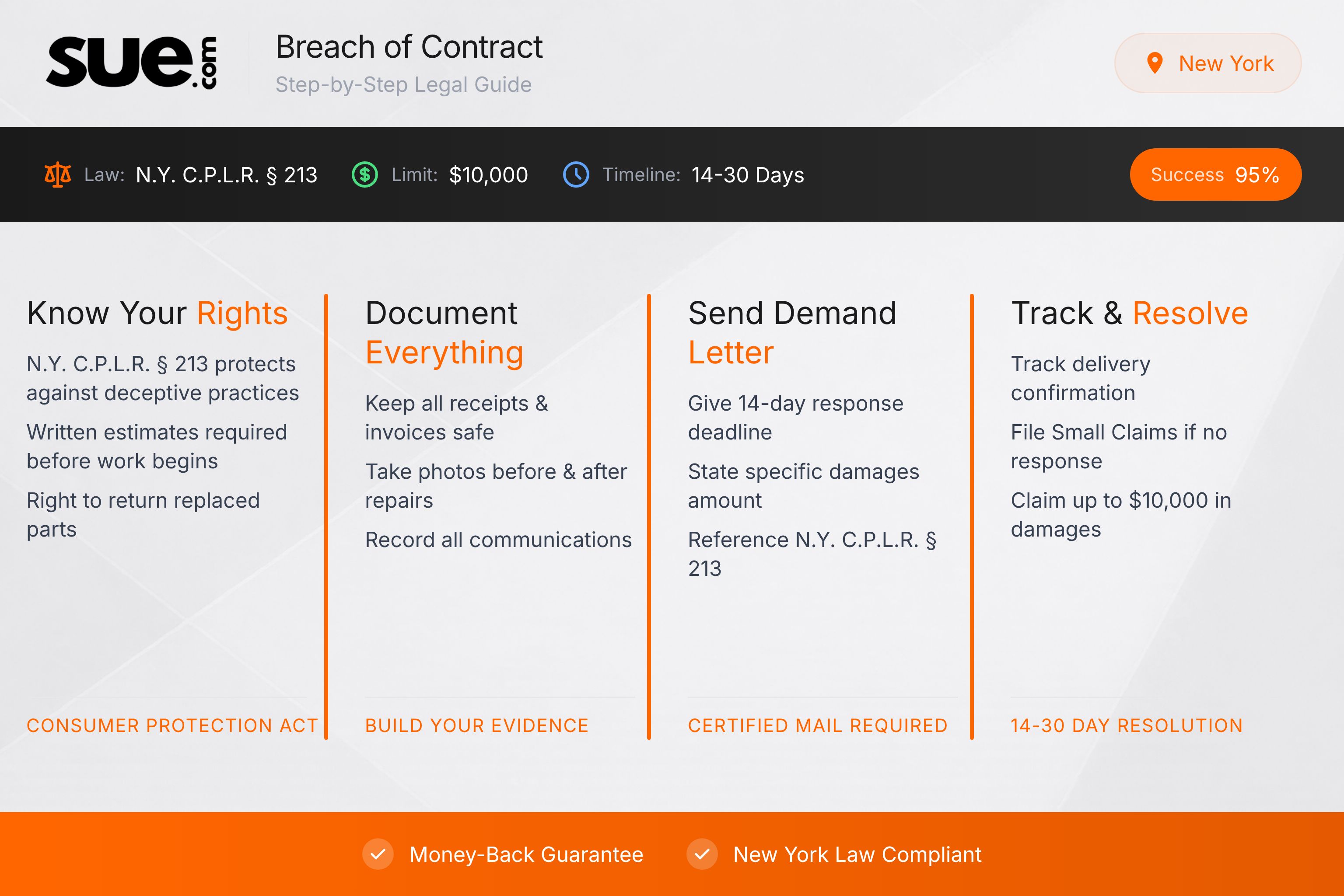
Under N.Y. C.P.L.R. § 213, you have six years from the date of the breach to file your claim for written contracts. This generous timeline means you have not missed your window, even if the breach happened a while ago. For oral agreements, the statute of limitations is also six years under the same provision, giving you substantial time to gather your evidence and prepare your case.
- The law protecting you: N.Y. C.P.L.R. § 213 (Statute of Limitations for Contract Actions)
- What it means: You have six years to file your claim, and the court will enforce valid agreements
- What you can recover: Up to $10,000 in Small Claims Court
- Where you file: New York City Civil Court (Small Claims Part) or local District/City Court
- Lawyer needed: No, and that is by design so regular people can seek justice
To win your breach of contract case, you will need to prove four elements: a valid contract existed, you performed your obligations, the other party failed to perform theirs, and you suffered damages as a result. This might sound technical, but it often comes down to showing the judge your written agreement and explaining what went wrong. New York judges in Small Claims Court are experienced at helping self-represented parties present their cases clearly. You are not alone in this process, and thousands of New Yorkers successfully recover money for broken contracts every year. Understanding how to sue for breach of contract in New York starts with knowing these fundamental protections are on your side.
How to File a Breach of Contract Claim in New York
Filing court paperwork can feel intimidating, but we want you to know that the New York Small Claims Court process is genuinely designed to be accessible. The clerks are there to help you, and the forms are simpler than you might expect.
- Step 1: Obtain the small claims filing form from your local court or download it from the New York State Courts website
- Step 2: Fill in your information, the defendant’s information, and a brief description of your breach of contract claim
- Step 3: File in person or through NYSCEF (New York State Courts Electronic Filing) and pay the filing fee, typically $15 to $20 for claims under $1,000 and $20 to $25 for larger claims
- Step 4: The court clerk will schedule your hearing date and mail notice to the defendant for you
- Step 5: Attend your hearing, which feels more like a conversation with the judge than a formal trial
You will file in the county where the defendant lives, works, or where the contract was supposed to be performed. For breach of contract cases, this often means filing where the work was supposed to happen or where the business is located. The filing fees are intentionally low because the court wants to make justice accessible. Most hearings are scheduled within 30 to 60 days of filing, so you will not be waiting forever for your day in court. Taking small claims New York legal action is a straightforward process that thousands of people complete successfully each year.
Building Your Breach of Contract Case in New York
We know you have been dealing with this broken promise for too long, and now it is time to build the strongest possible case. The evidence you bring to court makes all the difference, and gathering it is more manageable than you might think.
- The original contract or agreement: This is your foundation, showing exactly what was promised
- Proof of your performance: Receipts, bank statements, or records showing you held up your end of the deal
- Communications about the breach: Emails, texts, or letters where the other party acknowledged the problem or made excuses
- Evidence of damages: Invoices from replacement services, estimates for completing unfinished work, or records of financial losses
- Witness information: Names and contact details for anyone who can confirm what happened
Calculating your damages clearly helps the judge understand exactly what you lost. Here is an example of how to organize your claim:
| What You Lost | Amount |
|---|---|
| Deposit paid for services never rendered | $3,500 |
| Cost to hire replacement contractor | $1,200 |
| Materials purchased that went unused | $450 |
| Your claim total | $5,150 |
When you arrive at your hearing, the judge will ask you to explain what happened in your own words. Bring copies of everything for yourself, the judge, and the defendant. Speak honestly and calmly, focusing on the facts rather than emotions. Judges appreciate organized presentations, so consider putting your documents in chronological order. If you win but the defendant does not pay voluntarily, New York offers several collection options. You can learn how to garnish wages in New York or place liens on property to enforce your judgment.
How Sue.com Supports Your New York Breach of Contract Case
You have already been through enough stress dealing with someone who broke their promise to you. Our $249 Small Claims Court service is designed to take the confusion out of the process so you can focus on presenting your case with confidence.
- Attorney-drafted demand letter to try resolving the dispute before court
- Complete filing guide specific to New York Small Claims Court procedures
- All required forms identified and explained
- Evidence checklist tailored to breach of contract cases
- Damages calculation worksheet to maximize your recovery
- Hearing preparation guide so you know exactly what to expect
Many breach of contract disputes settle after receiving a professional demand letter, which means you might recover your money without ever stepping into a courtroom. Through Sue.com’s New York dispute filing hub, you get everything you need in one place. You can also recover money for breach of contract New York by starting with a demand letter that shows the other party you mean business. You have got this, and we are here to support you every step of the way.
Step 1
Answer a Few Simple Questions
Tell us what happened — who owes you, how much, and why. Our system guides you step-by-step with no legal jargon.
Step 2
We Draft Your New York Demand Letter
Step 3
We Mail It for You

Ready to Send Your New York Demand Letter?
Need Assistance?
Need help?
Find answers
Got questions about how Sue.com works, what’s included in each package, or what happens after your letter is sent? We’ve got you covered — quick, clear answers to help you move forward with confidence.
1. What is the small claims limit for Breach of Contract in New York?
You can recover up to $10,000 in New York Small Claims Court for breach of contract claims. If your damages exceed this amount, you can still file in small claims but would be waiving the excess, or you could consider filing in a higher court.
2. What evidence do I need for a Breach of Contract case in New York?
The most important evidence is your written contract or agreement, along with proof that you performed your obligations. Communications showing the other party acknowledged the breach, plus documentation of your financial losses, will strengthen your case significantly.
3. How long does a Breach of Contract case take in New York?
Most small claims hearings are scheduled within 30 to 60 days of filing your claim. The hearing itself typically lasts 15 to 30 minutes, and judges often announce their decision the same day or within a few weeks.
4. Do I need a lawyer for Breach of Contract small claims in New York?
No, and the system is specifically designed for people to represent themselves. In fact, corporations must have a lawyer, but individuals can present their own cases. Judges are accustomed to helping self-represented parties navigate the process.
5. What happens if I win but they don't pay?
New York provides several enforcement options, including wage garnishment, bank account levies, and property liens. The court clerk can provide information about filing an enforcement action, and these tools give you real leverage to collect what you are owed.