
Home » New York » Demand Letters » Defective Product Dispute
New York Defective Product Demand Letter
Pursuant to N.Y. C.P.L.R. § 214-c, consumers who have sustained injury or economic loss due to a defective product possess statutory rights to seek compensation from manufacturers, distributors, and retailers. A formal Defective product demand letter New York establishes the legal foundation for recovery by documenting the defect, quantifying damages, and providing notice of the claimant’s intent to pursue remedies under New York law. The demand letter serves as a prerequisite to litigation and demonstrates compliance with procedural requirements. Claims for defective products in New York may be pursued under theories of strict liability, breach of warranty, and negligence as established by state statute and common law.
Statutory Framework: Defective Product Under New York Law
Under N.Y. C.P.L.R. § 214-c, the statute of limitations for defective product claims involving latent injuries is three years from the date of discovery of the injury. This discovery rule applies specifically to cases where the defect was not immediately apparent, such as toxic exposure or gradual product degradation. The statute provides critical protection for consumers who could not have reasonably known of the defect at the time of purchase or initial use.
| Code Section | Requirement | Deadline | Penalty |
|---|---|---|---|
| N.Y. C.P.L.R. § 214-c | Discovery rule for latent defects | 3 years from discovery | Claim barred if not filed timely |
| N.Y. U.C.C. § 2-314 | Implied warranty of merchantability | 4 years from delivery | Compensatory damages plus incidentals |
| N.Y. U.C.C. § 2-315 | Implied warranty of fitness | 4 years from delivery | Compensatory damages plus consequentials |
| N.Y. Gen. Bus. Law § 349 | Prohibition of deceptive practices | 3 years from transaction | Actual damages or $50 minimum, plus attorney fees |
The interplay between these statutes creates multiple avenues for recovery. N.Y. U.C.C. § 2-314 establishes that goods sold by merchants must be fit for ordinary purposes, while § 2-315 imposes heightened obligations when the seller knows the buyer’s particular purpose. Pursuant to N.Y. Gen. Bus. Law § 349, deceptive acts in connection with the sale of consumer goods constitute an independent cause of action with statutory damages. A properly drafted demand letter shall cite all applicable provisions to maximize the claimant’s negotiating position. Understanding How to write a defective product demand letter New York requires familiarity with these overlapping statutory frameworks.
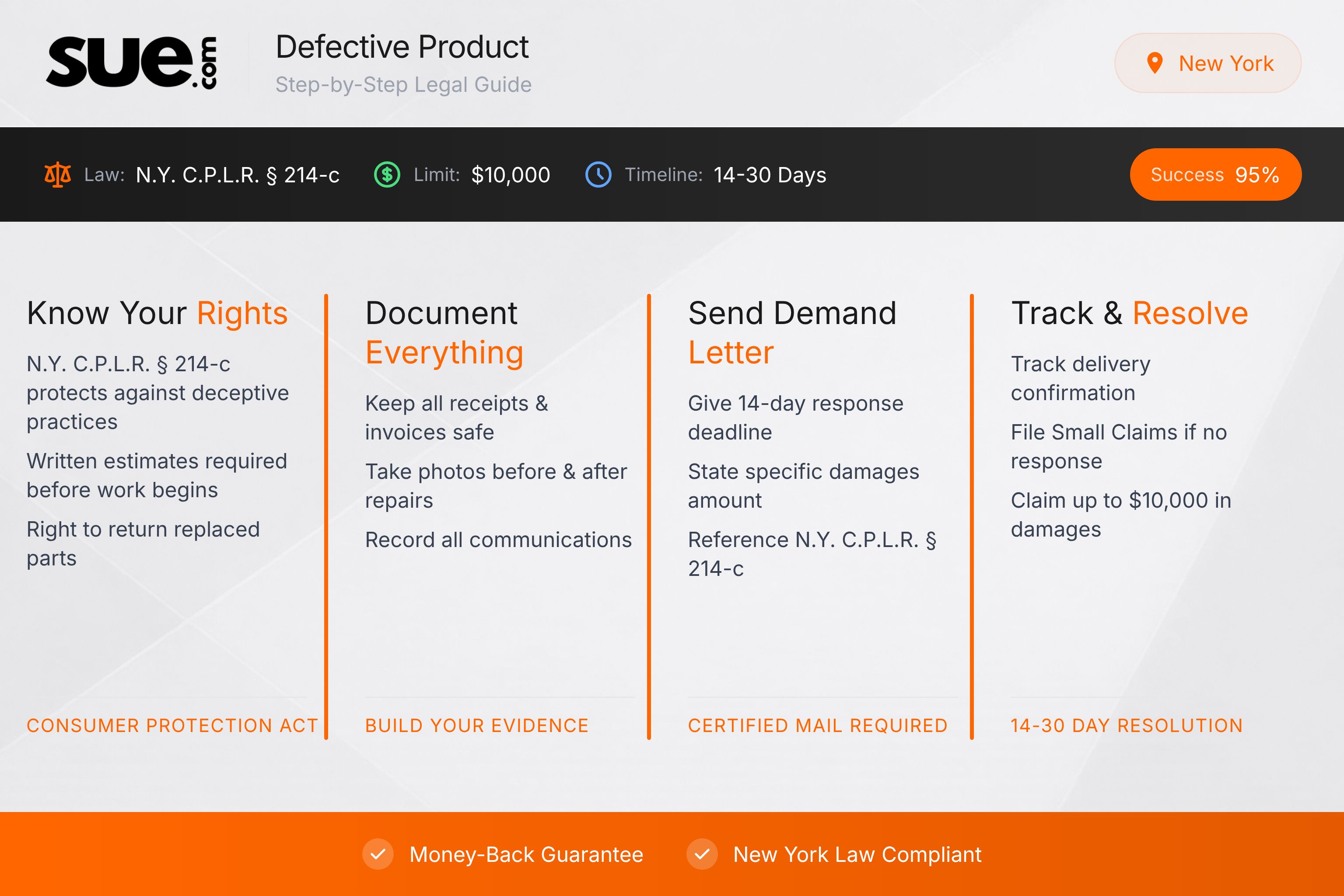
Legal Basis for a Formal Defective Product Demand in New York
The issuance of a formal demand letter prior to litigation serves multiple procedural and strategic purposes under New York law. First, the demand establishes a clear record of the claimant’s attempts to resolve the dispute without judicial intervention, which may be considered by the court in awarding costs and fees. Second, the demand provides the respondent with an opportunity to cure the defect or tender compensation, potentially avoiding the expense and delay of litigation.
Consider the following: A consumer purchases a space heater from a New York retailer, and the unit malfunctions after 60 days, causing $2,400 in property damage to flooring and furniture. The consumer sends a demand letter citing N.Y. U.C.C. § 2-314 and N.Y. Gen. Bus. Law § 349, documenting the defect with photographs and repair estimates. The retailer, upon receipt of the demand via certified mail, offers $2,000 in settlement within 14 days to avoid potential liability for attorney fees under the consumer protection statute. Without the formal demand citing specific New York law, the retailer’s legal department would likely have delayed response or denied the claim outright.
Pursuant to New York procedural requirements, a Legal demand for New York moving costs and other civil claims benefits from formal written notice that demonstrates the claimant’s seriousness and legal sophistication. The demand letter transforms an informal complaint into a documented legal dispute with clear deadlines and consequences.
Procedural Requirements for a New York Defective Product Demand Letter
The preparation of a legally effective demand letter requires strict adherence to procedural formalities. Failure to comply with these requirements may undermine the claimant’s position in subsequent litigation or settlement negotiations.
Step 1: Documentation Assembly. All evidence of the defect must be preserved and catalogued. This includes the defective product itself, original packaging, purchase receipts, warranty documentation, photographs of the defect and resulting damage, repair estimates from qualified professionals, and medical records if personal injury occurred. Under New York evidence rules, contemporaneous documentation carries greater weight than reconstructed accounts.
Step 2: Statutory Research. The applicable statutes must be identified based on the nature of the defect and the resulting harm. Product liability claims may proceed under strict liability, negligence, or breach of warranty theories, each with distinct elements and damages calculations.
Step 3: Damages Calculation. New York law permits recovery of compensatory damages including the cost of the defective product, repair or replacement costs, property damage, medical expenses, lost wages, and in certain cases, consequential damages. Pursuant to N.Y. U.C.C. § 2-715, consequential damages are recoverable if the seller had reason to know of the buyer’s particular circumstances.
Step 4: Letter Drafting. The demand letter must state the facts, cite applicable law, quantify damages, and specify a deadline for response.
Dear [Recipient]: Pursuant to N.Y. U.C.C. § 2-314 and N.Y. Gen. Bus. Law § 349, this letter constitutes formal demand for $3,200 representing the purchase price of the defective product, property damage, and statutory damages. Under New York law, you are obligated to provide goods fit for ordinary purposes and to refrain from deceptive trade practices. Failure to respond within 21 days may result in the filing of a complaint in Small Claims Court and a claim for attorney fees as permitted by statute.
Step 5: Service via Certified Mail. The demand shall be transmitted via certified mail with return receipt requested to establish proof of delivery. The Demand letter response time in New York typically ranges from 14 to 30 days, depending on the complexity of the claim and the respondent’s business practices.
Professional Defective Product Demand Letter Services for New York
For claimants who require professional assistance, attorney-drafted demand letter services provide statutory compliance and persuasive legal argumentation. The $199 service fee includes comprehensive preparation and delivery of the formal demand.
- Attorney-drafted correspondence citing applicable New York statutes including N.Y. C.P.L.R. § 214-c, N.Y. U.C.C. § 2-314, and N.Y. Gen. Bus. Law § 349
- Certified mail delivery with return receipt to establish proof of service
- Statutory compliance review ensuring all procedural requirements are satisfied
- Escalation path to Small Claims Court for claims up to $10,000
Claims that do not resolve through the demand letter process may be escalated to litigation. Through the Sue.com New York dispute portal, claimants can initiate the formal dispute resolution process. For claims requiring court intervention, the option to Sue for defective product in New York provides a streamlined path to judgment. The NYSCEF (New York State Courts Electronic Filing) system facilitates electronic submission of court documents for eligible claims.
Step 1
Answer a Few Simple Questions
Tell us what happened — who owes you, how much, and why. Our system guides you step-by-step with no legal jargon.
Step 2
We Draft Your New York Demand Letter
Step 3
We Mail It for You

Ready to Send Your New York Demand Letter?
Need Assistance?
Need help?
Find answers
Got questions about how Sue.com works, what’s included in each package, or what happens after your letter is sent? We’ve got you covered — quick, clear answers to help you move forward with confidence.
1. Is a formal demand letter a legal prerequisite to filing a Defective Product claim in New York?
New York law does not mandate a pre-suit demand letter for most defective product claims. However, certain warranty claims under the U.C.C. require the buyer to notify the seller of the breach within a reasonable time pursuant to N.Y. U.C.C. § 2-607(3)(a). A formal demand letter satisfies this notice requirement and creates a favorable litigation record.
2. Which New York statutes should be cited in a Defective Product demand letter?
The primary statutes include N.Y. C.P.L.R. § 214-c for the discovery rule, N.Y. U.C.C. § 2-314 for implied warranty of merchantability, N.Y. U.C.C. § 2-315 for fitness for particular purpose, and N.Y. Gen. Bus. Law § 349 for deceptive trade practices. Citation of multiple statutes strengthens the claimant’s position.
3. What constitutes a reasonable response period under New York law?
A response period of 14 to 30 days is considered reasonable for defective product demands in New York. The specific timeframe should account for the complexity of the claim and the respondent’s need to investigate the allegations. Shorter deadlines may be appropriate for time-sensitive matters.
4. What legal remedies are available if the demand is not honored in New York?
If the respondent fails to comply with the demand, the claimant may file suit in Small Claims Court for claims up to $10,000 or in Civil Court for larger amounts. Remedies include compensatory damages, statutory damages under N.Y. Gen. Bus. Law § 349, and in certain cases, attorney fees.
5. What is the maximum recoverable amount for Defective Product claims in New York?
In Small Claims Court, the jurisdictional limit is $10,000. Claims exceeding this amount must be filed in Civil Court. Statutory damages under N.Y. Gen. Bus. Law § 349 include actual damages or a minimum of $50, whichever is greater, plus reasonable attorney fees upon prevailing.