
California Security Deposit Law
A Complete Guide for Tenants
Navigating the complexities of your security deposit can be one of the most stressful parts of renting in California. This guide provides a comprehensive overview of your rights and your landlord’s obligations under California Civil Code § 1950.5.
Understanding these rules is the first step in ensuring you get your money back fairly and on time. Knowing what tools are available, like a professional demand letter, can make the process much easier and give you the confidence to stand up for your rights.
Understanding Your Rights Under California Civil Code § 1950.5
California law is very clear when it comes to security deposits, and the rules are laid out in Civil Code § 1950.5. This state law governs everything from how much a landlord can charge to the specific reasons they can make deductions and the strict timeline they must follow to return it. It was designed to protect tenants from landlords who might unfairly withhold funds after a tenancy ends.
Critically, the law presumes that the deposit money is your property, and the landlord is only holding it in trust. This means the burden is on the landlord to prove that any deductions they make are reasonable, necessary, and legally permissible. Knowing the specifics of this code is your best defense against improper charges and is the key to recovering the money you are rightfully owed.
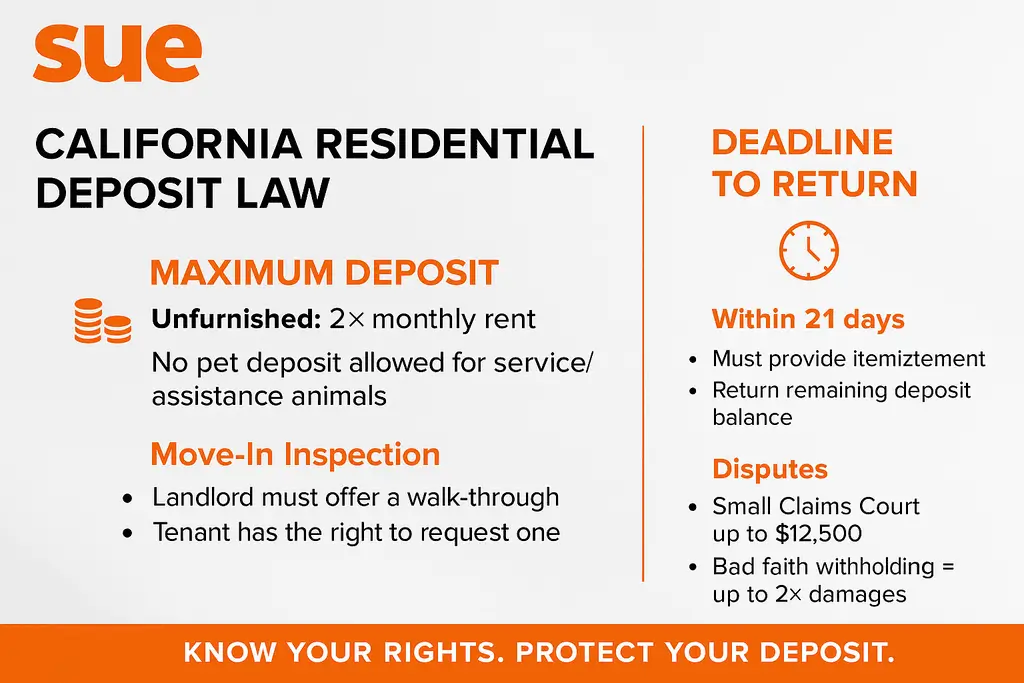
This Guide Covers:
Maximum allowable security deposit amounts
Legally permitted deductions for damages, cleaning, and unpaid rent
Clear examples of “normal wear and tear” versus actual damage
The strict 21-day rule for returning your deposit
Your right to a pre-move-out inspection
Steps to take if your landlord illegally withholds your deposit
How Sue.com can help you with a professional demand letter
How Much Can a Landlord Charge for a Security Deposit in California?
In California, the amount a landlord can require for a security deposit is capped by law to prevent excessive upfront costs for tenants. The maximum amount depends on whether the residential unit is furnished or unfurnished.
The limits are as follows:
Unfurnished Property: Up to two months’ rent.
Furnished Property: Up to three months’ rent.
These amounts are in addition to the first month’s rent. The law broadly defines a “security deposit” as any payment or fee intended to cover potential costs like unpaid rent or repairs. This means a landlord cannot bypass these limits by calling a fee something else, like a “key deposit” or “pet deposit.” All such payments are part of the total security deposit and must fall within the legal cap.
What Are Permitted Deductions from a Security Deposit?
Once you move out, a landlord cannot use your deposit for routine maintenance, upgrades, or fixing problems that existed before you moved in. The law is very specific about what they can legally deduct.
The Three Legal Deductions
According to Civil Code § 1950.5, a landlord can only deduct for three specific reasons:
The cost of fixing damages you or your guests caused, beyond normal wear and tear.
The cost of cleaning the unit to return it to the state of cleanliness it was in at the start of your tenancy.
Any rent you still owe under the lease agreement.
Damages vs. Normal Wear and Tear
This is the most common area of dispute. Landlords can charge you for damage, but not for the expected decline of a property over time, which is normal wear and tear.
Examples of Normal Wear and Tear (Not Deductible):
Faded paint or wallpaper due to sunlight
Minor scuffs on walls or floors from regular living
Worn-out carpet in high-traffic areas
Small nail holes from hanging pictures
Loose grout between tiles
Examples of Damage (Deductible):
Large holes in walls or doors
Broken tiles, windows, or fixtures
Deep scratches in wood floors
Pet urine stains in the carpet or subfloor
Burn marks on a countertop
It is always a good idea to take extensive photos and videos when you move in and move out to document the property’s condition.
Cleaning Costs
A landlord can only deduct cleaning costs necessary to restore the unit to the same level of cleanliness it was in when you first moved in. If you leave the apartment in the same condition, minus normal wear and tear, the landlord cannot legally charge a cleaning fee.
The 21-Day Rule: Returning the Security Deposit
California law is very strict about the timeline for returning a security deposit. After you have officially moved out and returned the keys, your landlord has 21 calendar days to act.
For example, if you move out on June 1st, your landlord has until June 22nd to take action.
Within this 21-day period, they must either:
Return your full security deposit.
Provide you with an itemized statement listing any deductions, plus a refund of the remaining balance.
If the landlord makes deductions totaling more than $125, they must also include copies of receipts or invoices for the work performed. This ensures transparency and prevents landlords from inventing or exaggerating costs.
Failure to comply with the 21-day rule has serious consequences for the landlord and may require them to return your entire deposit.
The Pre-Move-Out Inspection: Your Right to a Walkthrough
To help avoid disputes, California law gives you the right to request a pre-move-out inspection. This “initial inspection” must take place no earlier than two weeks before your tenancy ends.
The purpose of this inspection is for the landlord to walk through the unit with you and provide an itemized list of potential deductions. This gives you a valuable opportunity to fix the identified issues yourself before you move out, helping ensure you receive your full deposit back. It is highly recommended that all tenants exercise this right.
What to Do if Your Landlord Unlawfully Withholds Your Deposit
If the 21-day period passes and your landlord has not complied with the law, you have legal recourse. The process is straightforward:
Send a Formal Demand Letter: Your first and most important step is to send a demand letter via certified mail. This letter formally requests the return of your deposit, states the landlord’s legal obligation under Civil Code § 1950.5, and creates a crucial paper trail.
File in Small Claims Court: If the landlord ignores your demand letter, your next step is to file a lawsuit in small claims court. You can sue for the wrongfully withheld deposit and, if the judge finds the landlord acted in “bad faith,” you may be awarded additional damages of up to twice the amount of the deposit.
How Sue.com Helps You Get Your Deposit Back
If your landlord has failed to return your deposit, sending a formal demand letter is the most effective first step. A professional letter citing the specific violations of California law often resolves the issue without needing to go to court.
This is where Sue.com can help. We specialize in empowering tenants in your exact situation.
For just $39, our Demand Letter Package provides you with:
A Professionally Drafted Letter: No more guessing what to say. We use clear, firm language tailored to your case.
Reference to Legal Codes: The letter cites California Civil Code § 1950.5, showing your landlord you know your rights.
Certified Mail Service: We send the letter via certified mail on your behalf, providing you with the tracking and delivery confirmation you need as evidence.
Peace of Mind: We handle the most critical step in recovering your money, saving you time and stress.
"Non-Refundable" Deposits Are Illegal in California
Under California law, any and all money you pay that is meant to be returned is part of the security deposit, and it must be refundable. Any provision in a lease agreement that states a deposit is “non-refundable” is legally void and unenforceable.
This rule applies to all types of fees that function as a deposit, including “pet deposits” or “cleaning fees.” While a landlord can deduct for pet damage or cleaning from the total security deposit, they cannot pre-charge a fee that you have no chance of getting back.
Key Takeaways: Protecting Your Deposit
Document Everything: Take photos and videos when you move in and move out.
Know the Limits: A landlord can only charge up to 2 months’ rent (unfurnished) or 3 months’ (furnished).
Request an Inspection: Always ask for the pre-move-out inspection to fix issues beforehand.
Understand the 21-Day Rule: The landlord has 21 calendar days to return your deposit or an itemized list.
Use a Demand Letter: If your landlord is non-compliant, a formal demand letter is your most powerful first step.
Resources
California Civil Code Section 1950.5: https://leginfo.legislature.ca.gov/faces/codes_displaySection.xhtml?lawCode=CIV§ionNum=1950.5.
California Department of Real Estate – Landlord/Tenant Guide:https://www.dre.ca.gov/publications/landlord_tenant.html
Courts of California – Small Claims Guide: https://www.courts.ca.gov/selfhelp-smallclaims.htm
Step 1
Answer a Few Simple Questions
Tell us what happened — who owes you, how much, and why. Our system guides you step-by-step with no legal jargon.
Step 2
We Draft Your California Demand Letter
Your answers are reviewed and used to create an attorney-drafted demand letter tailored to your case.
Step 3
We Mail It for You
We print and mail the California demand letter directly to the recipient via USPS — creating proof you attempted to resolve the matter before court.

Ready to Send Your California Demand Letter?
Need Assistance?
Need help?
Find answers
Got questions about how Sue.com works, what’s included in each package, or what happens after your letter is sent? We’ve got you covered — quick, clear answers to help you move forward with confidence.
Can my landlord in California charge me for painting after I move out?
It depends. If the paint is damaged beyond normal wear and tear, the landlord may deduct the cost. However, a landlord cannot charge you for repainting to freshen up the apartment after a multi-year tenancy, as faded paint is considered normal wear and tear.
What is my immediate next step if I don't get my deposit back within 21 days?
Your immediate next step is to send your former landlord a formal demand letter via certified mail. The letter should clearly state that they have failed to comply with the law. Sue.com offers a $39 service to create and send this professional demand letter for you.
Is my landlord required to pay interest on my security deposit in California?
There is no statewide law requiring landlords to pay interest. However, a few cities, like San Francisco and Berkeley, have local ordinances that do. You must check your local city or county regulations to see if this applies to you.
Can I use my last month's rent as my security deposit in California?
No, not unless your landlord explicitly agrees to it in writing. The security deposit is intended to cover potential damages and cleaning costs discovered after you move out. Refusing to pay your last month’s rent is a breach of your lease agreement.
What is the best evidence to have to protect my security deposit?
The best evidence is photographic and video documentation. Take extensive photos and videos of the unit’s condition when you move in and again right before you move out. Also, keep copies of all written communication with your landlord, including your lease and repair requests.