
Home » Texas » Small Claims Court » Security Deposit Dispute
Sue for Security Deposit in Texas Small Claims Court
Losing your security deposit feels personal, especially when you know you left the rental in good condition and followed every rule in your lease. You’re not alone in this frustration, and Texas law provides a clear path to recover what’s rightfully yours. The small claims court for security deposits Texas offers through its Justice Court system lets you file claims up to $20,000 without hiring an attorney. This guide walks you through everything you need to know about filing your claim, gathering evidence, and presenting your case with confidence.
Security Deposit Laws That Help You Win in Texas
Walking into a legal situation can feel overwhelming, but here’s something that might ease your mind: Texas law is actually written to protect tenants like you. The legislature recognized that landlords sometimes withhold deposits unfairly, and they created specific rules to prevent that.
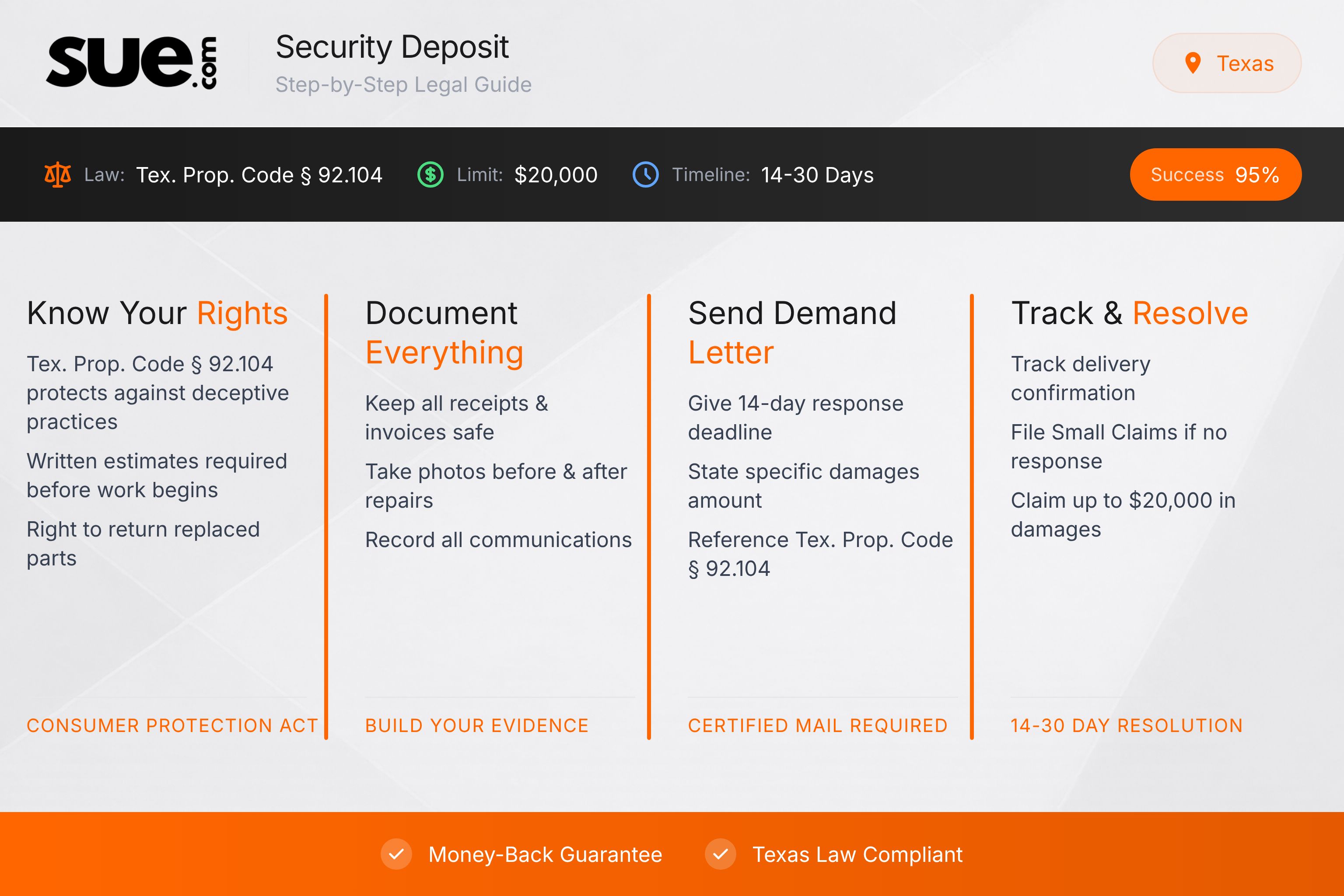
- The law protecting you: Tex. Prop. Code § 92.104
- What it means: Your landlord must return your deposit within 30 days after you move out, or provide a written itemized list explaining any deductions
- What you can recover: Up to $20,000 in Justice Court
- Where you file: Justice Court in the precinct where the rental property is located
- Lawyer needed: No, and that’s by design
Under Tex. Prop. Code § 92.109, if your landlord acts in bad faith by wrongfully withholding your deposit, you may be entitled to recover not just the deposit itself but also $100 in statutory damages plus three times the portion wrongfully withheld. This penalty exists because Texas lawmakers understood that some landlords count on tenants not knowing their rights.
To win your case, you’ll need to show the court three things: you paid the deposit, you gave proper notice when moving out, and the landlord either failed to return your money within 30 days or made improper deductions. Judges in Texas Justice Courts see these cases regularly, and they know exactly what to look for. If you can start a Texas security deposit court case with solid documentation, you’re already in a strong position.
How to File a Security Deposit Claim in Texas
We understand that the idea of filing court paperwork might feel intimidating, but thousands of Texans successfully navigate this process every year. Justice Court was specifically designed to be accessible to regular people without legal training.
- Step 1: Get the forms from your local Justice Court clerk’s office or download them from the court’s website
- Step 2: Fill in your petition with your name, the landlord’s name and address, the amount you’re claiming, and a brief description of what happened
- Step 3: File your petition and pay the filing fee, which typically ranges from $54 to $100 depending on your precinct
- Step 4: The court clerk handles serving your landlord with notice of the lawsuit
- Step 5: Attend your hearing, which feels more like a straightforward conversation than a dramatic courtroom scene
Many Texas counties now offer electronic filing through eFileTexas, which means you can submit your paperwork from home. You’ll file in the Justice Court precinct where the rental property is located, not where you currently live. The filing fee is often recoverable as part of your damages if you win, so don’t let that initial cost discourage you.
If you’re dealing with other civil matters in Texas, you might find it helpful to review the Recover unpaid wages Texas court process, which follows a similar structure. You’ve got this.
Building Your Security Deposit Case in Texas
This part of the process can feel overwhelming, but gathering evidence is actually where you take control of your situation. The more documentation you have, the easier it becomes for the judge to rule in your favor.
- Your lease agreement: This proves the deposit amount and any move-out requirements you followed
- Move-in and move-out photos: Date-stamped pictures showing the condition of the property protect you from false damage claims
- Written move-out notice: Proof that you gave proper notice as required by your lease
- Any correspondence with your landlord: Emails, texts, or letters discussing the deposit or deductions
- Receipts for cleaning or repairs: Documentation showing you addressed any issues before leaving
Calculating your damages doesn’t have to be complicated. Here’s an example of how to organize what you’re owed:
| What You Lost | Amount |
|---|---|
| Security deposit withheld | $1,500 |
| Statutory penalty (bad faith) | $100 |
| Treble damages (3x wrongful amount) | $4,500 |
| Filing fee | $75 |
| Your claim total | $6,175 |
When you appear for your hearing, the judge will ask you to explain what happened and show your evidence. Speak calmly, stick to the facts, and let your documentation tell the story. For a broader understanding of how Texas handles civil disputes, the Small claims Texas process overview provides helpful context. Remember, judges appreciate organized plaintiffs who come prepared.
How Sue.com Supports Your Texas Security Deposit Case in Texas
You’ve already been through the stress of losing your deposit and the frustration of dealing with an unresponsive landlord. You shouldn’t have to become a legal expert on top of everything else. That’s exactly why Sue.com’s Texas case tools exist.
For $249, our Small Claims Court service provides everything you need:
- A professionally written demand letter to give your landlord one last chance to pay before court
- A filing guide customized for Texas Justice Court procedures
- All required forms identified and ready for your specific precinct
- An evidence checklist tailored to security deposit disputes
- A damages calculation worksheet to maximize your recovery
- A hearing preparation guide so you know exactly what to expect
Many landlords settle once they receive a formal demand letter, which could resolve your situation without ever stepping into a courtroom. Our security deposit recovery service Texas includes this crucial first step. You’ve already dealt with enough, and we’re here to make the legal part as straightforward as possible.
Step 1
Answer a Few Simple Questions
Tell us what happened — who owes you, how much, and why. Our system guides you step-by-step with no legal jargon.
Step 2
We Draft Your Texas Demand Letter
Step 3
We Mail It for You

Ready to Send Your Texas Demand Letter?
Need Assistance?
Need help?
Find answers
Got questions about how Sue.com works, what’s included in each package, or what happens after your letter is sent? We’ve got you covered — quick, clear answers to help you move forward with confidence.
1. What is the small claims limit for Security Deposit in Texas?
Texas Justice Court allows you to file claims up to $20,000, which covers most security deposit disputes with room to spare for statutory penalties. This limit applies to the total amount you’re seeking, including the deposit itself, any bad faith penalties, and treble damages under Texas Property Code.
2. What evidence do I need for a Security Deposit case in Texas?
Your strongest evidence includes your signed lease showing the deposit amount, photos from move-in and move-out dates, your written notice to vacate, and any communication with your landlord about the deposit. Judges appreciate organized evidence, so consider creating a simple folder with everything labeled clearly.
3. How long does a Security Deposit case take in Texas?
Most security deposit cases in Texas Justice Court resolve within 30 to 60 days from filing to hearing. The timeline depends on your specific court’s schedule, but the process is designed to move quickly compared to higher courts.
4. Do I need a lawyer for Security Deposit small claims in Texas?
No, and that’s intentional. Justice Court was created so everyday Texans can represent themselves effectively. The procedures are simplified, the rules of evidence are relaxed, and judges are accustomed to guiding self-represented parties through the process.
5. What happens if I win but they don't pay?
Texas provides several collection tools if your landlord doesn’t voluntarily pay the judgment. You can request a writ of execution to have the constable seize assets, garnish bank accounts, or place liens on property. The court clerk can explain your options, and many landlords pay promptly once they realize enforcement is coming.