
Home » Texas » Demand Letters » Security Deposit Dispute
Texas Security Deposit Demand Letter
Waiting for your security deposit to come back, only to receive excuses or silence from your landlord, is genuinely frustrating. You held up your end of the lease, and now you deserve your money back. The good news is that Texas law provides some of the strongest tenant protections in the country when it comes to security deposits. A Texas security deposit demand letter is your first step toward recovering what you’re owed, and this guide will walk you through exactly how Texas law protects you, why a demand letter works, and how to get your deposit back without unnecessary stress.
Security Deposit Laws That Protect You in Texas
We understand that reading through legal codes while you’re already dealing with a stressful landlord situation can feel like too much. You shouldn’t need a law degree to get your own money back. The reality is that Texas has clear, straightforward rules that put the burden squarely on your landlord, and understanding these protections can give you real confidence moving forward.
Your Rights at a Glance:
- The law on your side: Tex. Prop. Code § 92.103 and § 92.104
- What it means for you: Your landlord must return your deposit or provide an itemized list of deductions within 30 days of you moving out and providing a forwarding address
- Their deadline: 30 days after you surrender the property
- If they don’t: You can recover up to three times the wrongfully withheld amount, plus $100 in statutory damages and reasonable attorney’s fees
- Where to file: Justice Court, up to $20,000
Here’s what this means in practical terms: if you left your apartment on March 1st and gave your landlord your new address, they have until March 31st to either mail you a check or send you a written, itemized statement explaining exactly what they deducted and why. Vague explanations like “cleaning” or “damages” without specific dollar amounts and descriptions don’t meet the legal standard under Tex. Prop. Code § 92.104.
If your landlord kept $800 for “carpet replacement” but the carpet was already ten years old and showing normal wear when you moved in, that deduction likely violates Texas law. Normal wear and tear, which includes things like minor scuffs on walls, worn carpet in high-traffic areas, and small nail holes from hanging pictures, cannot legally be deducted from your deposit. You’re not alone in facing this situation, and thousands of Texas tenants successfully challenge improper deductions every year. Ready to start a security deposit dispute Texas tenants win regularly? Understanding these laws is your foundation.
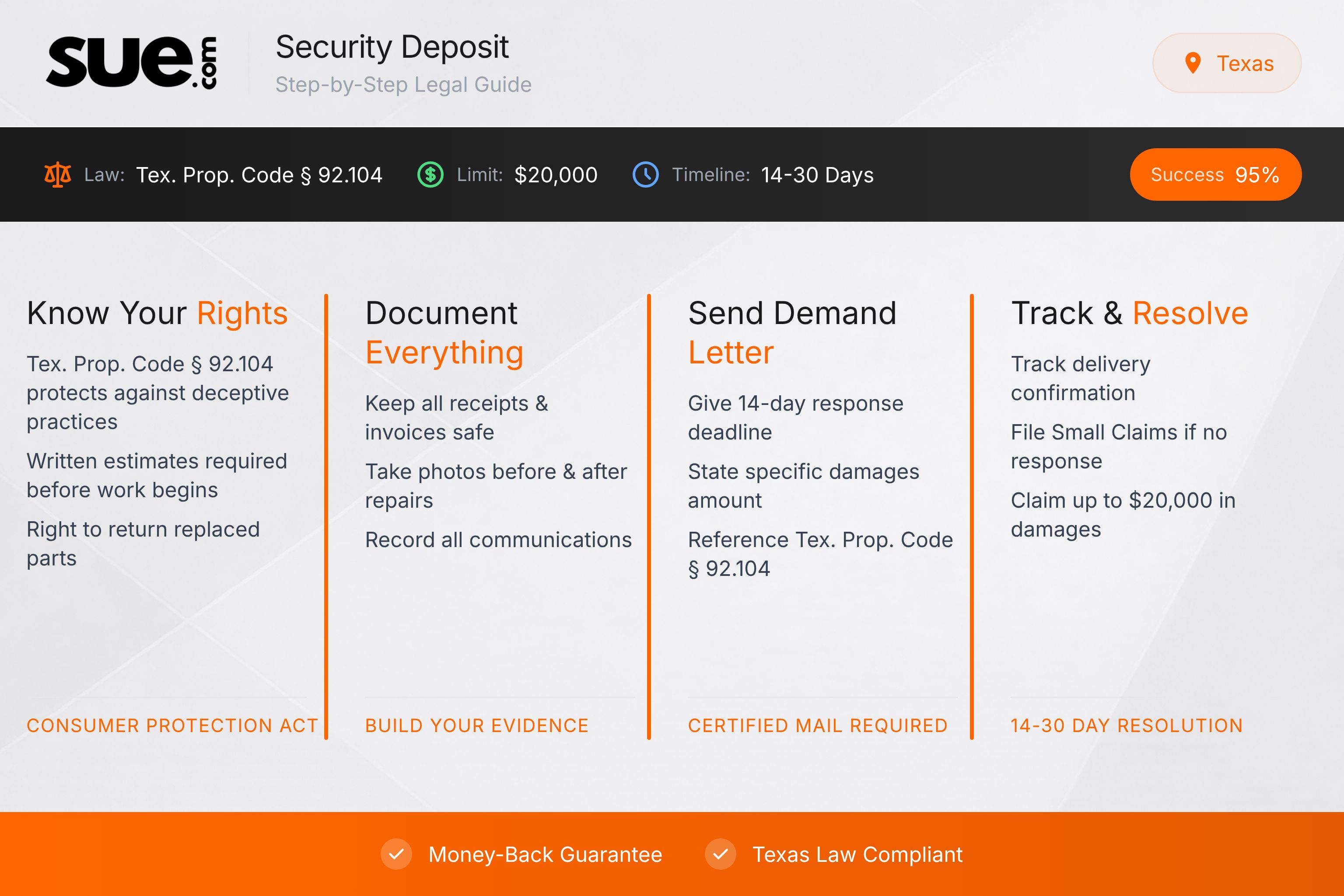
Why Sending a Demand Letter Is Worth It in Texas
We get it. You might be thinking, “Why bother with a letter? They already ignored me.” That frustration is completely valid. But here’s why this step is worth your time: a formal demand letter changes the dynamic entirely. It signals that you know your rights, you’re serious about pursuing them, and you’ve created a paper trail that will follow your landlord into court if necessary.
What to Expect After Sending:
- Week 1: You send the demand letter via certified mail with return receipt
- Week 2-3: Your landlord receives the letter and realizes you mean business
- Week 3-4: Most disputes resolve here, often with a settlement offer or full payment
- If no response: You have documented proof of your good-faith effort for Justice Court
Many landlords who ignore casual requests respond quickly to a formal demand letter citing Tex. Prop. Code § 92.104. Why? Because the letter makes clear that you understand the penalties they face: up to three times the wrongfully withheld amount plus statutory damages. A landlord who kept $1,000 improperly could owe you $3,100 or more if this goes to court.
Sending a Legal demand for Texas security deposit recovery also demonstrates to a judge that you tried to resolve this reasonably before filing suit. Texas Justice Courts appreciate seeing that plaintiffs made genuine efforts to settle disputes. You’ve got this, and this letter is your smartest next move.
Your Path to Writing a Texas Security Deposit Demand Letter
Writing a demand letter might sound intimidating, but we promise it’s more manageable than you think. The key is being organized, specific, and professional. Here’s exactly how to approach each step:
Step 1: Gather Your Documentation
Before you write a single word, collect everything that supports your claim:
- Your original lease agreement
- Move-in and move-out inspection reports (if available)
- Photos or videos of the property’s condition when you left
- Any written communication with your landlord about the deposit
- Proof you provided your forwarding address
- The itemized deduction list (if you received one)
Step 2: Research the Specific Texas Law That Applies
You’ve already learned the basics above. Now identify which provision your landlord violated. Did they miss the 30-day deadline? Did they fail to itemize deductions? Did they deduct for normal wear and tear? Each violation has specific legal consequences under Tex. Prop. Code § 92.109.
Step 3: Calculate Your Damages
Be precise about what you’re owed. Here’s an example calculation:
| Item | Amount |
|---|---|
| Original security deposit | $1,200 |
| Legitimate deductions (you agree with) | -$150 |
| Wrongfully withheld amount | $1,050 |
| Potential treble damages (3x) | $3,150 |
| Statutory damages | $100 |
Step 4: Draft Your Letter
Your letter should be firm but professional. Here’s a sample paragraph you can adapt:
Dear [Landlord Name], I am writing to formally request the return of my security deposit from [Property Address]. I vacated the premises on [Date] and provided my forwarding address as required. Under Tex. Prop. Code § 92.103, you were required to return my deposit or provide an itemized statement of deductions within 30 days. As of today, [X] days have passed, and I have not received my deposit or a lawful accounting. I have enclosed documentation supporting my claim of $[amount]. I respectfully request full payment within 14 days of this letter to avoid further legal action.
Step 5: Send Via Certified Mail
Always send your demand letter via certified mail with return receipt requested. This creates proof that your landlord received it, which is essential if you need to file in Justice Court later.
Writing a formal Texas demand for money owed to you doesn’t require perfection. It requires clarity, documentation, and confidence. You can absolutely do this.
How Sue.com Supports Your Texas Security Deposit Claim
If the thought of researching statutes, calculating damages, and drafting legal language feels like more than you want to handle right now, we completely understand. You’re already dealing with the stress of a landlord who won’t do the right thing. Sometimes the best move is letting someone else carry the load.
For $199, the Sue.com Texas dispute toolkit provides everything you need:
- Research the Texas statutes that apply to your specific situation
- Draft a professional, attorney-written demand letter
- Calculate your damages accurately under Texas law
- Send your letter via certified mail with return receipt
- Guide you through filing in Justice Court if your landlord doesn’t respond
Our attorneys ghostwrite your demand letter, meaning it carries the weight of professional legal language while coming from you. Most security deposit disputes resolve after a well-crafted demand letter, and you won’t need to step foot in a courtroom.
If your landlord still refuses to pay, Texas security deposit small claims filing in Justice Court is straightforward, and we can guide you through that process too. You’ve already taken the hardest step by deciding to stand up for yourself. We’re here to make the rest easier.
Step 1
Answer a Few Simple Questions
Tell us what happened — who owes you, how much, and why. Our system guides you step-by-step with no legal jargon.
Step 2
We Draft Your Texas Demand Letter
Step 3
We Mail It for You

Ready to Send Your Texas Demand Letter?
Need Assistance?
Need help?
Find answers
Got questions about how Sue.com works, what’s included in each package, or what happens after your letter is sent? We’ve got you covered — quick, clear answers to help you move forward with confidence.
1. Do I need to send a demand letter before suing for Security Deposit in Texas?
Texas law doesn’t technically require a demand letter before filing in Justice Court, but sending one is almost always the smart move. It often resolves the dispute faster than going to court, and judges appreciate seeing that you tried to settle things reasonably first. Think of it as giving your landlord one clear chance to do the right thing before you escalate.
2. What Texas laws protect me in a Security Deposit dispute?
The main protections come from the Texas Property Code, specifically Tex. Prop. Code § 92.103 through § 92.109. These sections require landlords to return deposits within 30 days, provide itemized deductions in writing, and prohibit deductions for normal wear and tear. If your landlord violates these rules, you may be entitled to recover up to three times the wrongfully withheld amount plus $100 in statutory damages.
3. How long should I give them to respond to my demand letter?
Most demand letters give the recipient 14 to 30 days to respond, which is standard and reasonable. This timeframe shows you’re acting in good faith while also making clear you expect prompt action. If they don’t respond within that window, you have solid grounds to proceed to Justice Court.
4. What if they ignore my Security Deposit demand letter in Texas?
If your landlord ignores your demand letter, you have clear options. You can file a claim in Texas Justice Court for up to $20,000, and your demand letter becomes evidence that you tried to resolve this without litigation. Many tenants find that the court process moves quickly, and the penalties landlords face under Texas law often motivate them to settle even after a lawsuit is filed.
5. How much can I recover for my Security Deposit claim in Texas?
Beyond your actual deposit, Texas law allows you to recover up to three times the amount wrongfully withheld if your landlord acted in bad faith, plus $100 in statutory damages and reasonable attorney’s fees. This means a $1,000 wrongfully withheld deposit could result in a judgment of $3,100 or more. Texas law is designed to discourage landlords from playing games with your money, and you’re in a strong position to recover what you’re owed.