
Home » Texas » Demand Letters » Auto Repair Dispute
Texas Auto Repair Demand Letter
Pursuant to Tex. Occ. Code § 2301.204, motor vehicle repair facilities in Texas are required to provide accurate written estimates and obtain authorization before performing work. When a repair shop has overcharged, performed unauthorized repairs, or failed to complete work properly, a formal demand letter establishes the legal foundation for recovery. The claimant’s right to compensation is protected under Texas statutory law, and a mechanic overcharge demand letter Texas serves as the requisite pre-litigation notice. Failure by the repair facility to respond appropriately may result in liability for actual damages, statutory penalties, and attorney fees as provided under the Texas Deceptive Trade Practices Act.
Statutory Framework: Auto Repair Under Texas Law
Under Tex. Occ. Code § 2301.204, licensed motor vehicle dealers and repair facilities must comply with specific consumer protection requirements when performing repairs. This statute mandates that written estimates be provided prior to commencing work and that authorization be obtained for any repairs exceeding the original estimate by more than 10 percent. Violations of these requirements constitute actionable conduct under Texas law.
| Code Section | Requirement | Deadline | Penalty |
|---|---|---|---|
| Tex. Occ. Code § 2301.204 | Written estimate required before repairs | Prior to work | Voided charges for unauthorized work |
| Tex. Bus. & Com. Code § 17.46 | Prohibition on deceptive trade practices | N/A | Treble damages up to $200,000 |
| Tex. Bus. & Com. Code § 17.50 | Consumer remedy for DTPA violations | 60-day notice required | Actual damages plus attorney fees |
| Tex. Occ. Code § 2301.601 | Warranty repair compliance | Reasonable time | Replacement or refund remedy |
The Texas Deceptive Trade Practices Act (DTPA), codified at Tex. Bus. & Com. Code § 17.46, provides additional protections for consumers who have been subjected to false, misleading, or deceptive acts in connection with auto repairs. Repair facilities that misrepresent the need for parts or services, charge for work not performed, or fail to disclose material information regarding repairs may be held liable under this statute. To start an auto repair dispute Texas, the claimant must first provide written notice as required under § 17.505.
The intersection of these statutes creates a comprehensive framework for consumer recovery. A repair facility that performs unauthorized work forfeits its right to payment under Tex. Occ. Code § 2301.204, while simultaneously exposing itself to DTPA liability if the conduct was knowing or intentional.
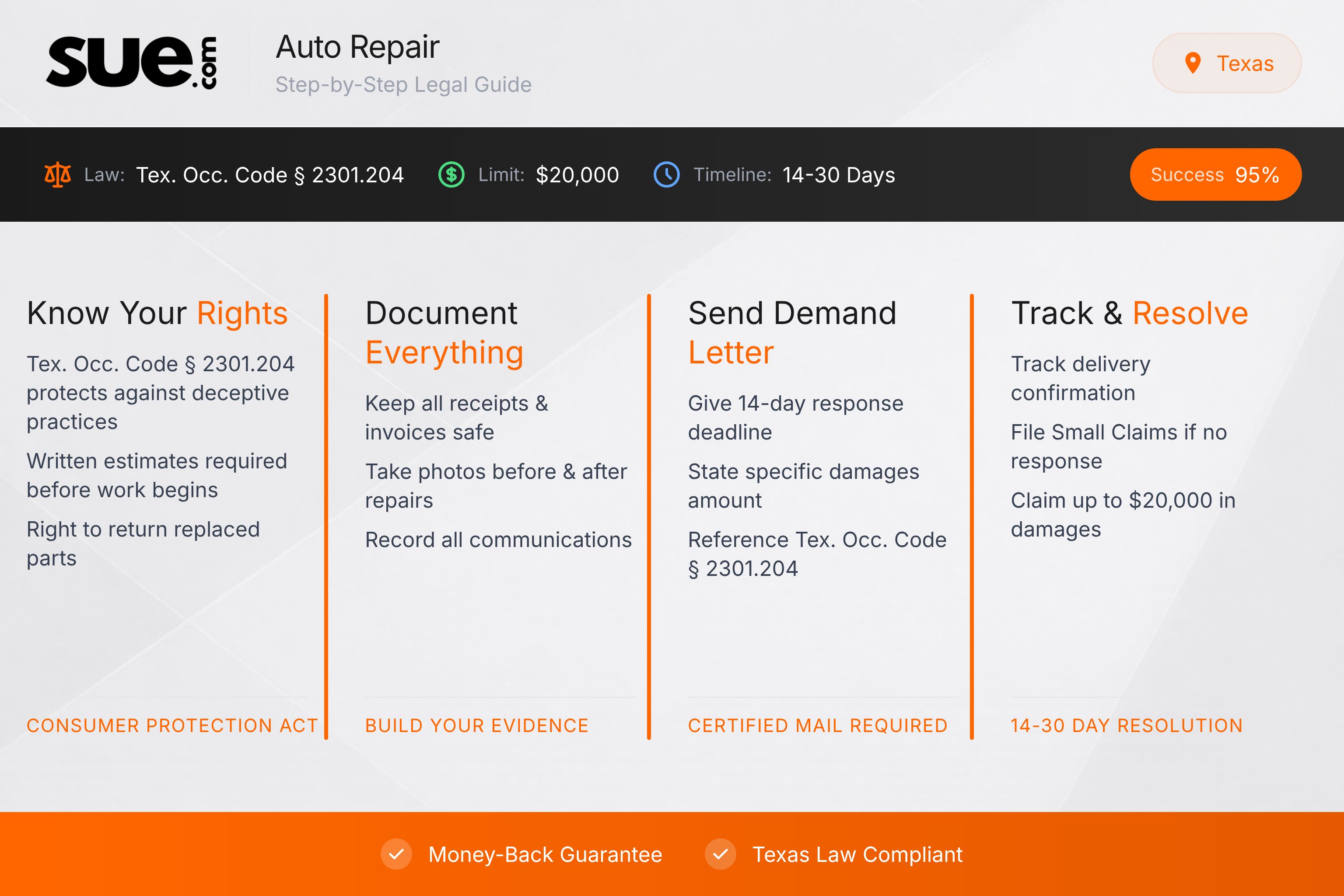
Legal Basis for a Formal Auto Repair Demand in Texas
The issuance of a formal demand letter serves multiple legal functions under Texas law. Pursuant to Tex. Bus. & Com. Code § 17.505(a), a consumer must provide written notice to the defendant at least 60 days before filing a DTPA lawsuit. This notice must advise the defendant of the specific complaint and the amount of actual damages claimed. Failure to comply with this pre-suit notice requirement may result in abatement of the action.
Consider the following: A vehicle owner in Harris County authorized a transmission repair with a written estimate of $1,800. Upon completion, the repair facility presented an invoice for $3,200, claiming additional parts were necessary. The facility failed to obtain authorization for the additional $1,400 in charges as required by Tex. Occ. Code § 2301.204. A formal demand letter citing this statute resulted in the facility reducing the invoice to the original estimate within 14 days, thereby avoiding litigation.
The demand letter also establishes the claimant’s good faith effort to resolve the dispute, which is relevant to the court’s determination of attorney fees under Tex. Bus. & Com. Code § 17.50(d). A Legal notice for money owed Texas demonstrates compliance with statutory requirements and strengthens the claimant’s position should litigation become necessary.
Procedural Requirements for a Texas Auto Repair Demand Letter
The preparation and service of a Texas auto repair demand letter requires adherence to specific procedural steps to ensure legal effectiveness.
Step 1: Documentation Assembly. The claimant shall compile all relevant records, including the original written estimate, final invoice, authorization forms, photographs of the vehicle condition, and any correspondence with the repair facility. Under Tex. R. Civ. P. 193.3, these documents may be discoverable in subsequent litigation.
Step 2: Statutory Research. The applicable statutes must be identified and cited with precision. For unauthorized repair charges, Tex. Occ. Code § 2301.204 applies. For deceptive conduct, Tex. Bus. & Com. Code § 17.46 governs. Common mistakes in Texas demand letters often involve failure to cite the correct statutory authority.
Step 3: Damages Calculation. The demand amount shall include actual damages (unauthorized charges, cost of corrective repairs), and where applicable, statutory damages under the DTPA. A sample calculation:
- Unauthorized repair charges: $1,400
- Cost of corrective repair at second facility: $650
- Towing expenses: $125
- Total actual damages: $2,175
Step 4: Letter Drafting. The demand letter must contain specific elements to satisfy statutory notice requirements:
Dear [Repair Facility]: Pursuant to Tex. Occ. Code § 2301.204 and Tex. Bus. & Com. Code § 17.505, this letter constitutes formal demand for $2,175 in damages. Under Texas law, your facility was obligated to obtain written authorization before performing repairs exceeding the original estimate by more than 10 percent. Failure to remit payment within 30 days may result in the filing of a civil action in Justice Court, where treble damages and attorney fees may be sought.
Step 5: Service via Certified Mail. The demand letter shall be transmitted via certified mail with return receipt requested to establish proof of delivery as required for DTPA compliance.
Professional Auto Repair Demand Letter Services for Texas
The Sue.com Texas demand letter platform provides attorney-drafted demand letters for $199. This service ensures compliance with Texas statutory requirements while maximizing the probability of pre-litigation resolution.
- Attorney-drafted correspondence citing applicable Texas statutes including Tex. Occ. Code § 2301.204 and Tex. Bus. & Com. Code § 17.46
- Certified mail delivery with return receipt to satisfy DTPA notice requirements
- Statutory compliance review to ensure all procedural prerequisites are met
- Escalation path to Justice Court for claims up to $20,000
Should the demand letter fail to produce a satisfactory response, the claimant may proceed to file suit in small claims court for auto repairs Texas. The Justice Court maintains jurisdiction over civil matters not exceeding $20,000, and the demand letter serves as evidence of the claimant’s compliance with pre-suit notice requirements.
Step 1
Answer a Few Simple Questions
Tell us what happened — who owes you, how much, and why. Our system guides you step-by-step with no legal jargon.
Step 2
We Draft Your Texas Demand Letter
Step 3
We Mail It for You

Ready to Send Your Texas Demand Letter?
Need Assistance?
Need help?
Find answers
Got questions about how Sue.com works, what’s included in each package, or what happens after your letter is sent? We’ve got you covered — quick, clear answers to help you move forward with confidence.
1. Is a formal demand letter a legal prerequisite to filing an auto repair claim in Texas?
Pursuant to Tex. Bus. & Com. Code § 17.505(a), a written demand letter is required at least 60 days before filing a DTPA lawsuit. Failure to provide this notice may result in abatement of the action and denial of attorney fees.
2. Which Texas statutes should be cited in an auto repair demand letter?
The primary statutes include Tex. Occ. Code § 2301.204 for unauthorized repair charges, Tex. Bus. & Com. Code § 17.46 for deceptive trade practices, and Tex. Bus. & Com. Code § 17.50 for consumer remedies. Warranty disputes may also invoke Tex. Occ. Code § 2301.601.
3. What constitutes a reasonable response period under Texas law?
The DTPA requires a minimum of 60 days for the defendant to respond before litigation may commence. A demand letter typically requests a response within 30 days, providing adequate time for negotiation before the statutory period expires.
4. What legal remedies are available if the demand is not honored in Texas?
The claimant may file suit in Justice Court for claims up to $20,000. Under the DTPA, knowing violations may result in treble damages, and the court shall award reasonable attorney fees to the prevailing consumer.
5. What is the maximum recoverable amount for auto repair claims in Texas?
Justice Court jurisdiction extends to $20,000. However, DTPA claims involving knowing conduct may result in treble damages up to $200,000, which would require filing in County Court or District Court depending on the amount.