
Texas Small Claims Court Guide:
How to File and Win Your Case
$20,000 is the maximum you can sue for in Texas small claims court. The court is called Justice Court, operated by Justices of the Peace in each precinct. No attorney required. If you need to Sue for Texas HVAC failure or recover money from any dispute, this guide covers filing procedures, fees, evidence requirements, and judgment collection. Texas has 802 Justice Court precincts across 254 counties, so you will file in the precinct where the defendant lives or where the dispute occurred.
Get Started in Your State
We provide state-specific demand letter services across the country. Find your state below to see our tailored guides and packages for your exact dispute.
Texas Small Claims Court Guide: How to File and Win Your Case
$20,000 is the maximum you can sue for in Texas small claims court. The court is called Justice Court, operated by Justices of the Peace in each precinct. No attorney required. If you need to Sue for Texas HVAC failure or recover money from any dispute, this guide covers filing procedures, fees, evidence requirements, and judgment collection. Texas has 802 Justice Court precincts across 254 counties, so you will file in the precinct where the defendant lives or where the dispute occurred.
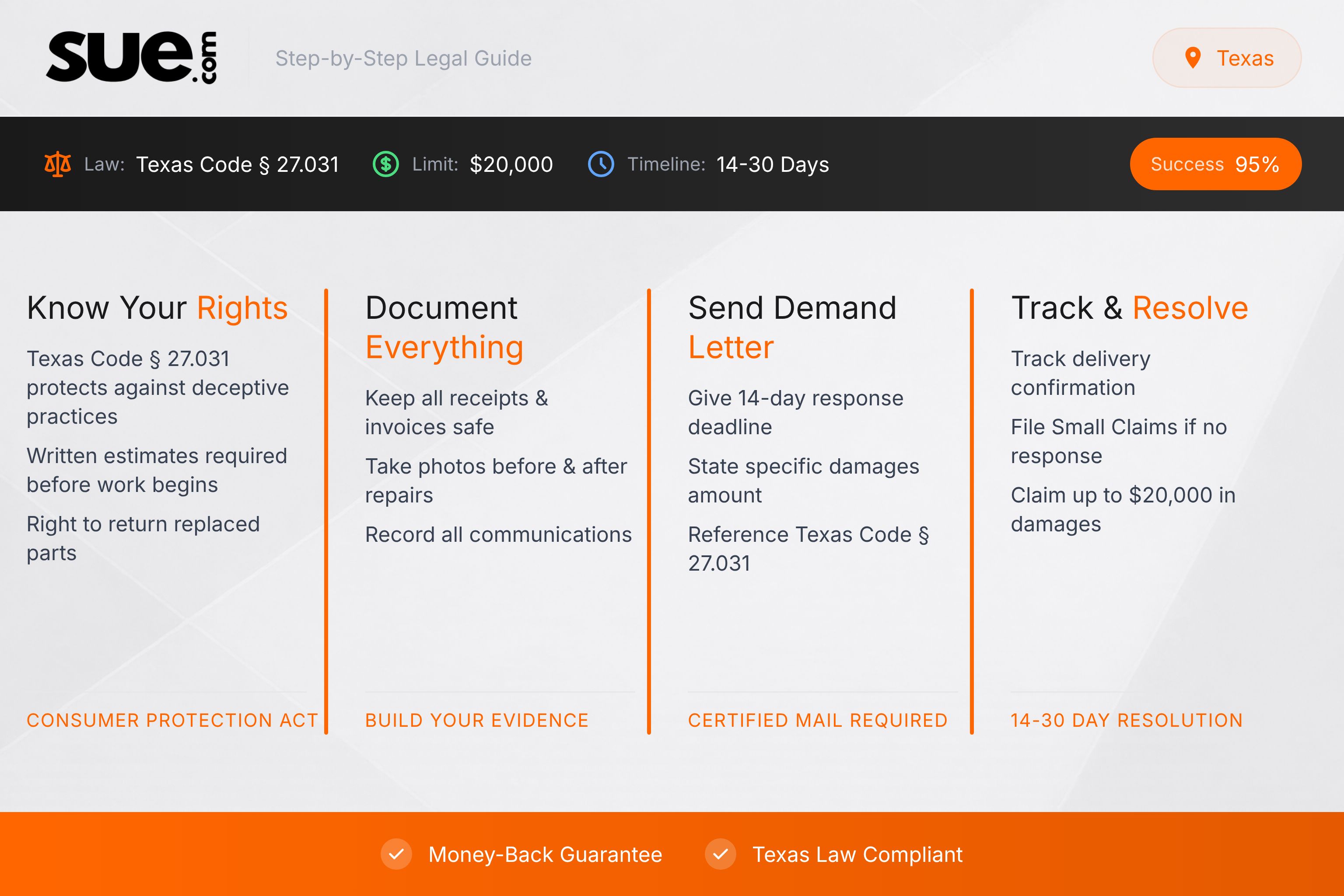
Texas Justice Court Overview
- Official court name: Justice Court (Texas Government Code § 27.031)
- Maximum claim amount: $20,000
- Minimum age to file: 18 years (or emancipated minor)
- Filing fee range: $54–$116 (varies by county and claim amount)
- Service of process fee: $75–$150 (constable or private process server)
- Response deadline for defendant: 14 days after service
- Appeal deadline: 21 days after judgment
- Contract disputes (written or oral)
- Property damage claims
- Security deposit disputes
- Unpaid debts or loans
- Consumer protection violations
- Personal injury (up to $20,000)
Who can file: Any individual, business, corporation, or organization. Corporations must be represented by an employee or owner, not an outside attorney, for claims under $20,000.
Who you can sue: Individuals, businesses, landlords, contractors, or any entity that owes you money or caused you financial harm.
Where to file: Justice Court in the precinct where the defendant resides or where the transaction/injury occurred (Texas Civil Practice and Remedies Code § 15.001). Learn How to object in Texas small claims court if the defendant challenges venue.
Attorney rules: Attorneys are permitted but not required. Most plaintiffs represent themselves. If the defendant hires an attorney, you can still proceed pro se.
Appeals: Either party may appeal to County Court within 21 days. Appeal bond required. The County Court conducts a new trial (trial de novo).
Texas Laws That Help You Win
- Texas Deceptive Trade Practices Act (DTPA) (Texas Business & Commerce Code § 17.41–17.63)
- Texas Property Code (§ 92.101–92.109) for security deposits
- Texas Finance Code (§ 392) for debt collection violations
- Texas Civil Practice and Remedies Code (§ 38.001) for attorney fee recovery
- Damages: Economic damages + up to 3x damages for knowing violations (§ 17.50)
- Notice requirement: 60-day demand letter required before filing (§ 17.505)
- Statute of limitations: 2 years from discovery of violation
- Return deadline: 30 days after tenant vacates (§ 92.103)
- Damages: Full deposit + $100 statutory penalty + 3x wrongful deductions + attorney fees (§ 92.109)
- Bad faith penalty: $100 minimum even if deposit was properly withheld but no statement provided
- Violations: Threatening arrest, contacting employer without permission, misrepresenting debt amount
- Damages: Actual damages + statutory penalties (§ 392.403)
Texas Deceptive Trade Practices Act (DTPA)
Case types: False advertising, defective products, misleading business practices, failure to disclose defects.
Texas Property Code (Security Deposits)
Case types: Landlord fails to return deposit, wrongful deductions, no itemized statement.
Texas Finance Code (Debt Collection)
Case types: Harassment, false threats, unauthorized collection attempts.
Attorney Fee Recovery (§ 38.001)
For breach of contract claims, the prevailing party may recover reasonable attorney fees. This applies even if you represent yourself, you can claim the value of your time in preparing the case.
Common Texas Small Claims Cases
1. Security Deposit Disputes Texas Property Code § 92.109 allows recovery of deposit + $100 + 3x wrongful deductions. Landlords must provide itemized statement within 30 days.
2. Contractor and Home Repair Disputes Sue for incomplete work, poor workmanship, or failure to perform. DTPA applies if contractor made false promises. Recover cost of repairs + consequential damages.
3. Auto Repair and Vehicle Disputes Texas Occupations Code § 2301 governs auto repairs. Sue for unauthorized repairs, overcharges, or failure to fix the problem.
4. Landlord-Tenant Issues Beyond deposits: sue for failure to make repairs (§ 92.056), illegal lockouts (§ 92.0081 penalty: one month’s rent + $1,000), or utility cutoffs.
5. Consumer Protection Violations DTPA covers false advertising, bait-and-switch, undisclosed defects. 60-day notice required. Potential treble damages.
6. Property Damage Claims Neighbor’s tree damages your fence, someone hits your parked car. Sue for repair costs + diminished value. 2-year statute of limitations.
7. Personal Injury (Minor) Claims under $20,000 for slip-and-fall, dog bites, minor auto accidents. Medical bills + lost wages + pain and suffering.
8. Unpaid Debts and Loans Personal loans, bounced checks, unpaid invoices. Written contracts: 4-year statute of limitations. Oral agreements: 4 years.
9. Breach of Contract Written or oral agreements. Recover actual damages + attorney fees under § 38.001. Bring the contract and proof of breach.
10. Employment Disputes Unpaid wages (Texas Labor Code § 61.001), unreimbursed expenses, wrongful deductions. Texas Workforce Commission complaint may be required first for wage claims.
The Texas Small Claims Court Process
Step 1: Send a Demand Letter
- Required for DTPA claims: 60-day notice (§ 17.505)
- Recommended for all claims: creates evidence of good faith
- Send via certified mail with return receipt
- State amount owed, deadline to pay, consequence of non-payment
- File at Justice Court in correct precinct
- Filing fee: $54–$116
- Complete petition form (varies by county)
- Include defendant’s full name and address
- Service methods: constable, private process server, certified mail (if court allows)
- Cost: $75–$150
- Defendant has 14 days to respond
- If no response: request default judgment
- Contracts, receipts, invoices
- Photos, videos, text messages
- Witness statements (written or in-person)
- Damage estimates from professionals
- Organize chronologically
- Arrive 15 minutes early
- Bring 3 copies of all evidence (judge, defendant, yourself)
- Dress professionally
- Speak only when addressed
- Present facts, not emotions
- Typical hearing: 15–30 minutes
- Judgment valid for 10 years (renewable)
- Collection methods: wage garnishment, bank levy, property lien
- Abstract of judgment fee: $5
- Writ of execution fee: $55–$100
Step 2: File Your Petition
Step 3: Serve the Defendant
Step 4: Prepare Your Evidence
Step 5: Attend the Hearing
Step 6: Collect Your Judgment
How Sue.com's Texas Small Claims Court Package Works
- Price: $249 (one-time fee)
- Demand letter: attorney-drafted, sent certified mail
- Court identification: correct Justice Court precinct for your case
- Filing guide: step-by-step instructions for Texas
- Required forms: petition, service documents, fee waiver (if eligible)
- Evidence checklist: case-specific documentation guide
- Damage calculation: itemized breakdown of recoverable amounts
- Court prep guide: what to say, what to bring, how to present
Under Demand letter for Texas pet deposit, sending a formal demand letter is a powerful first step, and it is included in our package. The demand letter cites applicable statutes, states your claim amount, and sets a payment deadline.
Sue.com Texas case management provides your complete case file in one dashboard. Track deadlines, store documents, and access your materials anytime.
No attorney fees. No hourly billing. One flat rate covers everything from demand letter through court preparation.
Step 1
Answer a Few Simple Questions
Tell us what happened — who owes you, how much, and why. Our system guides you step-by-step with no legal jargon.
Step 2
We Draft Your Texas Demand Letter
Your answers are reviewed and used to create an attorney-drafted demand letter tailored to your case.
Step 3
We Mail It for You

Ready to Send Your Texas Demand Letter?
Need Assistance?
Need help?
Find answers
Got questions about how Sue.com works, what’s included in each package, or what happens after your letter is sent? We’ve got you covered — quick, clear answers to help you move forward with confidence.
1. What is the small claims court limit in Texas?
$20,000 is the maximum claim amount in Texas Justice Court. For claims exceeding this limit, file in County Court at Law or District Court.
2. How much does it cost to file in Texas Justice Court?
Filing fees range from $54 to $116 depending on your county and claim amount. Add $75–$150 for service of process. Fee waivers available for those who qualify financially.
3. Do I need a lawyer for Texas Justice Court?
No attorney required. Justice Court is designed for self-representation. Corporations must send an employee or owner, not an outside attorney, for claims under $20,000.
4. How long does a Texas small claims case take?
Most cases resolve within 30–60 days from filing to judgment. Contested cases may take 60–90 days. Default judgments (defendant no-show) can be granted within 21 days of service.
5. What if the defendant doesn't show up to court?
Request a default judgment. The judge will review your evidence and typically grant judgment for the amount you can prove. Defendant has 21 days to file motion to set aside.
6. What if I win but they refuse to pay?
Texas provides multiple collection tools: wage garnishment (up to 25% of disposable earnings), bank account levy, property liens, vehicle liens. Judgments are valid for 10 years and renewable for another 10 years.