
How to Sue a Mechanic
in Texas Justice Court
You sent the 60-day DTPA demand letter, and the auto shop called your bluff. They ignored you, refused your claim, or offered an insulting settlement. Now, it’s time to stop warning and start acting. Filing a lawsuit is the final and most powerful step you can take to recover your money.
This isn’t a high-priced, complicated lawsuit. You will be filing in the Texas Justice Court, the true “people’s court” (and what most people call small claims). It’s designed for you to represent yourself without a lawyer, and you can sue for up to $20,000. This guide is the complete, step-by-step playbook for filing your petition, building your evidence, and winning your case against a bad mechanic
$39 Texas Demand Letter
Mailed in Minutes!
[H2] Understanding Your Rights: The DTPA & Justice Court
Your case is built on the Texas Deceptive Trade Practices Act (DTPA). This law makes it illegal for a mechanic to mislead you, charge for unapproved work, use substandard parts, or fail to honor a warranty. Because you already sent the required 60-day demand letter, you have now “unlocked” the ability to ask the judge for up to three times (3x) your economic damages if the shop knowingly ripped you off.
This lawsuit is how you enforce those rights. The Justice Court is where you present your evidence—your invoices, your photos, your text messages—to a Justice of the Peace (JP) and ask them to issue a legal judgment ordering the mechanic to pay you.
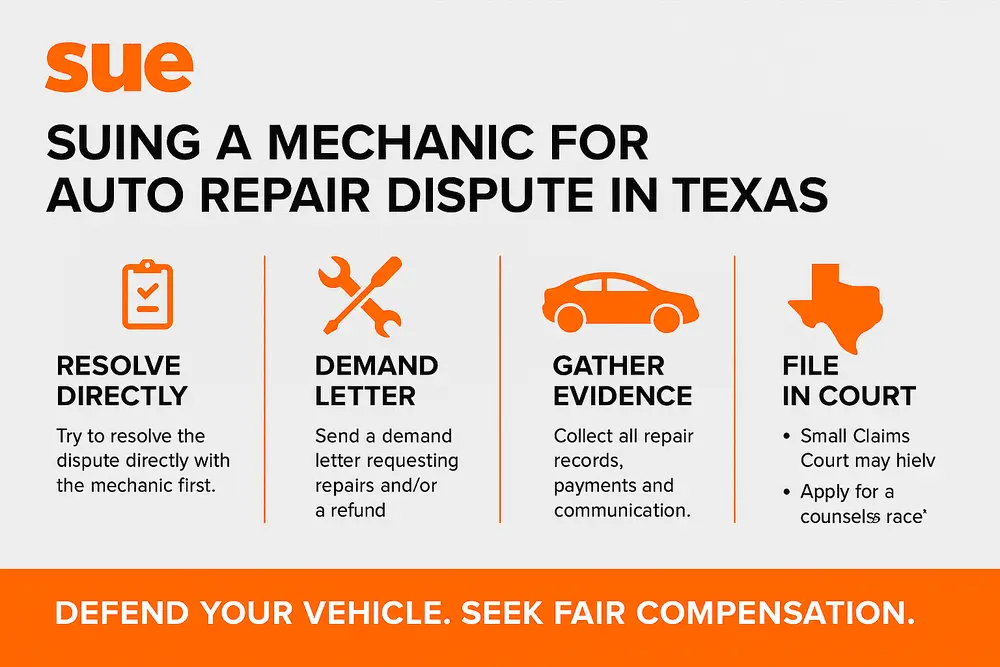
This Guide Covers:
The 6-step process for filing your “Small Claims Petition” in the correct Texas court.
How to find the mechanic’s true legal name (a step where most cases fail).
A complete checklist of the 7 key pieces of evidence you must bring to court.
How to prepare for your hearing, from organizing your “evidence binder” to practicing your 3-minute summary.
What happens after you win your judgment.
Common Auto Repair Disputes in Texas
We handle hundreds of auto repair cases. The most frequent disputes filed in Texas Justice Courts involve:
Unauthorized Work: The mechanic performs and charges for repairs you never approved in writing.
Faulty Repairs: You pay for a major fix (like a transmission rebuild or head gasket replacement), and the exact same problem returns days or weeks later.
Parts Fraud: The shop charges you for a new, OEM part but installs a used, aftermarket, or reconditioned part without your consent.
Bait-and-Switch Estimates: You are given a low written estimate, but the final bill is dramatically higher without your authorization for the additional charges.
Mechanic’s Liens: The shop refuses to return your car until you pay a disputed, inflated bill.
The Law: The 60-Day Notice is Now Your "Exhibit A"
The 60-day notice rule from the DTPA was your prerequisite. Now, in your lawsuit, that letter and your Certified Mail green card become “Exhibit A.” This proves to the judge that you acted in good faith, gave the mechanic a legal chance to “make whole,” and were ignored. This is a crucial fact that helps you argue for treble damages.
The Step-by-Step Guide to Filing Your Texas Lawsuit
This is the most critical part of the process. One error—like suing in the wrong court or using the wrong name—can get your case dismissed. Follow these steps precisely.
Step 1: Find the Correct Justice (JP) Precinct
You cannot file in just any courthouse. You must file in the correct “precinct.” The law gives you two main options:
Where the Defendant (Mechanic) is: File in the JP precinct where the auto shop is physically located. This is the simplest and most common choice.
Where the “Event” Occurred: File in the JP precinct where the bad repairs or damage happened. This is usually the same as the shop’s address.
Action: You must find the JP precinct for the shop’s address. Use the court lookup tools on the official website for the county (e.g., “Harris County JP precinct lookup”). Filing in the wrong precinct is a waste of money and time.
Step 2: Identify the Defendant's Legal Name
This is the #1 mistake people make. If the sign says “Dave’s Auto,” that is not their legal name. Suing “Dave’s Auto” will result in a judgment against a non-existent entity, and you will never collect your money.
You must sue their official, legal business entity.
Action: Go to the Texas Secretary of State’s “SOSDirect” website or the Texas Comptroller’s website. Search for the business. You are looking for its legal name (e.g., “Dave’s Automotive, LLC,” “Houston Auto Experts, Inc.,” or “David Smith DBA Dave’s Auto”).
You must also find the name of their Registered Agent (the person legally authorized to accept lawsuits). This information is on the same state websites.
Step 3: Get and Complete the "Petition for Small Claims"
This is the official form that starts your lawsuit.
Get the Form: Go to the website for the exact JP precinct court you identified in Step 1. They will have a downloadable PDF form, often called a “Small Claims Petition” or “Petition in a Small Claims Case.”
Fill It Out:
Plaintiff: This is you.
Defendant: This is the full legal name (e.g., “Dave’s Automotive, LLC”) you found in Step 2.
Registered Agent for Service: The form will ask who to serve. You will put the Registered Agent’s name and address.
Cause of Action (Your Story): Be clear and concise. Do NOT write an angry, page-long story. Use bullet points.
“1. On [Date], Plaintiff paid Defendant $3,500 to repair a 2021 Ford F-150 transmission. 2. The repair was faulty and failed on [Date], two days after pickup. 3. Defendant performed unauthorized work, charging $800 for a part not approved. 4. Plaintiff sent a DTPA 60-day notice on [Date], which Defendant ignored. 5. Plaintiff seeks $4,300 in economic damages, plus court costs. Plaintiff also seeks treble damages under the DTPA as the Defendant’s actions were knowing and deceptive.”
Step 4: File the Petition and Pay the Fees
Take your completed Petition to the court clerk.
The Fees: You will pay two separate fees:
Filing Fee: This is the court’s cost to open your case. It is typically $54 (this can vary slightly by county).
Service Fee: This is the cost to have a legal official serve the papers. This fee is paid to the Constable or Sheriff and is usually $75 – $100+ per defendant.
You will pay a total of roughly $130 – $175 to start your case. You must add these costs to the amount you are suing for.
Step 5: "Service of Process" (This is what makes it official)
Once you pay, the clerk will issue a “Citation” (a court summons) and attach it to your Petition. A Constable or certified process server will then take these documents and “serve” (formally deliver) them to the mechanic’s Registered Agent.
You cannot do this yourself. The court must have a formal “Return of Service” from the Constable saying the defendant was legally notified.
[H2] What Happens After You File
The Defendant’s “Answer”: Once served, the auto shop has a set time (usually 14 days) to file a written “Answer” with the court. Most small businesses don’t, which can put them at risk of a default judgment.
The Hearing Date: The court will send both you and the mechanic a notice in the mail with your court date, time, and courtroom number. This can be anywhere from a few weeks to a few months later. Now, you prepare for trial.
How to Prepare Your Evidence and Win in Court
You have the “burden of proof.” This means it’s your job to prove your case to the judge. The person with the best-organized evidence wins. Do not show up with a shoebox of receipts.
Your "Evidence Binder" (The Key to Winning)
Go to an office supply store and get a 3-ring binder, dividers, and page protectors. Make three copies of this binder: one for you, one for the judge, and one for the defendant.
Tab 1: Case Summary: One page, typed, with your 3-minute summary (see below).
Tab 2: Demand Letter: Your DTPA demand letter and the green Certified Mail receipt.
Tab 3: Contracts & Estimates: The original written work order or estimate the shop gave you.
Tab 4: Invoices & Proof of Payment: The final bill, your credit card statement, or a canceled check.
Tab 5: Communications: Printed screenshots of every text message and email.
Tab 6: Photos/Videos: Clear, printed photos of the bad repair, the damage it caused, or the faulty part. (Bring videos on a flash drive/tablet).
Tab 7: The “Fix-It” Bill (Your Strongest Evidence): The invoice from the second, competent mechanic you paid to fix the first shop’s mistake. This invoice should ideally list the errors made by the first shop.
Tab 8: Witnesses: If you have a witness (e.g., the second mechanic), you can bring them. If they won’t come, you can ask the court to issue a Subpoena to legally compel them to appear.
Your 3-Minute Summary
When the judge calls your case, they will say, “Plaintiff, tell me what this is about.” You have three minutes. Do not ramble.
“Your Honor, this is an auto repair dispute. On October 1st, I paid ‘Dave’s Auto, LLC’ $3,500 to repair my truck’s transmission.
Two days later, the transmission failed again. My evidence binder at Tab 7 shows I had to pay a different shop $4,000 to fix their faulty work.
My original invoice at Tab 4 also shows they charged me $800 for a ‘new OEM part’ I never authorized, and my evidence at Tab 5 shows the texts where I told them not to.
I sent a 60-day DTPA demand letter, which they ignored, at Tab 2. I am asking for my economic damages of $4,800, plus my court costs of $150, and for you to consider treble damages for their knowing deception under the DTPA.”
How Sue.com Helps You Win in Texas Justice Court
The Texas Justice Court process is designed for the public, but the official court forms are blank, confusing, and offer no guidance. It’s incredibly easy to make a small mistake that gets your case dismissed—such as suing the shop’s “brand name” instead of its legal name or filing in the wrong county precinct.
Our $99 Small Claims Court Package is a powerful guided workflow that solves this. We’ve translated the complex legal process into a simple, step-by-step tool that empowers you to file with confidence.
Here’s what our platform helps you do:
Find the Right Defendant: We provide a simple, step-by-step guide showing you exactly how to use Texas’s free, official databases (like the Secretary of State and Comptroller) to find the mechanic’s true legal name and Registered Agent for service—a critical step you must get right.
Locate the Correct Court: Our tool includes a guide and links to the official precinct lookup tools for Texas counties. This helps you easily identify the correct JP precinct for your filing, preventing a common and costly mistake.
Generate Your Court-Ready Petition: This is our core value. Instead of a blank PDF, you enter your information—your story, your itemized damages, the defendant’s info you just found—into our simple online questionnaire. Our software then takes your answers and generates the official “Small Claims Petition,” filled out with the proper legal language, references to the DTPA, and your itemized damages, ready for filing.
Get Complete Filing Instructions: The package includes a complete, easy-to-follow checklist for everything that comes next, including how to file your generated petition with the court clerk (in person or via eFileTexas) and how to build the “Evidence Binder” you’ll need to win in court.
We don’t do the work for you; we give you the expert tool to do it right.
Know Your Rights: Official Texas Resources
Texas Attorney General (Consumer Protection): https://www.texasattorneygeneral.gov/consumer-protection/automotive-scams
The official state resource for auto-related complaints and consumer rights.
Texas Law Help: https://texaslawhelp.org/guide/small-claims-cases
A non-profit guide for self-represented litigants in Texas.
Texas Justice Court Training Center (Forms): https://www.tjctc.org/tjctc-resources/forms.html
Official source for the “Small Claims Petition” form and other legal documents.
Texas Business & Commerce Code, Ch. 17 (DTPA): https://statutes.capitol.texas.gov/Docs/BC/htm/BC.17.htm
The full text of the Deceptive Trade Practices Act.
Step 1
Answer a Few Simple Questions
Tell us what happened — who owes you, how much, and why. Our system guides you step-by-step with no legal jargon.
Step 2
We Draft Your Texas Demand Letter
Using your answers, we instantly generate a professionally written, legally sound Texas demand letter tailored to your situation.
Step 3
We Mail It for You
We print and mail the Texas demand letter directly to the recipient via USPS — creating proof you attempted to resolve the matter before court.

Ready to Send Your Texas Demand Letter?
Need Assistance?
Need help?
Find answers
Got questions about how Sue.com works, what’s included in each package, or what happens after your letter is sent? We’ve got you covered — quick, clear answers to help you move forward with confidence.
What is the maximum amount I can sue for in Texas Justice Court?
The small claims limit in Texas is $20,000. If your claim is for more (e.g., $22,000), you must either reduce your claim to $20,000 to stay in Justice Court or file in a higher court.
Do I need a lawyer to file in Justice Court?
No. Justice Court is designed for people to represent themselves (this is called “pro se”). The rules are simpler, and the judge’s job is to hear the case from both parties directly.
What was the Texas "Automotive Repair Act"?
Texas used to have a specific law (the Automotive Repair Act) that required shops to be licensed by the Texas Department of Licensing and Regulation (TDLR). This law was repealed (ended) in 2013. The DTPA is now the primary law protecting you.
Where do I file my lawsuit?
You must file in the correct Justice of the Peace (JP) “precinct.” This is almost always the precinct where the auto shop is physically located or where the faulty repairs occurred. Our package finds the correct precinct for you.
Can I get my court filing fees back?
Yes. When you fill out your petition, you will ask the judge to award you your “damages” plus “court costs.” If you win, the judge will typically order the mechanic to reimburse you for your filing and service fees.