
New York Security Deposit Law
A Complete Guide for Tenants
New York has some of the strongest tenant protection laws in the country when it comes to security deposits. From a strict one-month cap on the amount a landlord can charge to a rapid 14-day return deadline, the law places clear and firm obligations on landlords. This guide is designed to help you understand and enforce these powerful rights.
The rules, primarily found in New York’s General Obligations Law, treat your deposit as your property being held in trust. This page will walk you through the entire process, from the initial payment to the final refund, so you can be confident you’re being treated fairly and know exactly what to do if a landlord fails to follow the law.
Understanding Your Rights Under New York General Obligations Law
The foundation of your rights is New York General Obligations Law § 7-108, significantly strengthened by the Housing Stability and Tenant Protection Act of 2019. This legislation was specifically designed to prevent landlords from unfairly charging excessive fees or withholding deposits for illegitimate reasons.
The law is built on a few core principles: your deposit is limited, it cannot be mixed with the landlord’s personal money, and it must be returned to you promptly. If a landlord willfully violates these rules, they can be forced to pay you punitive damages. This guide will give you the tools to ensure these principles are upheld.
This Guide Covers:
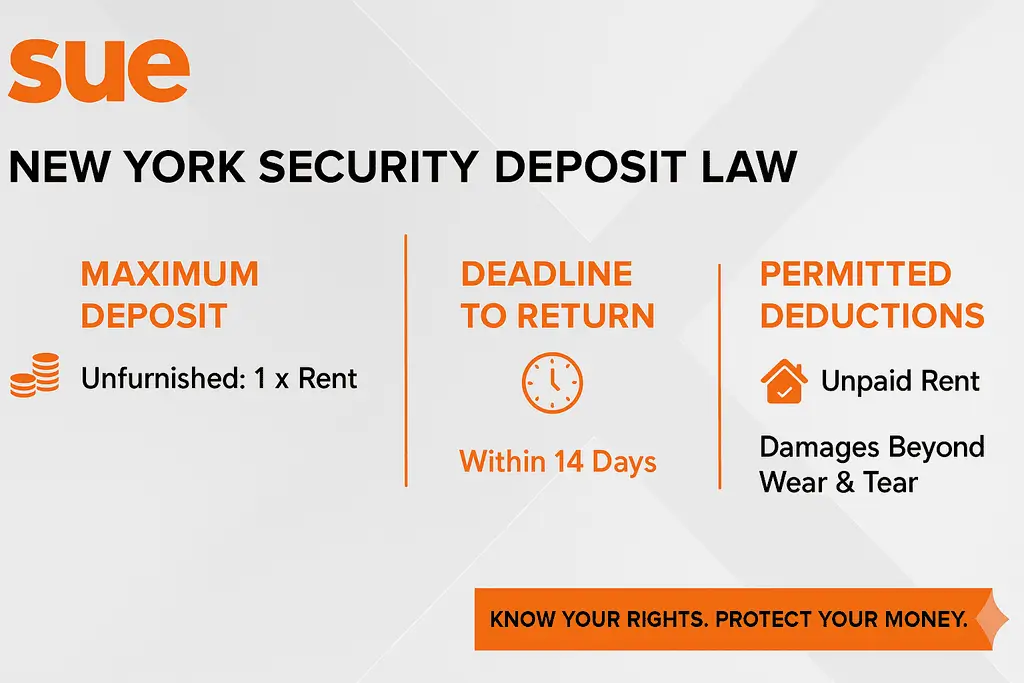
The strict one-month’s rent limit on all security deposits in New York
The rapid 14-day deadline for your landlord to return your deposit
Your legal right to a pre-move-out inspection with your landlord
The rules for how your landlord must hold your money in a separate account
The penalties a landlord faces for illegally withholding your deposit
How a Sue.com demand letter can help you recover your funds in New York
How Much Can a Landlord Charge for a Security Deposit in New York?
This is one of the most important tenant protections in New York. A landlord cannot charge more than one month’s rentfor a security deposit.
This is a firm cap. A landlord cannot try to circumvent this rule by calling a fee something else, such as a “move-in fee” or “decorating fee,” if it is intended to function as a security deposit. Any advance payment, other than prepaid rent, is considered part of this one-month limit.
Where is Your Money? New York's Deposit Holding Rules
In New York, your security deposit is not the landlord’s money. The law requires that the deposit be held in trust and cannot be co-mingled with the landlord’s personal funds.
Your deposit must be placed in a separate, interest-bearing account in a banking institution located within New York State. The landlord is required to notify you in writing of the name and address of the bank where your deposit is being held. The interest earned on the account, minus a 1% administrative fee for the landlord, belongs to you.
The 14-Day Rule: A Swift Return of Your Deposit
New York law mandates a quick and efficient return process. A landlord must return your security deposit and any accrued interest, minus any reasonable and itemized deductions, within 14 days of you vacating the property.
If the landlord intends to keep any portion of the deposit, they must provide you with a written, itemized statement of the deductions within that same 14-day period. This list must detail the specific repairs or cleaning costs that justify the deduction.
If a landlord fails to provide this itemized statement within 14 days, they forfeit any right to keep any portion of your deposit.
Your Right to a Pre-Move-Out Inspection
To prevent surprise deductions, New York law gives tenants the right to a walkthrough inspection.
After you’ve given your notice to move out, you can request an inspection. The landlord must then allow you to walk through the rental unit with them before you vacate. During this inspection, the landlord must provide you with a written, itemized list of any damages or conditions they believe could lead to deductions. This gives you a crucial opportunity to clean or repair these issues yourself before you leave, helping to ensure a full refund.
What to Do When a Landlord Breaks the Rules
If your landlord fails to return your deposit within 14 days, withholds it for illegitimate reasons, or fails to provide an itemized list, they have violated the law.
Send a Formal Demand Letter: Your first step should be to send a strong, professional demand letter via certified mail. The letter should clearly state the landlord’s violation of New York General Obligations Law and demand the immediate return of your full deposit.
File in Small Claims Court: If the landlord does not comply, you can file a lawsuit in Small Claims Court. If a court finds that the landlord’s violation was willful, they can award you punitive damages up to twice the amount of your original deposit.
How Sue.com Enforces Your New York Tenant Rights
When a New York landlord ignores the 14-day rule, they are often hoping the tenant won’t know about the severe penalties for willful violations. A professional demand letter from Sue.com immediately signals that you are aware of your powerful rights.
For just $39, our Demand Letter Package is your first line of defense:
Professionally Drafted for New York Law: We craft a letter that specifically references the 14-day rule and the potential for punitive damages under state law.
Legally Authoritative: The letter clearly outlines the consequences of their failure to follow New York’s strict procedures.
Sent via Certified Mail: We handle the crucial step of sending the letter via certified mail, providing the legal proof you need.
Cost-Effective: It’s a powerful tool to enforce your rights for a fraction of what it costs to hire an attorney.
Key Takeaways: Protecting Your Deposit in New York
One Month Max: A landlord can never charge more than one month’s rent for a deposit.
14-Day Deadline: The landlord must return your deposit or provide an itemized list within 14 days of you moving out.
Request an Inspection: You have the legal right to a pre-move-out walkthrough to identify and fix potential issues.
Funds Must Be Separate: Your deposit cannot be mixed with your landlord’s personal money.
Penalties are Severe: A landlord who willfully violates the law can owe you up to double your deposit in punitive damages.
Resources
New York General Obligations Law § 7-108: https://www.nysenate.gov/legislation/laws/GBS/7-108
Changes in New York State Rent Law (Tenant Protection Act of 2019): https://ag.ny.gov/sites/default/files/changes-in-nys-rent-law.pdf
A Guide to Small Claims in the NYS City, District, Town and Village Courts:https://www.nycourts.gov/courthelp/pdfs/SmallClaimsHandbook.pdf
Step 1
Answer a Few Simple Questions
Tell us what happened — who owes you, how much, and why. Our system guides you step-by-step with no legal jargon.
Step 2
We Draft Your New York Demand Letter
Your answers are reviewed and used to create an attorney-drafted demand letter tailored to your case.
Step 3
We Mail It for You
We print and mail the New York demand letter directly to the recipient via USPS — creating proof you attempted to resolve the matter before court.
Ready to Send Your New York Demand Letter?
Need Assistance?
Need help?
Find answers
Got questions about how Sue.com works, what’s included in each package, or what happens after your letter is sent? We’ve got you covered — quick, clear answers to help you move forward with confidence.
My landlord is asking for "first month's rent, last month's rent, and a security deposit." Is this legal in New York?
No. Under the 2019 law, a landlord cannot demand “last month’s rent” in addition to a security deposit that is equal to one month’s rent. Any advance payment is limited to the first month’s rent and a security deposit of the same amount.
What if my landlord doesn't give me the bank information for my deposit?
The law requires the landlord to notify you in writing of the bank’s name and address where your deposit is held. Failure to do so is a violation and can be used as evidence if a dispute arises over the return of your deposit.
Does the 14-day rule include weekends and holidays in New York?
Yes, the 14-day deadline is based on calendar days. The landlord must ensure the refund is sent or the itemized list is provided within that 14-day period.
Can my landlord deduct for painting after I move out?
Generally, no. After a typical lease term, the need to repaint is considered normal wear and tear, which is the landlord’s responsibility. You could only be charged if you caused excessive damage to the walls that required more than a standard paint job to fix.
I didn't request a pre-move-out inspection. Can my landlord still make deductions?
Yes, they can still make legitimate deductions. However, by not offering you the opportunity for an inspection after you requested one, the landlord’s case for making those deductions may be weakened if you challenge them in court.