
Home » Florida » Small Claims Court » Security Deposit Dispute
Sue for Security Deposit in Florida Small Claims Court
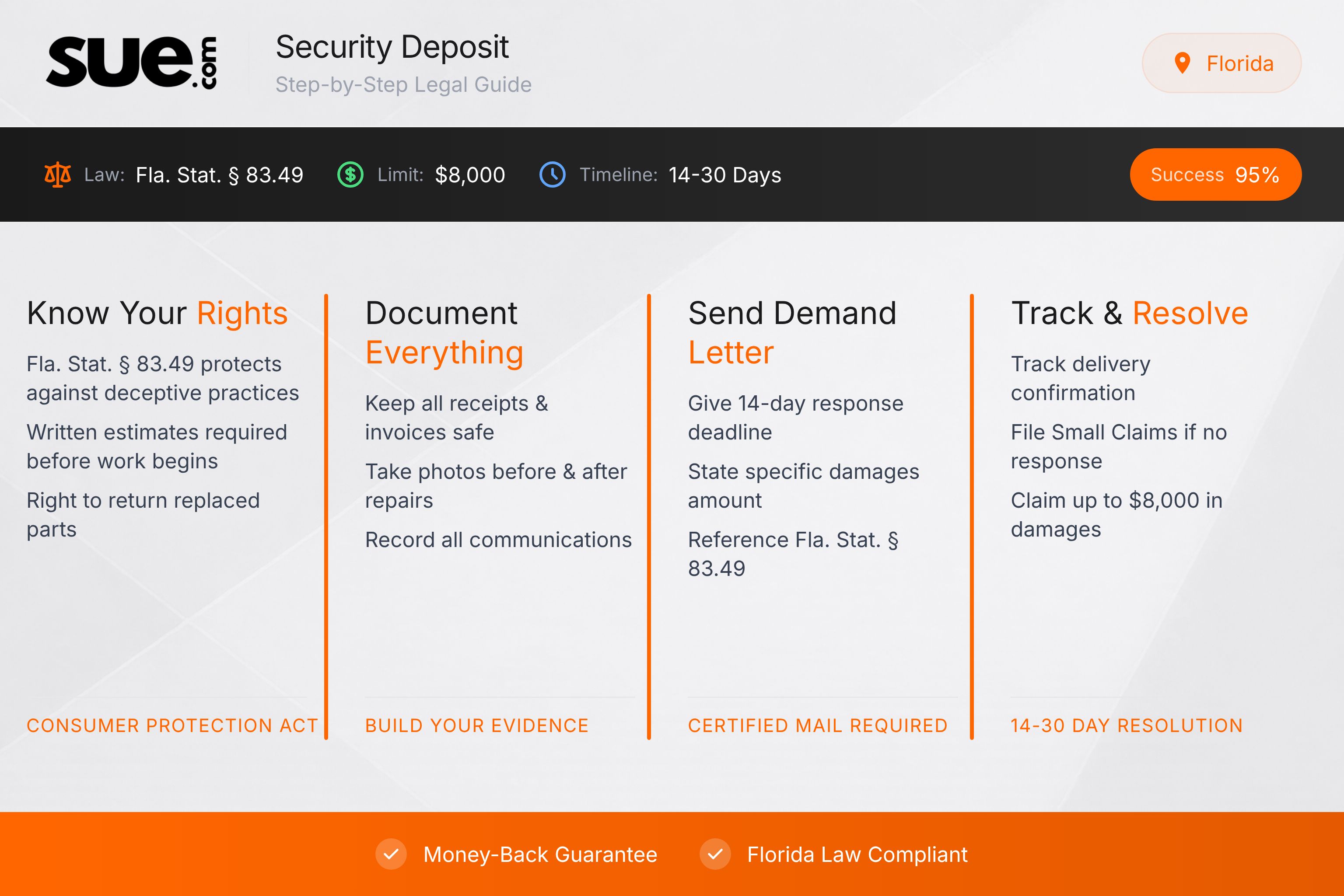
Pursuant to Fla. Stat. § 83.49, landlords in Florida are required to return security deposits within 15 to 60 days of lease termination, depending on whether deductions are claimed. Tenants seeking to sue landlord for security deposit Florida may file claims in the County Court Small Claims Division for amounts up to $8,000. The petition shall be filed in the county where the rental property is located or where the landlord resides. This guide establishes the statutory framework, procedural requirements, and evidentiary standards necessary to pursue security deposit recovery through Florida courts.
Statutory Basis: Security Deposit Claims in Florida County Court Small Claims Division
The Florida Residential Landlord and Tenant Act establishes comprehensive requirements governing security deposit retention and return. Under Fla. Stat. § 83.49, the statutory framework imposes strict obligations upon landlords and provides specific remedies for tenants whose deposits are wrongfully withheld.
| Code Section | Provision | Damages Available | Burden of Proof |
|---|---|---|---|
| Fla. Stat. § 83.49(3)(a) | Return of deposit within 15 days if no claim | Full deposit amount | Landlord must prove deductions |
| Fla. Stat. § 83.49(3)(b) | Written notice of claim within 30 days | Deposit plus court costs | Landlord must itemize damages |
| Fla. Stat. § 83.49(3)(c) | Failure to give required notice | Forfeiture of right to impose claim | Tenant proves notice not received |
| Fla. Stat. § 83.51 | Landlord maintenance obligations | Offset against claimed damages | Tenant documents pre-existing conditions |
The statutory scheme operates as follows: when a landlord intends to impose a claim on the security deposit, written notice by certified mail shall be provided to the tenant within 30 days of lease termination. The notice must include an itemized list of damages and the amount claimed. Failure to provide such notice results in forfeiture of the landlord’s right to impose any claim whatsoever.
Florida courts consistently hold that the burden of proof rests upon the landlord to justify any deductions from the security deposit. In cases where tenants seek to how to sue for a security deposit in Florida, the claimant must demonstrate that the deposit was paid, the tenancy terminated, and the landlord failed to return the deposit or provide proper notice. The landlord then bears the burden of proving that deductions were reasonable and supported by documentation.
Filing Procedures: Security Deposit in Florida County Court Small Claims Division
The procedural requirements for initiating a security deposit claim in Florida County Court Small Claims Division are established by Florida Small Claims Rules 7.010 through 7.350 and Fla. Stat. § 34.01. Strict compliance with these procedures is necessary for the court to exercise jurisdiction over the matter.
- Court: County Court Small Claims Division
- Jurisdictional limit: $8,000
- Filing fee: $55 to $300 depending on claim amount
- Forms required: Statement of Claim (Form 7.010), Summons
- Statute of limitations: 5 years for written lease; 4 years for oral agreement
- Venue: County where property is located or defendant resides
- Service of process: Personal service, certified mail, or substitute service
The Statement of Claim shall be filed with the Clerk of Court in the appropriate county. Pursuant to Florida Small Claims Rule 7.050, the claim must set forth the basis of the claim, the amount demanded, and the facts supporting recovery. The Florida Courts E-Filing Portal provides electronic filing capabilities for most Florida counties.
To File a lawsuit in Florida, the claimant must ensure proper service upon the defendant landlord. Service by certified mail with return receipt requested is permitted under Fla. Stat. § 48.031 for small claims matters. The defendant has 20 days from service to file a response or appear at the pretrial conference.
Evidentiary Standards for Security Deposit Claims in Florida
The evidentiary requirements for security deposit claims in Florida are governed by Florida Evidence Code Chapter 90 and the procedural standards established in Florida Small Claims Rule 7.140. Documentation shall be organized and presented in a manner that establishes each element of the claim.
| Evidence Type | Purpose | Legal Basis |
|---|---|---|
| Lease agreement | Establishes deposit amount and lease terms | Fla. Stat. § 83.49(1) |
| Move-in inspection report | Documents pre-existing conditions | Fla. Stat. § 83.49(3)(b) |
| Move-out inspection photos | Proves condition at termination | Florida Evidence Code § 90.401 |
| Deposit payment receipt | Confirms amount paid to landlord | Fla. Stat. § 83.49(2) |
| Landlord notice (or lack thereof) | Demonstrates compliance or violation | Fla. Stat. § 83.49(3)(a) |
| Correspondence with landlord | Shows demand and response | Florida Small Claims Rule 7.140 |
Damages calculation in security deposit cases requires precise documentation. The claimant shall present evidence of the full deposit amount paid, any partial refund received, and the difference claimed. Under Florida small claims court rules and limits, the total claim including the deposit, court costs, and any applicable statutory damages must not exceed $8,000.
The hearing in County Court Small Claims Division proceeds informally pursuant to Florida Small Claims Rule 7.140. However, the rules of evidence apply, and hearsay testimony is generally inadmissible. The claimant should prepare a chronological presentation: lease execution, deposit payment, tenancy period, move-out condition, and landlord’s failure to return the deposit or provide proper notice. Photographs shall be date-stamped and authenticated through testimony regarding when and where they were taken.
Professional Security Deposit Filing Services for Florida County Court Small Claims Division
The procedural complexity of security deposit litigation in Florida County Court Small Claims Division necessitates thorough preparation and documentation. Sue.com Florida court case tools provide comprehensive filing assistance for claimants pursuing deposit recovery.
- Attorney-drafted demand letter citing Fla. Stat. § 83.49 and applicable provisions
- Filing guide for County Court Small Claims Division procedures
- Court-ready Statement of Claim and supporting forms
- Evidence checklist aligned with Florida evidentiary standards
- Damages calculation methodology pursuant to statutory requirements
- Hearing preparation materials and presentation outline
The $249 service includes a Florida security deposit refund notice that establishes the statutory basis for the claim and provides the landlord with an opportunity to resolve the matter prior to litigation. Attorneys ghostwrite all demand letters to ensure proper citation of Florida statutes and compliance with procedural requirements. The filing package is designed to present the claim in a manner consistent with Florida Small Claims Rule standards.
Step 1
Answer a Few Simple Questions
Tell us what happened — who owes you, how much, and why. Our system guides you step-by-step with no legal jargon.
Step 2
We Draft Your Florida Demand Letter
Step 3
We Mail It for You

Ready to Send Your Florida Demand Letter?
Need Assistance?
Need help?
Find answers
Got questions about how Sue.com works, what’s included in each package, or what happens after your letter is sent? We’ve got you covered — quick, clear answers to help you move forward with confidence.
1. What is the jurisdictional limit for Security Deposit claims in Florida County Court Small Claims Division?
The County Court Small Claims Division maintains jurisdiction over claims not exceeding $8,000 pursuant to Fla. Stat. § 34.01. Claims exceeding this amount must be filed in County Court Civil Division or Circuit Court. The jurisdictional limit includes the deposit amount, court costs, and any statutory damages claimed.
2. What evidentiary standard applies to Security Deposit claims in Florida?
The preponderance of the evidence standard applies to civil matters in Florida County Court. The claimant must prove that the deposit was paid and not properly returned. Pursuant to Fla. Stat. § 83.49(3), the burden then shifts to the landlord to justify any deductions with itemized documentation.
3. What is the applicable statute of limitations for Security Deposit in Florida?
Security deposit claims based on written lease agreements are subject to a 5-year statute of limitations under Fla. Stat. § 95.11(2)(b). Claims arising from oral agreements must be filed within 4 years pursuant to Fla. Stat. § 95.11(3)(k). The limitations period begins when the landlord fails to return the deposit within the statutory timeframe.
4. Is legal representation permitted in Florida County Court Small Claims Division?
Parties may represent themselves or retain legal counsel in Florida small claims proceedings. Pursuant to Florida Small Claims Rule 7.090, corporations must be represented by an attorney or authorized officer. Individual claimants frequently proceed pro se, as the informal nature of small claims proceedings is designed to accommodate self-represented litigants.
5. What remedies are available upon judgment in a Florida Security Deposit case?
Upon entry of judgment, the prevailing party may pursue collection through wage garnishment, bank levy, or property lien pursuant to Fla. Stat. Chapter 56. Judgments bear interest at the statutory rate established by the Chief Financial Officer. The judgment remains enforceable for 20 years and may be renewed pursuant to Fla. Stat. § 55.081.