
How to Sue Your Landlord for a
Security Deposit in
Texas Small Claims Court
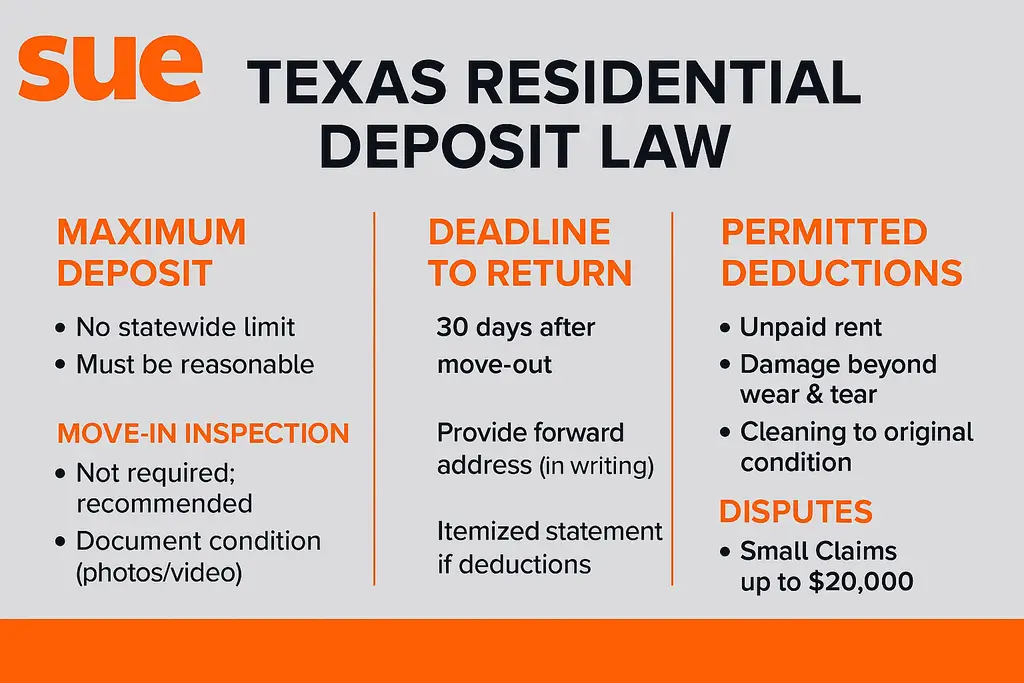
When your Texas landlord ignores your demand letter, your most powerful recourse is the Justice Court, also known as the Justice of the Peace or JP court. This is Texas’s version of small claims, and it’s designed to be accessible to everyone. If your landlord failed to refund your deposit within 30 days of receiving your forwarding address, the law is on your side.
This guide will walk you through the process of suing your landlord in Justice Court. We will cover the high claim limit, the forms you need, and how to leverage the powerful “bad faith” penalties in the Texas Property Code to get your money back.
$39 Texas Demand Letter
Mailed in Minutes!
Understanding Your Legal Basis for Suing in Texas
Your case in Justice Court will be built on Texas Property Code § 92.109. This is the law that gives your lawsuit teeth. As we covered in our Texas Security Deposit Demand Letter Guide, a landlord who fails to refund your deposit or provide an itemized list within 30 days of receiving your forwarding address is presumed to have acted in “bad faith.”
This “bad faith” presumption is your key to winning. If the court agrees, you are entitled to sue for not just your original deposit, but for $100, plus three times the portion of the deposit wrongfully withheld, and your attorney’s fees.Justice Court is the venue where you hold the landlord accountable for these penalties.
This Guide Covers:
-
The $20,000 limit for Texas Justice Court
-
A step-by-step guide to filing a “Small Claims Petition”
-
How to have the “Constable” or process server serve your landlord
-
The evidence you need to prove “bad faith”
-
How Sue.com can help you prepare your case file
Key Questions Before You File Your Case
How Much Can I Sue For?
Texas has one of the highest small claims limits in the nation. You can sue for any amount up to $20,000 in Justice Court. This gives you plenty of room to sue for your original deposit (e.g., $1,500) plus the 3x penalty ($4,500) and the $100 statutory fee, for a total claim of $6,100.
Where Do I File My Case?
You must file in the correct “Justice of the Peace Precinct.” This is almost always the precinct where the rental property is located. If you file in the wrong precinct, the case may be dismissed. You can find the correct precinct on your county’s Justice of the Peace website.
How Long Do I Have to File? (Statute of Limitations)
You should act quickly, but you have time. For a breach of a written lease, the statute of limitations in Texas is four years. If you had an oral or verbal lease, the limit is two years.
How to File Your Small Claims Case in Texas: A Step-by-Step Guide
Step 1: Get the Correct Forms
The document that starts your lawsuit is called a “Small Claims Petition.” Do not look for a “complaint” form. You can get this form from the website of the Justice Court Clerk in the county where you are filing.
Step 2: File Your Petition with the Justice Court Clerk
You must file the Petition with the clerk of the correct JP precinct. Many larger counties in Texas (like Harris, Dallas, and Travis) use the eFileTexas.gov system for mandatory electronic filing. You will fill out the petition, which states who you are, who you are suing, and why they owe you money (citing the bad faith violation of the Property Code).
Step 3: Pay the Filing and Service Fees
You will have to pay a filing fee to the court, which varies by county. You must also pay a “service” fee, which is the cost to have the lawsuit officially delivered to your landlord. If you win, you can ask the judge to add these costs to the judgment the landlord has to pay.
Step 4: "Serve" the Citation on Your Landlord
Once you file, the clerk will issue a “Citation,” which is the official notice of the lawsuit. This must be formally delivered (or “served”) on your landlord. This is almost always handled by the county Constable or a private process server. You cannot just mail it or hand it to them yourself.
Gathering Your Evidence to Win
Your case will be won or lost based on your evidence. To win a bad faith claim, you must bring the following to your hearing:
-
The “Forwarding Address” Proof: This is the most important piece of evidence. You must have a copy of the certified mail receipt showing you sent your forwarding address to the landlord.
-
The Lease: A copy of your signed lease agreement.
-
Proof of Payment: Canceled checks or bank statements showing you paid the deposit.
-
The Demand Letter: A copy of the demand letter you sent and its certified mail receipt.
-
Photos/Videos: Move-in and move-out photos showing the unit’s clean condition, which disproves any of the landlord’s potential “damage” claims.
-
Communications: All emails or texts about the move-out and deposit.
How Sue.com Helps You File Your Case
The Texas Justice Court system, with its precincts, e-filing rules, and specific petitions, can be confusing. Our $99 Small Claims Court Package is designed to guide you through it.
The $39 Demand Letter was the first step. This is the next. We move beyond just a guide and help you:
-
Prepare Your Official “Petition”: We help you complete the correct forms for your specific precinct, making sure you correctly state your claim for bad faith damages under § 92.109.
-
Navigate E-Filing: We provide guidance on using the eFileTexas system to get your case properly filed.
-
Organize Your Evidence: We’ll help you structure your evidence (especially that crucial forwarding address receipt) to present a clear, winning case to the Justice of the Peace.
This package gives you the tools and confidence to use the full power of the Texas Property Code.
Resources
-
Texas Property Code § 92.109 (Landlord’s Liability):https://statutes.capitol.texas.gov/Docs/PR/htm/PR.92.htm#92.109
-
Texas Justice Court (Small Claims) Information from Texas Legal Aid: https://guides.sll.texas.gov/small-claims
-
Texas Attorney General (Tenants’ Rights): https://www.texasattorneygeneral.gov/consumer-protection/home-real-estate-and-travel/renters-rights
Step 1
Answer a Few Simple Questions
Tell us what happened — who owes you, how much, and why. Our system guides you step-by-step with no legal jargon.
Step 2
We Draft Your Texas Demand Letter
Using your answers, we instantly generate a professionally written, legally sound Texas demand letter tailored to your situation.
Step 3
We Mail It for You
We print and mail the Texas demand letter directly to the recipient via USPS — creating proof you attempted to resolve the matter before court.

Ready to Send Your Texas Demand Letter?
Need Assistance?
Need help?
Find answers
Got questions about how Sue.com works, what’s included in each package, or what happens after your letter is sent? We’ve got you covered — quick, clear answers to help you move forward with confidence.
What is the maximum amount I can sue for in Texas Justice Court?
The limit in Texas is $20,000, which is much higher than in most states. This gives you plenty of room to sue for your deposit plus the full 3x penalty for bad faith.
What is a "Justice of the Peace Precinct" (JP)?
This is simply what Texas calls its local small claims courts. Each county is divided into several “precincts,” and you must file in the one that has jurisdiction over your case (usually where the property is).
What is the single most important piece of evidence for my case?
Your certified mail receipt proving you sent your written forwarding address to the landlord. Without this, the landlord’s 30-day clock never legally starts, and their “bad faith” is not presumed.
Do I need a lawyer for Texas Justice Court?
No, you are not required to have a lawyer. The system is designed for individuals to represent themselves. In fact, in many JP courts, you cannot have a lawyer unless the other side brings one.
What happens if my landlord doesn't show up to court?
If you have proof that your landlord was properly served by the Constable or process server and they fail to appear, you can ask the Justice of the Peace for a “default judgment.” This means you win the case automatically.