
Home » New Jersey » Small Claims Court
New Jersey Small Claims Court Guide:
How to File and Win Your Case
The New Jersey Small Claims Section operates as a division of the Superior Court Special Civil Part, providing an accessible forum for the resolution of civil disputes involving amounts up to $5,000. Pursuant to N.J.S.A. 2A:6-41 and the New Jersey Court Rules governing the Special Civil Part, individuals and businesses may pursue monetary claims without the procedural complexities of standard civil litigation. This comprehensive resource on Small claims court New Jersey lawsuit addresses all procedural requirements, applicable statutes, and strategic considerations necessary for successful case prosecution. The guide encompasses filing procedures, service requirements, evidentiary standards, and judgment collection mechanisms under New Jersey law. Self-represented litigants may effectively navigate the Small Claims Section by adhering to the statutory framework and procedural rules outlined herein.
Get Started in Your State
We provide state-specific demand letter services across the country. Find your state below to see our tailored guides and packages for your exact dispute.
New Jersey Small Claims Court Guide: How to File and Win Your Case
The New Jersey Small Claims Section operates as a division of the Superior Court Special Civil Part, providing an accessible forum for the resolution of civil disputes involving amounts up to $5,000. Pursuant to N.J.S.A. 2A:6-41 and the New Jersey Court Rules governing the Special Civil Part, individuals and businesses may pursue monetary claims without the procedural complexities of standard civil litigation. This comprehensive resource on Small claims court New Jersey lawsuit addresses all procedural requirements, applicable statutes, and strategic considerations necessary for successful case prosecution. The guide encompasses filing procedures, service requirements, evidentiary standards, and judgment collection mechanisms under New Jersey law. Self-represented litigants may effectively navigate the Small Claims Section by adhering to the statutory framework and procedural rules outlined herein.
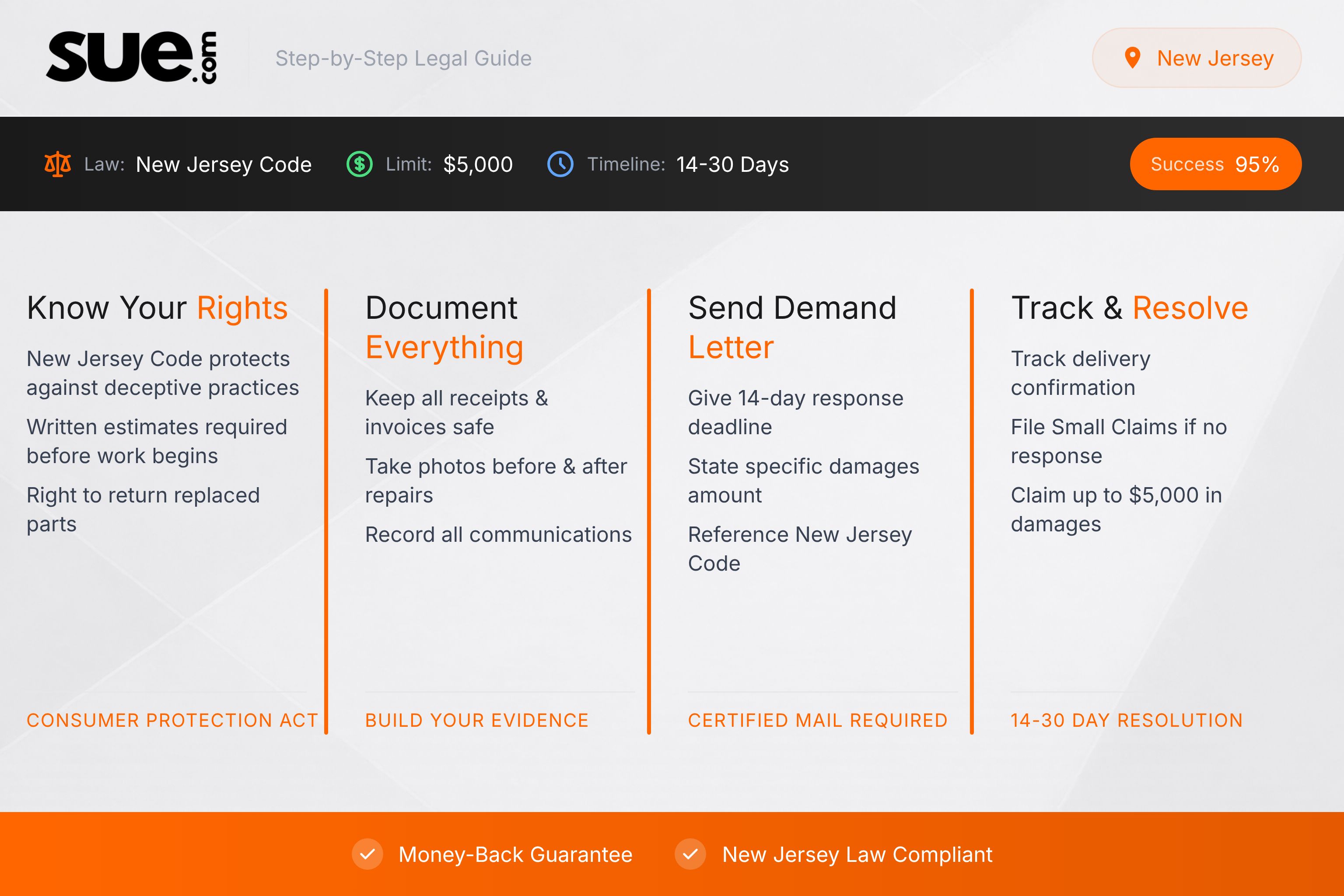
New Jersey Small Claims Section (Superior Court Special Civil Part) Overview
Pursuant to N.J. Court Rule 6:1-2, the Small Claims Section of the Superior Court Special Civil Part maintains exclusive jurisdiction over civil matters where the amount in controversy does not exceed $5,000, excluding costs. The Small Claims Section operates in each of New Jersey’s 21 counties, with venue properly established in the county where the defendant resides or where the cause of action arose under N.J. Court Rule 6:1-1.
Natural persons, corporations, partnerships, and other legal entities possess standing to initiate claims in the Small Claims Section. Actions may be brought against individuals, business entities, landlords, contractors, and other parties who have allegedly caused monetary harm to the claimant. The court adjudicates disputes involving breach of contract, property damage, consumer fraud, security deposit retention, unpaid debts, and similar monetary claims.
Under N.J.S.A. 2A:6-43, attorney representation is permitted but not required in the Small Claims Section. The procedural rules are intentionally simplified to accommodate self-represented litigants, and judges routinely assist parties in presenting their cases. However, corporations must be represented by an officer or authorized employee pursuant to N.J. Court Rule 6:11.
Filing fees in the Small Claims Section range from $35 to $50 depending on the amount claimed, with additional costs for service of process. The prevailing party may recover filing costs as part of the judgment. Appeals from Small Claims Section decisions must be filed within 45 days pursuant to N.J. Court Rule 6:4-8, and the appellate court conducts a de novo review of the matter.
Those seeking comprehensive guidance on How to sue in New Jersey small claims should understand that proper preparation significantly increases the likelihood of a favorable outcome. Judgments rendered by the Small Claims Section remain valid and enforceable for 20 years under N.J.S.A. 2A:14-5.
New Jersey Laws That Help You Win
New Jersey statutory law provides robust protections for consumers, tenants, and individuals harmed by the wrongful conduct of others. The following statutes establish the legal basis for common Small Claims Section cases and prescribe specific remedies available to prevailing parties.
New Jersey Consumer Fraud Act (N.J.S.A. 56:8-1 et seq.)
The Consumer Fraud Act constitutes one of the most powerful consumer protection statutes in the nation. Under N.J.S.A. 56:8-19, any person who suffers an ascertainable loss due to unlawful consumer fraud practices may recover treble damages (three times actual damages) plus reasonable attorney fees and costs. The Act applies to deceptive advertising, bait-and-switch tactics, misrepresentation of goods or services, and other unconscionable commercial practices. Claimants need not prove intent to deceive, as the statute imposes strict liability for violations.
Security Deposit Act (N.J.S.A. 46:8-21.1 et seq.)
Landlord-tenant disputes regarding security deposits are governed by this comprehensive statute. Pursuant to N.J.S.A. 46:8-21.1, landlords must return security deposits within 30 days of lease termination, accompanied by an itemized statement of any deductions. Failure to comply entitles the tenant to recover double the amount wrongfully withheld plus reasonable attorney fees under N.J.S.A. 46:8-21.1.
Home Improvement Contractor Registration Act (N.J.S.A. 56:8-136 et seq.)
This statute requires all home improvement contractors to register with the Division of Consumer Affairs. Under N.J.S.A. 56:8-151, contracts with unregistered contractors are voidable at the homeowner’s option, and violations constitute per se consumer fraud under the Consumer Fraud Act. Homeowners may recover all payments made to unregistered contractors plus treble damages.
Truth-in-Consumer Contract, Warranty and Notice Act (N.J.S.A. 56:12-14 et seq.)
This Act prohibits sellers from including certain provisions in consumer contracts that violate established legal rights. Violations entitle consumers to actual damages or $100, whichever is greater, plus reasonable attorney fees under N.J.S.A. 56:12-17.
Common New Jersey Small Claims Cases
The Small Claims Section adjudicates a diverse range of civil disputes, each governed by specific New Jersey statutes and common law principles. The following categories represent the most frequently litigated matters.
Security Deposit Disputes arise when landlords fail to return deposits within the 30-day statutory period under N.J.S.A. 46:8-21.1. Tenants may recover double damages for wrongful retention.
Contractor and Home Improvement Claims involve disputes over defective workmanship, project abandonment, or failure to complete contracted work. The Home Improvement Contractor Registration Act provides enhanced remedies against unregistered contractors.
Property Damage Cases encompass vehicle accidents, negligent destruction of personal property, and damage caused by pets or other instrumentalities. Claimants must establish the defendant’s negligence and prove damages through repair estimates or replacement costs.
Consumer Fraud Matters include deceptive sales practices, misrepresentation of goods or services, and bait-and-switch schemes. The Consumer Fraud Act authorizes treble damages for proven violations.
Unpaid Debt Collections permit creditors to recover amounts owed under oral or written agreements. The statute of limitations for written contracts is six years under N.J.S.A. 2A:14-1.
Vehicle Purchase Disputes involve undisclosed defects, odometer fraud, or breach of warranty claims against dealers or private sellers. The Consumer Fraud Act applies to dealer transactions.
Personal Injury Claims within the $5,000 jurisdictional limit may be pursued in Small Claims Section. Medical records and bills establish damages.
Breach of Contract Actions require proof of a valid agreement, the defendant’s breach, and resulting damages. Written contracts provide stronger evidentiary support.
Defective Product Claims allow consumers to recover for goods that fail to perform as warranted. The Uniform Commercial Code governs warranty claims under N.J.S.A. 12A:2-314.
Professional Service Disputes involve claims against service providers who failed to perform competently or as agreed. Documentation of the agreement and deficient performance is essential.
The New Jersey Small Claims Court Process
The prosecution of a Small Claims Section case requires adherence to specific procedural steps established by the New Jersey Court Rules and applicable statutes.
Step 1: Transmit a Formal Demand Letter
Prior to filing suit, claimants should transmit a written demand to the prospective defendant specifying the amount owed and the legal basis for the claim. Demand letters establish good faith efforts to resolve disputes and may prompt settlement without litigation. The demand should reference applicable statutes and set a reasonable deadline for payment.
Step 2: File the Complaint
The complaint shall be filed with the Special Civil Part Clerk’s Office in the appropriate county. Filing may be accomplished in person or electronically through the New Jersey Courts eCourts system. The complaint must state the factual basis for the claim, the amount demanded, and the relief sought. Filing fees range from $35 to $50 based on the claim amount.
Step 3: Serve the Defendant
Pursuant to N.J. Court Rule 6:2-3, the defendant must receive proper notice of the action. Service may be accomplished by certified mail, personal service by a process server, or other methods authorized by the court rules. Proof of service must be filed with the court prior to the hearing date.
Step 4: Prepare Evidence
Admissible evidence includes contracts, receipts, photographs, correspondence, repair estimates, and witness testimony. All documents should be organized chronologically and copied for the court and opposing party. Witnesses must appear in person unless their testimony is submitted by affidavit.
Step 5: Attend the Hearing
Small Claims Section hearings are conducted informally, with judges actively assisting parties in presenting their cases. Claimants should arrive early, dress professionally, and present their evidence in a clear, organized manner. The judge will render a decision at the conclusion of the hearing or by mail within several days.
Step 6: Collect the Judgment
If the defendant fails to satisfy the judgment voluntarily, collection mechanisms include wage garnishment under N.J.S.A. 2A:17-56, bank account levy, and judgment liens against real property. The court clerk can provide information regarding post-judgment collection procedures.
How Sue.com's New Jersey Small Claims Court Package Works
The Small Claims Court Package, available for $249, provides comprehensive legal resources for prosecuting claims in the New Jersey Small Claims Section. The package includes all materials necessary to pursue a case from initial demand through judgment collection.
Under Formal demand for payment New Jersey, a professionally drafted demand letter is included with the package. The demand letter cites applicable New Jersey statutes, specifies the amount owed, and establishes a deadline for payment. Many disputes resolve at this stage without the necessity of court proceedings.
The package includes a complete filing guide specific to New Jersey Small Claims Section procedures, identification of the proper court and venue for the case, a comprehensive list of required forms, and an evidence checklist tailored to the specific claim type. A damage calculation worksheet assists in determining the full extent of recoverable damages, including statutory penalties and interest.
Sue.com’s New Jersey legal tools provide court preparation materials that explain hearing procedures, evidentiary standards, and presentation strategies. All materials are designed for self-represented litigants and comply with New Jersey Court Rules governing the Special Civil Part.
Step 1
Answer a Few Simple Questions
Tell us what happened — who owes you, how much, and why. Our system guides you step-by-step with no legal jargon.
Step 2
We Draft Your New Jersey Demand Letter
Your answers are reviewed and used to create an attorney-drafted demand letter tailored to your case.
Step 3
We Mail It for You

Ready to Send Your New Jersey Demand Letter?
Need Assistance?
Need help?
Find answers
Got questions about how Sue.com works, what’s included in each package, or what happens after your letter is sent? We’ve got you covered — quick, clear answers to help you move forward with confidence.
1. What is the small claims court limit in New Jersey?
Pursuant to N.J. Court Rule 6:1-2, the jurisdictional limit for the Small Claims Section is $5,000, excluding filing costs and interest. Claims exceeding this amount must be filed in the regular Special Civil Part or Superior Court.
2. How much does it cost to file in New Jersey Small Claims Section (Superior Court Special Civil Part)?
Filing fees in the Small Claims Section range from $35 to $50 depending on the amount claimed. Additional costs for service of process by certified mail or process server typically range from $10 to $75. Prevailing parties may recover these costs as part of the judgment.
3. Do I need a lawyer for New Jersey Small Claims Section (Superior Court Special Civil Part)?
Attorney representation is not required in the Small Claims Section. The procedural rules are simplified to accommodate self-represented litigants, and judges routinely assist parties in presenting their cases. However, parties may choose to retain counsel if desired.
4. How long does a New Jersey small claims case take?
From filing to hearing, most Small Claims Section cases are resolved within 30 to 60 days. The court schedules hearings promptly, and judges typically render decisions on the hearing date. Collection of judgments may require additional time if the defendant does not pay voluntarily.
5. What if the defendant doesn't show up to court?
If the defendant fails to appear after proper service, the court may enter a default judgment in favor of the claimant pursuant to N.J. Court Rule 6:6-3. The claimant must still present sufficient evidence to establish the claim and the amount of damages.
6. What if I win but they refuse to pay?
New Jersey law provides multiple collection mechanisms for unsatisfied judgments. These include wage garnishment under N.J.S.A. 2A:17-56, bank account levy, and recording of judgment liens against real property. Judgments remain enforceable for 20 years and accrue interest at the statutory rate.