
Home » New Jersey » Demand Letters
How to Write and Send a
Demand Letter in New Jersey
Under New Jersey law, a formal demand letter constitutes the essential first step in pursuing legal remedies for civil disputes. Pursuant to the New Jersey Consumer Fraud Act (N.J.S.A. § 56:8-1 et seq.) and various other state statutes, written notice of a claim is required before certain causes of action may proceed. A properly drafted Demand letter for money New Jersey establishes the claimant’s legal position, creates an evidentiary record, and demonstrates good faith efforts at resolution. The demand letter serves as formal notification that legal action shall be initiated if the matter remains unresolved within the specified timeframe.
Get Started in Your State
We provide state-specific demand letter services across the country. Find your state below to see our tailored guides and packages for your exact dispute.
How to Write and Send a Demand Letter in New Jersey
Under New Jersey law, a formal demand letter constitutes the essential first step in pursuing legal remedies for civil disputes. Pursuant to the New Jersey Consumer Fraud Act (N.J.S.A. § 56:8-1 et seq.) and various other state statutes, written notice of a claim is required before certain causes of action may proceed. A properly drafted Demand letter for money New Jersey establishes the claimant’s legal position, creates an evidentiary record, and demonstrates good faith efforts at resolution. The demand letter serves as formal notification that legal action shall be initiated if the matter remains unresolved within the specified timeframe.
Legal Basis for Demand Letters in New Jersey
The legal weight of demand letters in New Jersey derives from both statutory requirements and judicial precedent. New Jersey courts consistently recognize that pre-litigation demand demonstrates the claimant’s reasonable efforts to resolve disputes without court intervention. Failure to provide adequate notice may result in dismissal of certain claims or denial of statutory remedies.
| Statute | Requirement | Notice Period | Consequence |
|---|---|---|---|
| N.J.S.A. § 46:8-21.1 (Security Deposit Act) | Written demand for deposit return | 30 days after tenancy ends | Double damages plus attorney fees |
| N.J.S.A. § 56:8-19 (Consumer Fraud Act) | Notice of unlawful practice | Reasonable period before suit | Treble damages and attorney fees |
| N.J.S.A. § 2A:15-97 (Frivolous Litigation) | Good faith demand required | Prior to filing | Sanctions for failure to attempt resolution |
The Superior Court of New Jersey has held that demand letters serve multiple evidentiary functions. The document establishes the date the claimant placed the respondent on notice, quantifies the damages sought, and preserves the claimant’s legal theories. Understanding How to write a New Jersey demand letter requires familiarity with these statutory frameworks. Judges in the Special Civil Part frequently inquire whether pre-suit demand was made, and the absence of such demand may negatively affect the court’s assessment of the claimant’s diligence.
New Jersey Statutes That Strengthen Your Demand
New Jersey provides robust statutory protections that significantly enhance the effectiveness of demand letters. Citation of applicable statutes signals to the respondent that the claimant understands available legal remedies and intends to pursue them.
- New Jersey Consumer Fraud Act (N.J.S.A. § 56:8-1 et seq.): This statute prohibits unconscionable commercial practices, deception, and fraud in consumer transactions. Violations entitle the claimant to treble damages, attorney fees, and costs. The mere citation of this statute in a demand letter creates substantial pressure, as defendants face exposure to damages three times the actual loss suffered.
- New Jersey Security Deposit Law (N.J.S.A. § 46:8-21.1): Landlords must return security deposits within 30 days of tenancy termination or provide an itemized statement of deductions. Wrongful withholding subjects the landlord to double the deposit amount plus reasonable attorney fees. This statute provides one of the strongest tenant protections in the nation.
- New Jersey Prompt Payment Act (N.J.S.A. § 2A:30A-2): Construction contractors must receive payment within 30 days of proper invoice submission. Failure to pay entitles the contractor to interest at prime rate plus 2% and recovery of attorney fees. This statute applies to both public and private construction projects.
- New Jersey Truth-in-Consumer Contract, Warranty and Notice Act (N.J.S.A. § 56:12-14 et seq.): This statute prohibits certain provisions in consumer contracts and requires clear disclosure of warranty terms. Violations may result in damages of $100 per violation or actual damages, whichever is greater, plus attorney fees.
Common New Jersey Disputes Requiring Formal Demand
Formal demand letters are appropriate for virtually all civil disputes cognizable in New Jersey courts. The following table identifies common dispute categories and their governing statutory frameworks.
| Dispute Category | Key New Jersey Statute | Notice Requirement |
|---|---|---|
| Security Deposit | N.J.S.A. § 46:8-21.1 | 30 days post-tenancy |
| Auto Repair | N.J.A.C. § 13:45A-26C.1 | Written estimate required |
| Contractor Disputes | N.J.S.A. § 2A:30A-2 | 30 days from invoice |
| Personal Injury | N.J.S.A. § 2A:14-2 | 2-year statute of limitations |
| Property Damage | N.J.S.A. § 2A:14-1 | 6-year statute of limitations |
| Unpaid Invoice | N.J.S.A. § 12A:2-709 | Reasonable demand period |
| Breach of Contract | N.J.S.A. § 2A:14-1 | 6-year statute of limitations |
| Defective Product | N.J.S.A. § 2A:58C-1 | Product liability notice |
| Neighbor Disputes | N.J.S.A. § 2A:14-1 | Property damage claims |
| Professional Services | N.J.S.A. § 2A:14-1 | Contract-based claims |
Security deposit disputes represent the most common category of demand letters in New Jersey. Pursuant to N.J.S.A. § 46:8-21.1, landlords who fail to return deposits or provide proper itemization face liability for double damages. Contractor disputes frequently arise under the Prompt Payment Act, which provides statutory interest and fee-shifting remedies.
Consumer fraud claims under N.J.S.A. § 56:8-2 encompass a broad range of deceptive practices, including misleading advertising, bait-and-switch tactics, and failure to honor warranties. The treble damages provision makes these claims particularly valuable for demand letter purposes.
The New Jersey Demand Letter Process: Procedural Requirements
The preparation and transmission of a New Jersey demand letter requires adherence to specific procedural steps to maximize legal effectiveness.
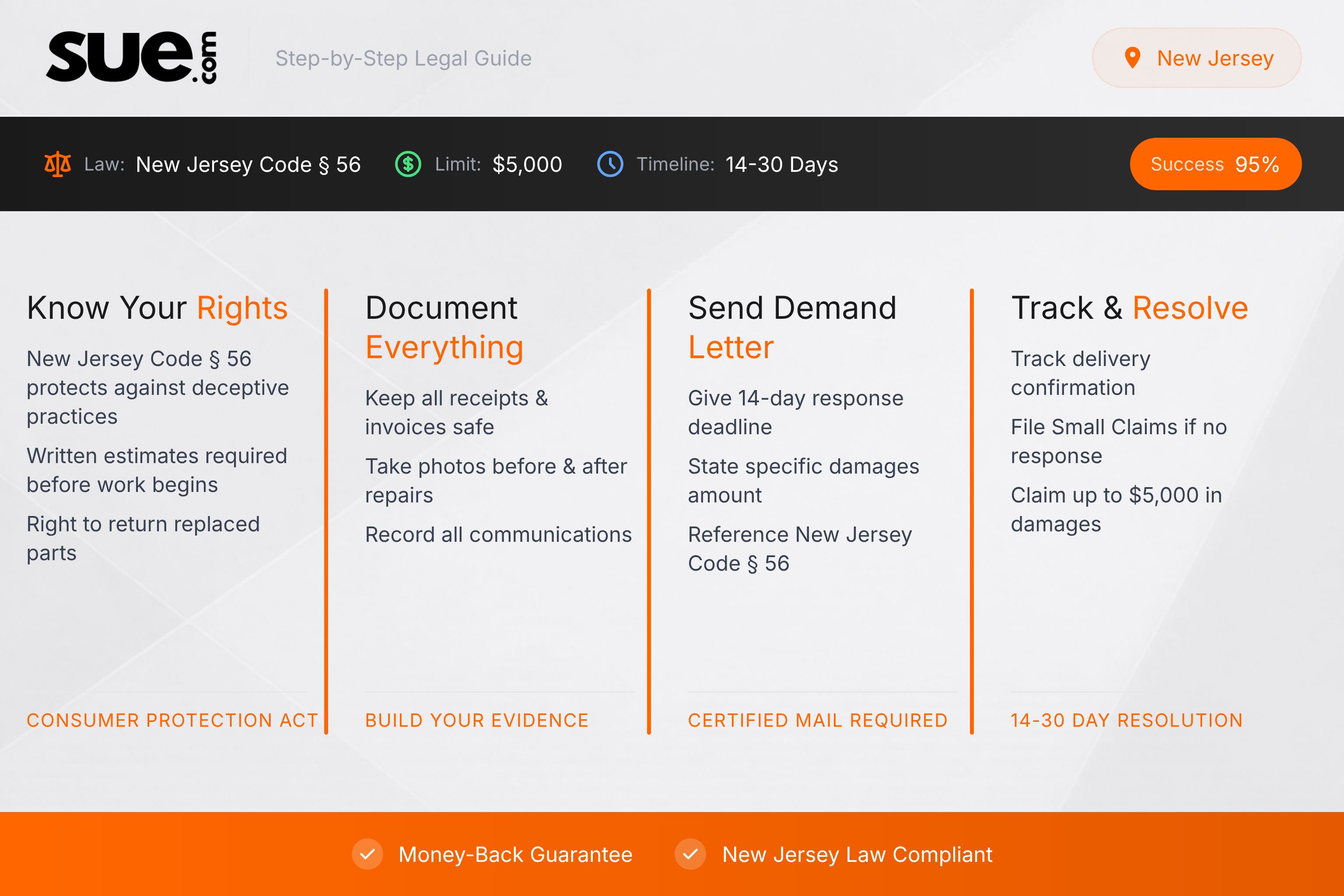
Step 1: Document the Claim. All evidence supporting the claim must be gathered and organized. This includes contracts, receipts, photographs, correspondence, and witness statements. The evidentiary record establishes the factual basis for the demand.
Step 2: Research Applicable New Jersey Statutes. Each claim type is governed by specific statutory provisions. The applicable statutes must be identified, including notice requirements, limitations periods, and available remedies.
Step 3: Calculate Damages. The total amount demanded must be calculated with precision. This includes actual damages, statutory penalties, interest, and any other recoverable amounts under New Jersey law.
Step 4: Draft the Demand with Statutory Citations. The letter must clearly state the factual basis for the claim, cite applicable statutes, specify the amount demanded, and establish a response deadline.
Pursuant to N.J.S.A. § 46:8-21.1, this letter constitutes formal demand for the return of the security deposit in the amount of $2,500. Under New Jersey law, the landlord is obligated to return the deposit within 30 days of tenancy termination or provide an itemized statement of deductions. Failure to respond within 14 days of receipt shall result in the filing of a claim in the Special Civil Part of the Superior Court of New Jersey, seeking double damages as provided by statute.
Step 5: Send via Certified Mail. The demand letter must be transmitted via USPS Certified Mail with Return Receipt Requested. This method provides documentary proof of delivery admissible in court.
Step 6: Document and Preserve the Record. Copies of the demand letter, certified mail receipt, and return receipt must be retained. These documents shall be presented as exhibits if litigation becomes necessary.
Professional New Jersey Demand Letter Services
Professional demand letter preparation ensures statutory compliance and maximizes the probability of favorable resolution. The $199 service includes attorney-drafted correspondence tailored to New Jersey legal requirements.
- Attorney-drafted correspondence citing applicable New Jersey statutes
- Certified mail delivery with return receipt documentation
- Statutory compliance review ensuring all notice requirements are satisfied
- Escalation path to the Special Civil Part for claims up to $5,000
Through Sue in New Jersey small claims court, claimants may pursue recovery of amounts up to $5,000 in the Special Civil Part (or up to $15,000 for certain claims). The demand letter serves as the foundation for subsequent litigation if the respondent fails to comply. The Sue.com New Jersey legal platform provides comprehensive support for both demand letter preparation and small claims court filing procedures.
Step 1
Answer a Few Simple Questions
Tell us what happened — who owes you, how much, and why. Our system guides you step-by-step with no legal jargon.
Step 2
We Draft Your New Jersey Demand Letter
Your answers are reviewed and used to create an attorney-drafted demand letter tailored to your case.
Step 3
We Mail It for You

Ready to Send Your New Jersey Demand Letter?
Need Assistance?
Need help?
Find answers
Got questions about how Sue.com works, what’s included in each package, or what happens after your letter is sent? We’ve got you covered — quick, clear answers to help you move forward with confidence.
1. Is a demand letter a legal prerequisite to filing suit in New Jersey?
While New Jersey does not universally require pre-suit demand, certain statutes mandate written notice before claims may be filed. Pursuant to N.J.S.A. § 46:8-21.1, tenants must demand return of security deposits before seeking double damages. The Consumer Fraud Act similarly contemplates pre-litigation notice for certain remedies.
2. Which New Jersey statutes should be cited in a demand letter?
The applicable statutes depend upon the nature of the claim. Consumer disputes should cite N.J.S.A. § 56:8-1 et seq. Security deposit claims require reference to N.J.S.A. § 46:8-21.1. Contract disputes may invoke N.J.S.A. § 12A:2-709 for goods or common law principles for services.
3. What constitutes a reasonable response period in New Jersey?
New Jersey courts generally consider 14 to 30 days a reasonable response period for demand letters. Statutory claims may specify particular timeframes. The response period should be clearly stated in the demand letter and calculated from the date of receipt.
4. What remedies are available if the demand is not honored?
Failure to comply with a demand letter entitles the claimant to file suit in the Special Civil Part of the Superior Court for claims up to $15,000. Statutory claims may provide for enhanced damages, including treble damages under the Consumer Fraud Act and double damages under the Security Deposit Law.
5. Is professional drafting required for a New Jersey demand letter?
Professional drafting is not legally required, and self-representation is permitted in New Jersey courts. However, attorney-drafted demand letters demonstrate seriousness of purpose and ensure proper citation of applicable statutes, increasing the likelihood of pre-litigation resolution.
6. How is delivery of a demand letter documented in New Jersey?
Delivery is documented through USPS Certified Mail with Return Receipt Requested. The green return receipt card provides proof of delivery admissible in New Jersey courts. The certified mail tracking number establishes the date of mailing, and the signed receipt confirms the date of delivery.