
Home » Georgia » Small Claims Court » Security Deposit Dispute
Sue for Security Deposit in Georgia Small Claims Court
Your landlord kept your money. Now you take it back. If you need to sue landlord for security deposit Georgia, Magistrate Court gives you the power to claim up to $15,000 without hiring a lawyer. Georgia law is on your side, and the filing process is straightforward. Stop waiting for a refund that will never come voluntarily. File your claim and demand what belongs to you.
Security Deposit Laws That Give You Power in Georgia
Georgia law hands you serious weapons. Use them.
- Maximum you can sue for: $15,000
- Key statute: Ga. Code Ann. § 44-7-30 through § 44-7-36
- What you must prove: You paid a deposit, moved out, and the landlord failed to return it properly
- Penalties they face: Up to three times the deposit amount if they acted in bad faith
- Lawyer needed: No. You do this yourself.
Here’s what makes Georgia’s security deposit law powerful. Under Ga. Code Ann. § 44-7-34, your landlord has exactly 30 days after you move out to return your deposit or provide a written itemized statement of deductions. Miss that deadline? You win. Period.
The law gets better. If your landlord held your deposit without proper justification, you can demand the full amount back. But if they acted in bad faith, meaning they knew they owed you money and kept it anyway, the court can award you three times your deposit under Ga. Code Ann. § 44-7-35(b). A $1,500 deposit becomes $4,500. That’s your leverage.
Georgia also requires landlords to keep deposits in an escrow account and provide you with written notice of where your money is held. Failed to do that? Another violation. Another weapon for your case. Learn how to sue for a security deposit in Georgia and put these laws to work.
Your landlord broke the rules. Make them pay.
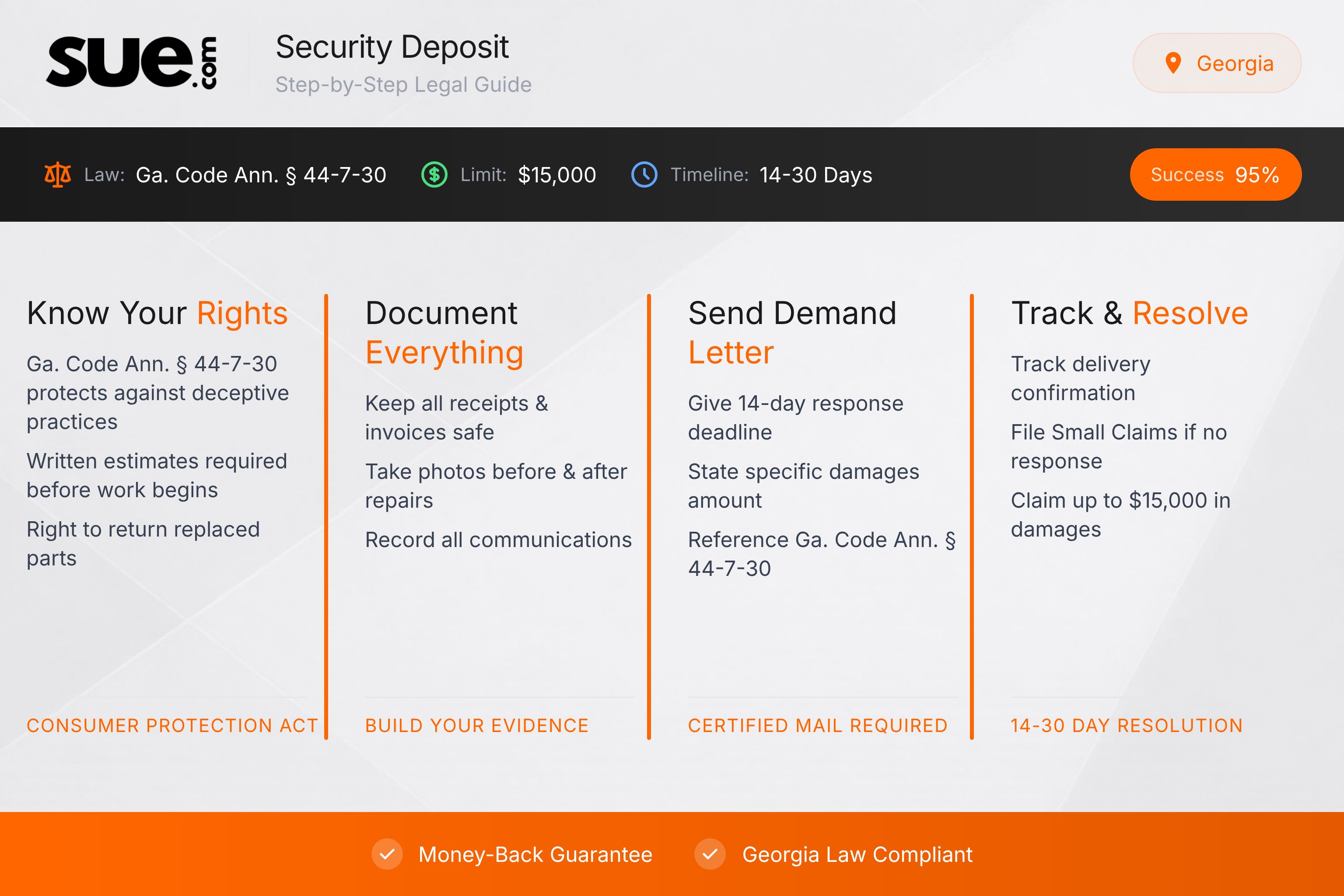
How to File Your Security Deposit Claim in Georgia
Filing is simple. Five steps. No lawyer required.
- Step 1: Go to your county’s Magistrate Court and request a Statement of Claim form
- Step 2: Fill in your claim amount, up to $15,000, and describe what happened
- Step 3: Pay the filing fee, typically $45 to $75 depending on your county and claim amount
- Step 4: Serve the defendant through the court’s service options or certified mail
- Step 5: Show up on your court date and present your evidence
Georgia makes this accessible. Magistrate Court handles cases up to $15,000, which covers nearly every security deposit dispute. You file in the county where the rental property is located or where the landlord resides.
Some Georgia counties offer electronic filing through PeachCourt (varies by county). Check your local Magistrate Court website. Either way, you can complete the paperwork in under an hour.
After filing, the court schedules a hearing, usually within 30 to 45 days. That’s fast. File a lawsuit in Georgia and get your court date locked in.
Stop asking. Start demanding.
Build a Security Deposit Case They Can't Beat in Georgia
Evidence wins cases. Stack yours high.
- Must have: Your lease agreement, proof of deposit payment (canceled check, bank statement, or receipt), move-in and move-out inspection reports, photos of the unit’s condition when you left
- Strengthens your case: Written communication with your landlord requesting the deposit, any itemized deduction list they provided, utility final bills showing your move-out date
- Kills their defense: Photos timestamped at move-in showing pre-existing damage, witness statements from anyone who saw the unit’s condition, landlord’s failure to provide the required escrow account notice
Now calculate what they owe you. Georgia courts award actual damages plus penalties for bad faith.
| What They Owe | Amount |
|---|---|
| Security deposit withheld | $1,800 |
| Bad faith penalty (3x deposit) | $5,400 |
| Total Potential Recovery | $7,200 |
That’s real money. Your landlord gambled by keeping your deposit. Make them lose.
Organize everything before your hearing. Put documents in chronological order. Practice explaining your timeline in under three minutes. Judges appreciate clarity. Know the Georgia small claims court rules and limits before you walk in.
Preparation is power. Walk in ready to win.
Sue for Security Deposit in Georgia Today
You have the law. You have the evidence. Now get the tools.
- Cost: $249
- Includes: Attorney-drafted demand letter, complete filing guide, court forms, evidence checklist, damage calculation worksheet, court preparation materials
- Court: Magistrate Court, claims up to $15,000
- Lawyer needed: No
The Sue.com Georgia court case tools give you everything you need. Your demand letter puts your landlord on notice. Many landlords pay up before you even file. If they don’t? You’re ready for court.
Start with a Georgia security deposit refund notice. It’s the first shot. Make it count.
Your money. Your move. Take action now.
Step 1
Answer a Few Simple Questions
Tell us what happened — who owes you, how much, and why. Our system guides you step-by-step with no legal jargon.
Step 2
We Draft Your Georgia Demand Letter
Step 3
We Mail It for You

Ready to Send Your Georgia Demand Letter?
Need Assistance?
Need help?
Find answers
Got questions about how Sue.com works, what’s included in each package, or what happens after your letter is sent? We’ve got you covered — quick, clear answers to help you move forward with confidence.
1. What's the most I can sue for in Georgia Magistrate Court for Security Deposit?
You can sue for up to $15,000 in Georgia Magistrate Court. Most security deposit disputes fall well under this limit. If your landlord acted in bad faith, you can claim up to three times your actual deposit.
2. What evidence wins a Security Deposit case in Georgia?
Photos of the unit at move-out, your lease agreement, and proof of deposit payment are essential. Add any written communication where your landlord acknowledged the deposit or made excuses for not returning it. Timestamped move-in photos destroy claims of damage you didn’t cause.
3. How long does a Security Deposit case take in Georgia?
From filing to hearing, expect 30 to 45 days in most Georgia counties. The hearing itself typically lasts 15 to 30 minutes. You can have a judgment the same day. Collection may take additional time if the landlord doesn’t pay voluntarily.
4. Do I need a lawyer for Security Deposit small claims in Georgia?
No. Magistrate Court is designed for self-representation. Corporations must have an attorney, but individuals represent themselves. You know your case better than anyone. Present your evidence clearly and let the facts speak.
5. What happens if I win but they don't pay?
Georgia gives you collection tools. File for a writ of fieri facias (fi fa) to garnish wages or bank accounts. You can also place a lien on property. The judgment is valid for seven years and can be renewed. They can’t hide forever.