
Home » Georgia » Demand Letters » Personal Injury Dispute
Georgia Personal Injury Demand Letter
Dealing with an injury caused by someone else’s negligence is exhausting, both physically and emotionally. You shouldn’t have to fight just to get fair compensation for your medical bills, lost wages, and pain. The good news is that Georgia law provides meaningful protections for injury victims, and a well-crafted Georgia personal injury demand letter is often the most effective first step toward the resolution you deserve. This guide will walk you through everything you need to know about Georgia’s personal injury laws, how to write a compelling demand letter, and what options you have if the other party refuses to cooperate.
Personal Injury Laws That Protect You in Georgia
We understand that trying to research legal statutes while you’re still recovering from an injury feels like an unfair burden. You’re dealing with pain, medical appointments, and financial stress, and now you have to become a legal expert too? The reassuring news is that Georgia has strong laws designed to protect people in exactly your situation, and understanding the basics is simpler than you might think.
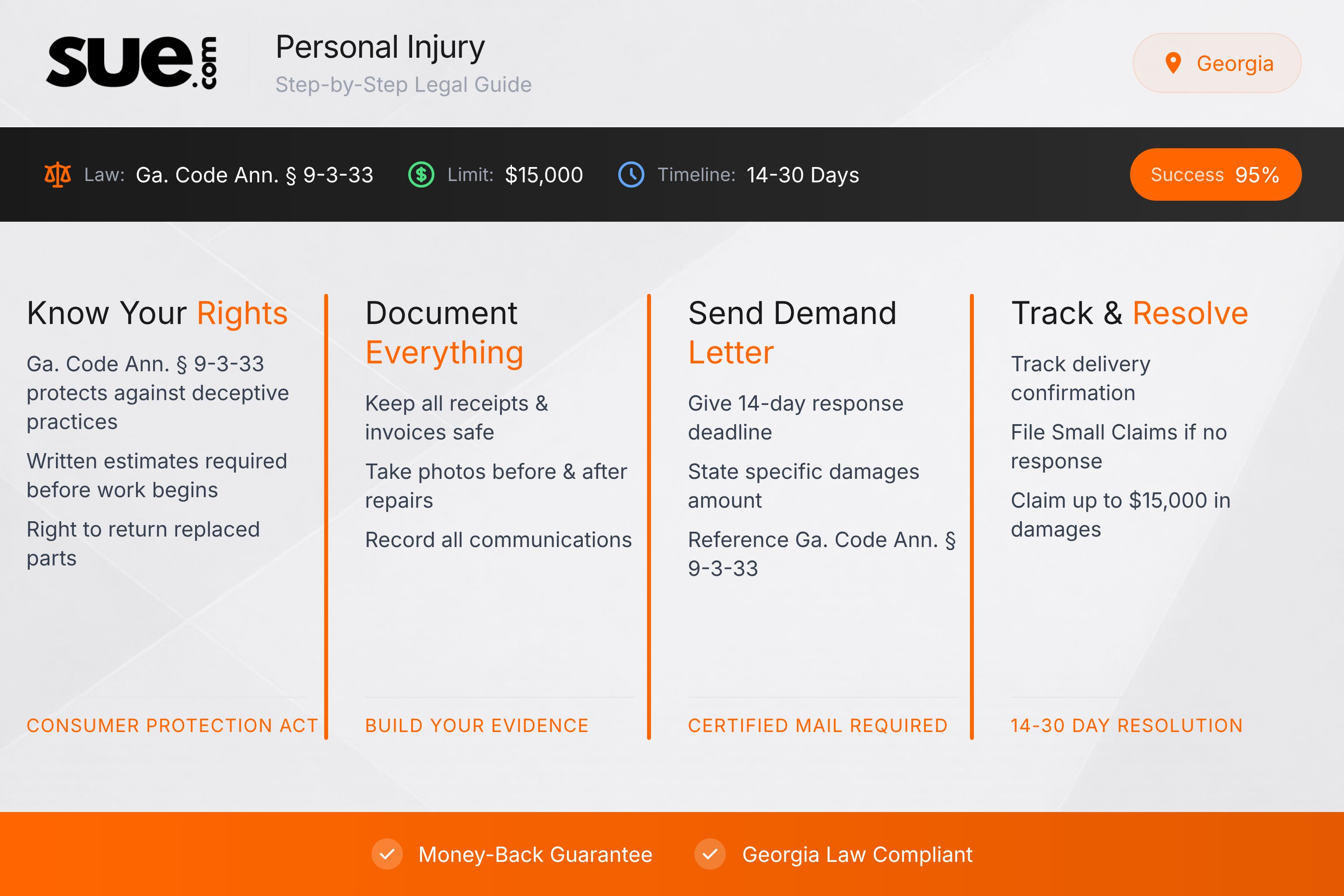
Your Rights at a Glance:
- The law on your side: Ga. Code Ann. § 9-3-33
- What it means for you: You have two years from the date of your injury to file a personal injury lawsuit in Georgia
- Their obligation: The at-fault party or their insurance company must respond to legitimate claims in good faith
- If they don’t: You can recover economic damages (medical bills, lost wages) plus non-economic damages (pain and suffering)
- Where to file: Magistrate Court, up to $15,000
Georgia follows a “modified comparative negligence” rule under Ga. Code Ann. § 51-12-33. This means you can still recover damages even if you were partially at fault, as long as you were less than 50% responsible for the accident. Your compensation is reduced by your percentage of fault, but you’re not shut out entirely. Many people worry that one small mistake on their part disqualifies them from any recovery, but that’s simply not how Georgia law works.
If you’re wondering whether you have a valid claim to dispute an injury claim in Georgia, the answer often depends on proving the other party’s negligence and documenting your damages thoroughly. You’ve already taken an important step by researching your options, and thousands of Georgians successfully pursue personal injury claims every year.
Why Sending a Demand Letter Is Worth It in Georgia
It’s completely understandable if you’re tempted to skip the demand letter and go straight to court. After all, you’re the one who was hurt, and it might feel like the responsible party should already know they owe you compensation. Here’s the reality though: a formal demand letter often resolves disputes faster and with less stress than jumping directly into litigation.
Typical Timeline:
- Week 1: You send the demand letter via certified mail
- Week 2-3: The other party or their insurance company receives it and evaluates your claim
- Week 3-4: Most disputes reach a settlement during this window
- If no response: You have a documented paper trail for Magistrate Court
Insurance companies and defendants take demand letters seriously because they signal you understand your rights and are prepared to pursue them. A Legal demand for Georgia back pay and compensation shows you’ve done your homework. The demand letter also creates a formal record that can strengthen your case if you do end up in court. Georgia judges appreciate seeing that you made a good-faith effort to resolve the matter before taking up court time.
Beyond the strategic advantages, there’s something empowering about putting your case in writing. You’re taking control of a situation where you’ve felt powerless, and that matters.
Your Path to Writing a Georgia Personal Injury Demand Letter
We know that writing a legal document while you’re still dealing with injury-related challenges feels daunting. But breaking it down into manageable steps makes the process much more approachable. Here’s exactly how to build a demand letter that gets results.
Step 1: Gather Your Documentation Before you write a single word, collect everything that supports your claim:
- Medical records and bills from all treatment providers
- Photographs of your injuries taken at different stages of healing
- Police reports or incident reports if applicable
- Witness contact information and statements
- Proof of lost wages (pay stubs, employer letter)
- Receipts for out-of-pocket expenses related to your injury
Step 2: Research the Applicable Georgia Law Your letter carries more weight when it cites specific statutes. Reference Ga. Code Ann. § 9-3-33 for the statute of limitations and Ga. Code Ann. § 51-12-33 if comparative negligence might be raised.
Step 3: Calculate Your Damages Georgia allows you to recover both economic and non-economic damages. Be specific:
| Damage Type | Example Amount |
|---|---|
| Medical expenses to date | $8,500 |
| Estimated future medical costs | $3,000 |
| Lost wages (6 weeks at $800/week) | $4,800 |
| Pain and suffering | $5,000 |
| Total Demand | $21,300 |
Step 4: Draft Your Letter Your demand letter should be professional, factual, and firm without being aggressive. Here’s a sample opening:
Dear [Insurance Adjuster/Defendant Name], I am writing to formally request compensation for injuries I sustained on [date] due to [brief description of incident]. Under Ga. Code Ann. § 9-3-33, I am entitled to pursue this claim within the statutory period. Enclosed please find medical records, bills, and documentation supporting my claim of $[amount]. I respectfully request a response within 30 days of receipt of this letter.
Step 5: Send Via Certified Mail Always use certified mail with return receipt requested. This creates proof that the other party received your demand, which is crucial if you later need to demonstrate your good-faith efforts. The Demand letter success rate in Georgia improves significantly when you can prove delivery.
You’ve got this. The hardest part is often just getting started, and you’re already past that point.
How Sue.com Supports Your Georgia Personal Injury Claim
We understand that even with a clear guide, writing a demand letter while managing an injury is a lot to handle. That’s exactly why Sue.com exists. For $199, our attorneys research your specific situation, draft a professional demand letter citing the Georgia statutes that apply to your case, and mail it via certified mail with return receipt.
What’s included:
- Research the Georgia statutes that apply to your personal injury claim
- Draft a professional demand letter tailored to your situation
- Calculate your damages based on documentation you provide
- Send via certified mail with return receipt
- Guide you through filing in Magistrate Court if needed
You don’t have to figure this out alone. The Sue.com Georgia legal resource center was built specifically for people in your situation, and we’re here to help you move forward. If your demand letter doesn’t resolve the dispute, you may also want to explore your options to Sue for medical bills in Georgia through Magistrate Court.
Whatever path you choose, you’re taking action to protect yourself, and that’s something to feel good about.
Step 1
Answer a Few Simple Questions
Tell us what happened — who owes you, how much, and why. Our system guides you step-by-step with no legal jargon.
Step 2
We Draft Your Georgia Demand Letter
Step 3
We Mail It for You

Ready to Send Your Georgia Demand Letter?
Need Assistance?
Need help?
Find answers
Got questions about how Sue.com works, what’s included in each package, or what happens after your letter is sent? We’ve got you covered — quick, clear answers to help you move forward with confidence.
1. Do I need to send a demand letter before suing for Personal Injury in Georgia?
While Georgia law doesn’t technically require a demand letter before filing suit, sending one is almost always in your best interest. It often leads to faster settlements, creates a documented record of your good-faith efforts, and shows the court you tried to resolve matters reasonably if litigation becomes necessary.
2. What Georgia laws protect me in a Personal Injury dispute?
The primary statute you’ll rely on is Ga. Code Ann. § 9-3-33, which gives you two years to file a personal injury claim. Georgia’s comparative negligence law under Ga. Code Ann. § 51-12-33 also protects your right to recover damages even if you were partially at fault, as long as your responsibility was under 50%.
3. How long should I give them to respond to my demand letter?
Giving the other party 30 days to respond is standard practice in Georgia personal injury cases. This timeframe is reasonable and widely accepted by courts. It gives the recipient enough time to review your documentation and consult with their insurance company or attorney.
4. What if they ignore my Personal Injury demand letter in Georgia?
If they don’t respond, you have solid options. Your demand letter creates a paper trail proving you attempted resolution in good faith. You can then file a claim in Georgia Magistrate Court for amounts up to $15,000, and your documented demand strengthens your position before the judge.
5. How much can I recover for my Personal Injury claim in Georgia?
Georgia allows you to recover both economic damages (medical bills, lost wages, out-of-pocket expenses) and non-economic damages (pain and suffering, emotional distress). For claims under $15,000, Magistrate Court is an accessible option. Your specific recovery depends on your documented damages and the strength of your evidence, but many Georgians successfully recover the full amount they’re owed.