
Home » Georgia » Demand Letters » Auto Repair Dispute
Georgia Auto Repair Demand Letter
When a mechanic charges you for work they didn’t complete, or your car comes back with new problems after a repair, you have legal options in Georgia. A Georgia auto repair demand letter is often the most effective first step toward getting your money back. Under Ga. Code Ann. § 10-1-393, Georgia’s Fair Business Practices Act protects consumers from deceptive repair practices and gives you real leverage when demanding payment. This guide will walk you through the process together, from understanding your rights to sending a professional demand letter that gets results.
Understanding Georgia Auto Repair Law
Georgia law provides meaningful protections for consumers who have been overcharged or received substandard vehicle repairs. Before we dive into the specifics, it helps to understand why these laws exist. The Georgia Fair Business Practices Act was designed to level the playing field between consumers and businesses, ensuring that repair shops cannot take advantage of customers through deceptive practices or unauthorized work.
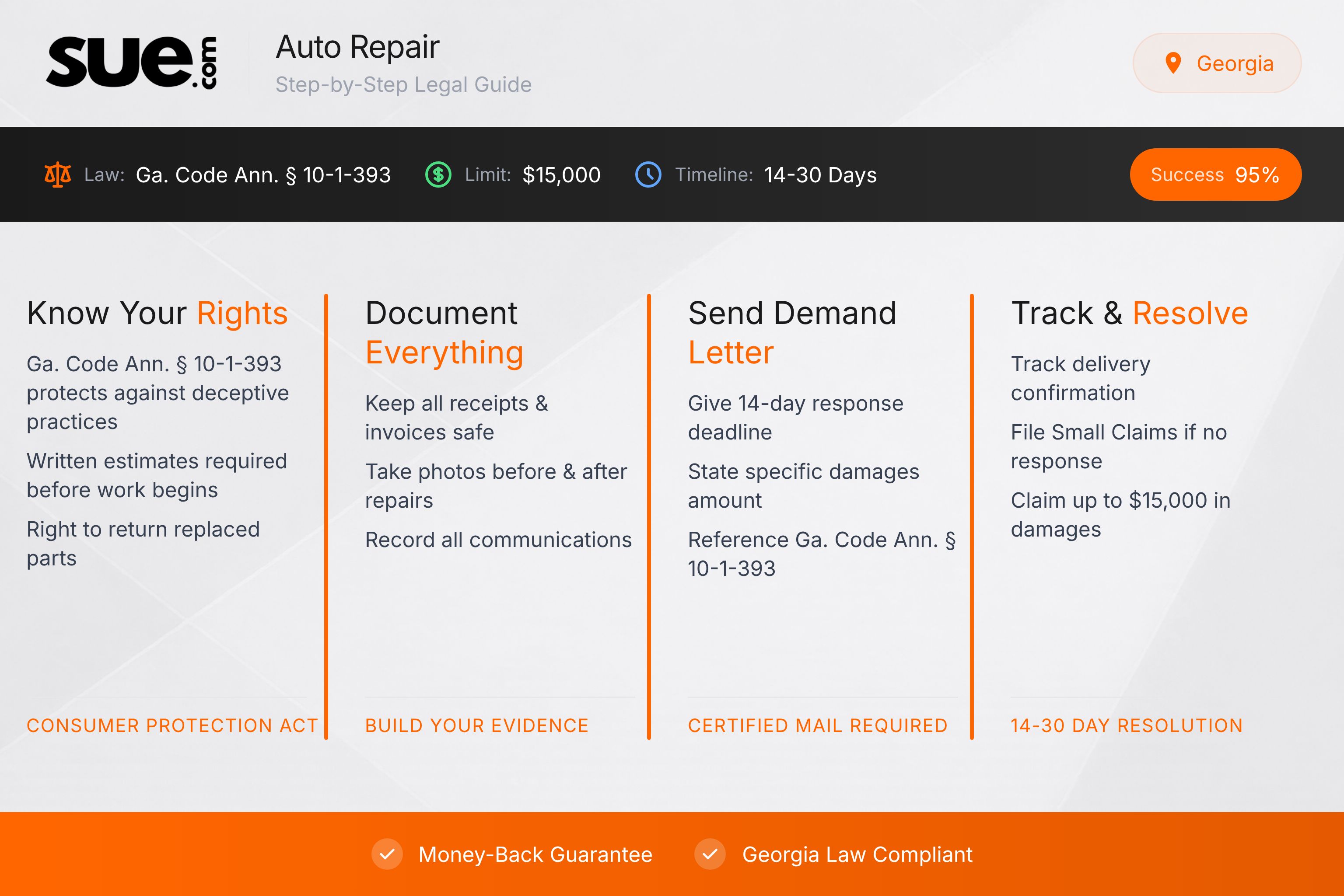
Under Ga. Code Ann. § 10-1-393, it is unlawful for any business to engage in unfair or deceptive acts. For auto repair specifically, this means mechanics cannot perform unauthorized repairs, charge for work not completed, or misrepresent the condition of your vehicle. When a repair shop violates these provisions, you have the right to recover your actual damages, and in some cases, the court may award additional penalties.
Georgia also requires repair shops to provide written estimates before beginning work on your vehicle. If a mechanic performs repairs beyond the original estimate without your authorization, you may not be obligated to pay for that additional work. This is a common issue that strengthens many auto repair claims.
- Your deadline: Georgia has a 4-year statute of limitations for written contracts and 6 years for breach of contract claims, giving you time to pursue your case
- Their obligation: Repair shops must complete authorized work properly, charge only for services rendered, and honor their warranties
- If they don’t comply: You can pursue your claim in Magistrate Court, where the process is designed to be accessible without an attorney
- Your maximum claim: $15,000 in Magistrate Court
- Important: Keep all repair orders, invoices, and written communications as evidence for your claim
Understanding these protections puts you in a stronger position when you dispute an auto repair bill in Georgia. With the law on your side, a well-crafted demand letter carries real weight.
Why a Demand Letter Is Your Best First Step in Georgia
Sending a formal demand letter before filing a lawsuit accomplishes several important goals. First, it demonstrates that you are serious about pursuing your claim and have taken the time to document your case. Many repair shops will settle disputes quickly once they receive a professional demand letter citing specific Georgia statutes.
Second, a demand letter creates a clear paper trail that Georgia courts look for when evaluating your case. Magistrate Court judges appreciate seeing that you attempted to resolve the matter before taking up court resources. This documentation also protects you if the other party later claims they were never notified of the problem.
- Week 1: You send the demand letter via certified mail
- Week 2-3: The other party receives and has time to respond
- Week 3-4: Most disputes resolve here
- If no response: You have a documented paper trail for Magistrate Court
The reality is that most auto repair disputes never make it to court. When a repair shop receives a demand letter that clearly states the legal violations and the amount owed, they often prefer to settle rather than face the time and expense of defending a lawsuit. You can Request payment via Georgia demand letter and give the other party a reasonable opportunity to make things right before escalating further.
How to Write Your Georgia Auto Repair Demand Letter, Step by Step
Writing an effective demand letter might seem intimidating at first, but we can break it down into manageable steps. Each step builds on the previous one, and by the end, you will have a professional document that clearly states your case.
Step 1: Gather your documentation. Before you write a single word, collect every piece of evidence related to your repair. This includes the original repair estimate, the final invoice, any written communications with the shop, photographs of the vehicle before and after repairs, and receipts for any subsequent repairs you needed to fix the original problem. The stronger your documentation, the more persuasive your letter will be.
Step 2: Research the Georgia laws that apply. Your demand letter should reference specific statutes that support your claim. For auto repair disputes, Ga. Code Ann. § 10-1-393 covers deceptive business practices, while Ga. Code Ann. § 10-1-399 addresses consumer remedies. Citing these laws shows the repair shop that you understand your rights.
Step 3: Calculate what you are owed. Be specific about your damages. Include the amount you paid for faulty repairs, the cost of any corrective repairs, rental car expenses if applicable, and any other direct financial losses. Present this as a clear itemized list.
Step 4: Draft your letter with proper citations. Your letter should be professional, factual, and direct. State what happened, cite the relevant laws, list your damages, and make a clear demand for payment.
Dear [Name], I am writing regarding the vehicle repair services performed on my [Year/Make/Model] at your shop on [date]. Under Ga. Code Ann. § 10-1-393, repair shops are prohibited from engaging in deceptive practices, including charging for services not rendered and performing unauthorized repairs. As of [date], [X] days have passed since I notified you of the defective repair work. I am requesting $[specific amount] to resolve this matter, which includes $[amount] for the original repair, $[amount] for corrective repairs, and $[amount] for related expenses.
Step 5: Send via certified mail. Always send your demand letter through certified mail with return receipt requested. This creates proof that the repair shop received your letter, which is essential if you later need to file a claim in Magistrate Court. Proof of service for Georgia demand letters can make the difference between a successful claim and a dismissed case.
How Sue.com Guides You Through Georgia Auto Repair Demand Letters
Sometimes the most efficient path forward is having a professional handle your demand letter. For $199, Sue.com’s Georgia case tools connect you with an attorney who will write your demand letter, ensuring it cites the correct Georgia statutes and presents your case in the most compelling way possible.
- Attorney writes your letter citing Georgia statutes including Ga. Code Ann. § 10-1-393
- Damages calculated based on your specific situation and documentation
- Sent via certified mail with return receipt for proof of delivery
- If needed, guidance on next steps in Magistrate Court
If your demand letter does not resolve the dispute, you may need to sue a mechanic in Georgia small claims court. The Magistrate Court process is designed to be accessible, and the demand letter you have already sent becomes valuable evidence of your good-faith attempt to resolve the matter. With your documentation in order and the law on your side, you are well-prepared to take the next step if needed.
Step 1
Answer a Few Simple Questions
Tell us what happened — who owes you, how much, and why. Our system guides you step-by-step with no legal jargon.
Step 2
We Draft Your Georgia Demand Letter
Step 3
We Mail It for You

Ready to Send Your Georgia Demand Letter?
Need Assistance?
Need help?
Find answers
Got questions about how Sue.com works, what’s included in each package, or what happens after your letter is sent? We’ve got you covered — quick, clear answers to help you move forward with confidence.
1. Is a demand letter required before suing for Auto Repair in Georgia?
Georgia does not legally require a demand letter before filing in Magistrate Court, but sending one is strongly recommended. Judges view it favorably when plaintiffs have attempted to resolve disputes before filing suit, and many cases settle after a demand letter without ever reaching court.
2. What Georgia laws should I reference in my Auto Repair demand letter?
The most important statute is Ga. Code Ann. § 10-1-393, which prohibits deceptive business practices including unauthorized repairs and charging for incomplete work. You should also reference Ga. Code Ann. § 10-1-399, which outlines the remedies available to consumers who have been harmed by these violations.
3. How long should I give them to respond to my demand letter?
A reasonable response period is typically 14 to 30 days from the date they receive your letter. This gives the repair shop enough time to review your claims, consult with their insurance if needed, and prepare a response or payment. State your deadline clearly in the letter.
4. What happens if they ignore my Auto Repair demand letter in Georgia?
If the repair shop does not respond within your stated deadline, you can file a claim in Magistrate Court. Your demand letter and certified mail receipt become evidence that you attempted to resolve the matter in good faith. The court filing process is straightforward, and Magistrate Court is designed for claims up to $15,000.
5. How much can I recover for Auto Repair in Georgia?
In Magistrate Court, you can recover up to $15,000, which covers most auto repair disputes. Your recoverable damages include the cost of the faulty repair, expenses for corrective work, rental car costs, and other direct financial losses. In some cases involving willful violations of the Fair Business Practices Act, additional penalties may be available.