
Georgia Small Claims Court Guide:
How to File and Win Your Case
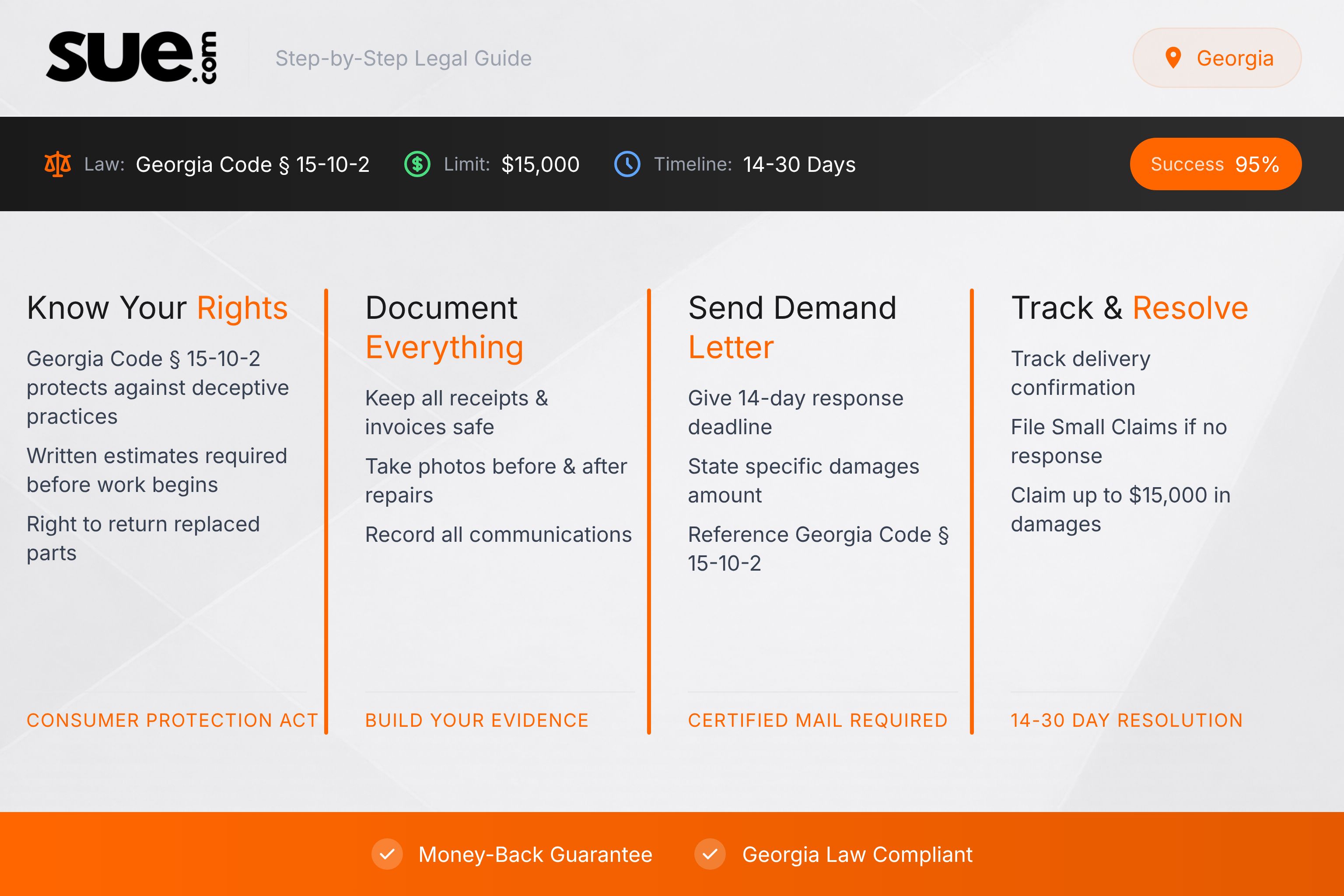
Georgia’s small claims division operates within the Magistrate Court system, providing an accessible forum for civil disputes involving amounts up to $15,000. Pursuant to O.C.G.A. § 15-10-2, Magistrate Courts maintain jurisdiction over civil claims where the amount in controversy does not exceed this statutory threshold. A Small claims court Georgia lawsuit may be initiated without legal representation, as the procedural rules are designed to accommodate self-represented litigants. This comprehensive guide addresses all procedural requirements, evidentiary standards, and statutory frameworks necessary to file and prevail in Georgia Magistrate Court. The information contained herein enables claimants to navigate the judicial process with confidence and legal precision.
Get Started in Your State
We provide state-specific demand letter services across the country. Find your state below to see our tailored guides and packages for your exact dispute.
Georgia Small Claims Court Guide: How to File and Win Your Case
Georgia’s small claims division operates within the Magistrate Court system, providing an accessible forum for civil disputes involving amounts up to $15,000. Pursuant to O.C.G.A. § 15-10-2, Magistrate Courts maintain jurisdiction over civil claims where the amount in controversy does not exceed this statutory threshold. A Small claims court Georgia lawsuit may be initiated without legal representation, as the procedural rules are designed to accommodate self-represented litigants. This comprehensive guide addresses all procedural requirements, evidentiary standards, and statutory frameworks necessary to file and prevail in Georgia Magistrate Court. The information contained herein enables claimants to navigate the judicial process with confidence and legal precision.
Georgia Magistrate Court Overview
Under O.C.G.A. § 15-10-2, the Magistrate Court of Georgia maintains exclusive jurisdiction over civil claims not exceeding $15,000. This court serves as the primary venue for small claims matters throughout the state’s 159 counties. Any individual or business entity that has suffered a legally cognizable harm may initiate proceedings as a claimant.
Defendants in Magistrate Court proceedings may include individuals, corporations, partnerships, and limited liability companies. Pursuant to O.C.G.A. § 15-10-40, claims must be filed in the county where the defendant resides or where the transaction or injury occurred. The court maintains subject matter jurisdiction over contract disputes, property damage claims, personal injury matters, and statutory violations.
Legal representation is permitted but not required in Georgia Magistrate Court. The procedural framework established under O.C.G.A. § 15-10-40 et seq. contemplates self-represented litigants and provides simplified rules of evidence and procedure. Understanding how to sue in Georgia small claims requires familiarity with these procedural accommodations.
Filing fees in Georgia Magistrate Court range from $45 to $75, depending on the county and claim amount. Additional service fees apply for process of service. Appeals from Magistrate Court judgments are heard de novo in Superior Court and must be filed within 30 days of the judgment pursuant to O.C.G.A. § 15-10-41. Failure to timely appeal renders the Magistrate Court judgment final and enforceable.
Georgia Laws That Help You Win
Georgia Fair Business Practices Act (O.C.G.A. § 10-1-390 et seq.) provides comprehensive consumer protection against unfair and deceptive trade practices. This statute applies to consumer transactions involving goods and services. Violations entitle the prevailing party to actual damages, attorney fees, and in cases of intentional violations, treble damages up to $5,000 pursuant to O.C.G.A. § 10-1-399.
Georgia Landlord-Tenant Act (O.C.G.A. § 44-7-30 et seq.) governs residential lease agreements and security deposit disputes. Under O.C.G.A. § 44-7-34, landlords must return security deposits within one month of lease termination. Wrongful retention of security deposits entitles tenants to recover the deposit amount plus damages for bad faith retention.
Georgia Motor Vehicle Warranty Rights Act (O.C.G.A. § 10-1-780 et seq.) establishes remedies for consumers who purchase defective vehicles. This statute, commonly referenced as Georgia’s lemon law, requires manufacturers to repair nonconforming vehicles within a reasonable number of attempts. Failure to cure defects entitles the consumer to replacement or refund pursuant to O.C.G.A. § 10-1-784.
Georgia Contract Law (O.C.G.A. § 13-1-1 et seq.) provides the foundational framework for breach of contract claims. Elements of a valid contract include offer, acceptance, and consideration. Breach entitles the non-breaching party to compensatory damages, including consequential damages that were reasonably foreseeable at the time of contract formation under O.C.G.A. § 13-6-2.
Common Georgia Small Claims Cases
Security Deposit Disputes constitute a significant portion of Magistrate Court filings. Under O.C.G.A. § 44-7-34, landlords bear the burden of proving legitimate deductions from security deposits. Tenants may recover wrongfully withheld deposits plus statutory damages.
Breach of Contract Claims arise when one party fails to perform contractual obligations. Georgia courts enforce written and oral contracts, though the statute of frauds under O.C.G.A. § 13-5-30 requires certain agreements to be in writing.
Property Damage Cases involve recovery for damage to real or personal property. Claimants may recover the cost of repair or fair market value diminution pursuant to O.C.G.A. § 51-12-1.
Unpaid Debts and Loans represent straightforward claims for money owed. Promissory notes and loan agreements are enforceable in Magistrate Court up to the $15,000 jurisdictional limit.
Consumer Protection Violations under the Fair Business Practices Act provide enhanced remedies including potential treble damages. Documentation of deceptive practices strengthens these claims substantially.
Vehicle Disputes encompass lemon law claims, repair disputes, and private sale fraud. The Motor Vehicle Warranty Rights Act provides specific remedies for new vehicle defects.
Service Provider Disputes involve claims against contractors, mechanics, and professional service providers who fail to deliver promised services. Breach of contract and negligence theories apply.
Personal Injury Claims for minor injuries fall within Magistrate Court jurisdiction. Medical expenses, lost wages, and pain and suffering are recoverable damages.
Neighbor Disputes involving property damage, nuisance, or boundary issues are cognizable in Magistrate Court. O.C.G.A. § 51-9-1 governs nuisance claims.
Business-to-Business Disputes between small businesses over unpaid invoices, defective goods, or service failures are properly filed in Magistrate Court when amounts do not exceed $15,000.
The Georgia Small Claims Court Process
Step One: Demand Letter Requirement. Prior to initiating litigation, claimants should transmit a formal demand letter to the opposing party. This correspondence establishes the claim, specifies the amount demanded, and provides opportunity for settlement. Many defendants satisfy claims upon receipt of a properly drafted demand letter, eliminating the need for court proceedings.
Step Two: Filing the Statement of Claim. The claimant must file a Statement of Claim with the Magistrate Court in the appropriate county. Pursuant to O.C.G.A. § 15-10-40, venue lies in the county of defendant’s residence or where the cause of action arose. Filing fees range from $45 to $75 and must be paid at the time of filing.
Step Three: Service of Process. The defendant must receive proper notice of the lawsuit. Under O.C.G.A. § 15-10-43, service may be accomplished by the sheriff, marshal, or certified mail with return receipt requested. Improper service constitutes grounds for dismissal.
Step Four: Evidence Preparation. Claimants must compile all relevant documentation including contracts, receipts, photographs, correspondence, and witness statements. Georgia Magistrate Courts apply relaxed evidentiary rules, but organized presentation of evidence substantially improves outcomes.
Step Five: Court Hearing. Both parties appear before the Magistrate Judge on the scheduled hearing date. The claimant presents the case first, followed by the defendant’s response. The judge may question both parties and examine evidence. Hearings typically last 15 to 30 minutes.
Step Six: Judgment Collection. Upon obtaining a favorable judgment, the claimant becomes a judgment creditor. If the defendant fails to pay voluntarily, enforcement mechanisms include wage garnishment under O.C.G.A. § 18-4-1 and bank account levies. Judgments remain valid for seven years and may be renewed pursuant to O.C.G.A. § 9-12-60.
How Sue.com's Georgia Small Claims Court Package Works
The Georgia Small Claims Court Package, priced at $249, provides comprehensive litigation support for Magistrate Court proceedings. Under Formal demand for payment Georgia protocols, a professionally drafted demand letter is included in every package, establishing the legal foundation for subsequent court action.
The package includes complete filing guidance identifying the correct Magistrate Court for the claim, all required forms with preparation instructions, and a comprehensive evidence checklist tailored to Georgia procedural requirements. A detailed damage calculation worksheet ensures claimants seek all recoverable amounts under applicable statutes.
Sue.com’s Georgia legal tools provide court preparation materials including hearing presentation guidance and objection responses. All documents are drafted by attorneys with knowledge of Georgia Magistrate Court procedures. The demand letter component alone frequently resolves disputes without the necessity of court proceedings, as defendants recognize the seriousness of properly documented claims.
Step 1
Answer a Few Simple Questions
Tell us what happened — who owes you, how much, and why. Our system guides you step-by-step with no legal jargon.
Step 2
We Draft Your Georgia Demand Letter
Your answers are reviewed and used to create an attorney-drafted demand letter tailored to your case.
Step 3
We Mail It for You

Ready to Send Your Georgia Demand Letter?
Need Assistance?
Need help?
Find answers
Got questions about how Sue.com works, what’s included in each package, or what happens after your letter is sent? We’ve got you covered — quick, clear answers to help you move forward with confidence.
1. What is the small claims court limit in Georgia?
The jurisdictional limit for Georgia Magistrate Court is $15,000 pursuant to O.C.G.A. § 15-10-2. Claims exceeding this amount must be filed in State Court or Superior Court. Claimants may waive amounts exceeding $15,000 to remain within Magistrate Court jurisdiction.
2. How much does it cost to file in Georgia Magistrate Court?
Filing fees in Georgia Magistrate Court range from $45 to $75 depending on the county and claim amount. Additional fees for service of process typically range from $25 to $50. These costs may be recovered as part of the judgment if the claimant prevails.
3. Do I need a lawyer for Georgia Magistrate Court?
Legal representation is not required in Georgia Magistrate Court. The procedural rules under O.C.G.A. § 15-10-40 et seq. accommodate self-represented litigants. However, corporations must be represented by an attorney pursuant to Georgia law prohibiting unauthorized practice of law.
4. How long does a Georgia small claims case take?
Georgia Magistrate Court cases typically proceed to hearing within 30 to 60 days of filing. The timeline varies by county docket congestion. Judgment is often rendered immediately following the hearing or within 10 days thereafter.
5. What if the defendant does not show up to court?
Failure of the defendant to appear results in a default judgment in favor of the claimant pursuant to O.C.G.A. § 15-10-43. The claimant must still present sufficient evidence to establish the claim amount. Default judgments are fully enforceable.
6. What if I win but they refuse to pay?
Georgia law provides multiple collection mechanisms for judgment creditors. Wage garnishment under O.C.G.A. § 18-4-1, bank account levies, and property liens are available remedies. Judgments accrue interest at 7% annually and remain enforceable for seven years with renewal options.