
Home » New York » Small Claims Court » Property Damage Dispute
Sue for Property Damage in New York Small Claims Court
When someone damages your property and refuses to pay for repairs, you have a clear path forward through the New York court system. This guide walks you through everything you need to know about filing a Property damage small claims court New York case, from understanding your legal rights to collecting your judgment. New York Small Claims Court allows you to recover up to $10,000 for property damage without hiring an attorney, and the process is more straightforward than most people expect. We will guide you through each step together, so you can feel confident about pursuing the compensation you deserve.
Property Damage Laws That Help You Win in New York
Understanding the legal framework behind your property damage claim helps you see exactly why the law supports your case. New York law recognizes that when someone damages your property through negligence or intentional conduct, they have a legal obligation to make you whole again. This principle has been part of New York common law for generations, and the courts take property damage claims seriously.
- Your court: Small Claims Court (part of the New York City Civil Court in NYC, or District Court and Justice Courts elsewhere in the state)
- Maximum claim: $10,000 ($5,000 in Town and Village Courts)
- Key law: N.Y. C.P.L.R. § 214 establishes a three-year statute of limitations for property damage claims, meaning you have three years from the date of the damage to file your case
- What you must show: The defendant had a duty of care, they breached that duty, their actions caused your property damage, and you suffered actual monetary losses
- Good news: Property damage cases often have clear physical evidence, making them easier to prove than many other types of claims
The beauty of property damage cases is that the evidence often speaks for itself. A dented car fender, a broken fence, or water damage from a neighbor’s neglected plumbing all create visible, documentable proof of what happened. When you can show the court photographs, repair estimates, and receipts, judges can easily connect the dots between what the defendant did and what it cost you. This is why property damage claims have strong success rates in New York Small Claims Court. With your evidence organized and your story clear, you are in a solid position to How to sue for property damage in New York and recover what you are owed.
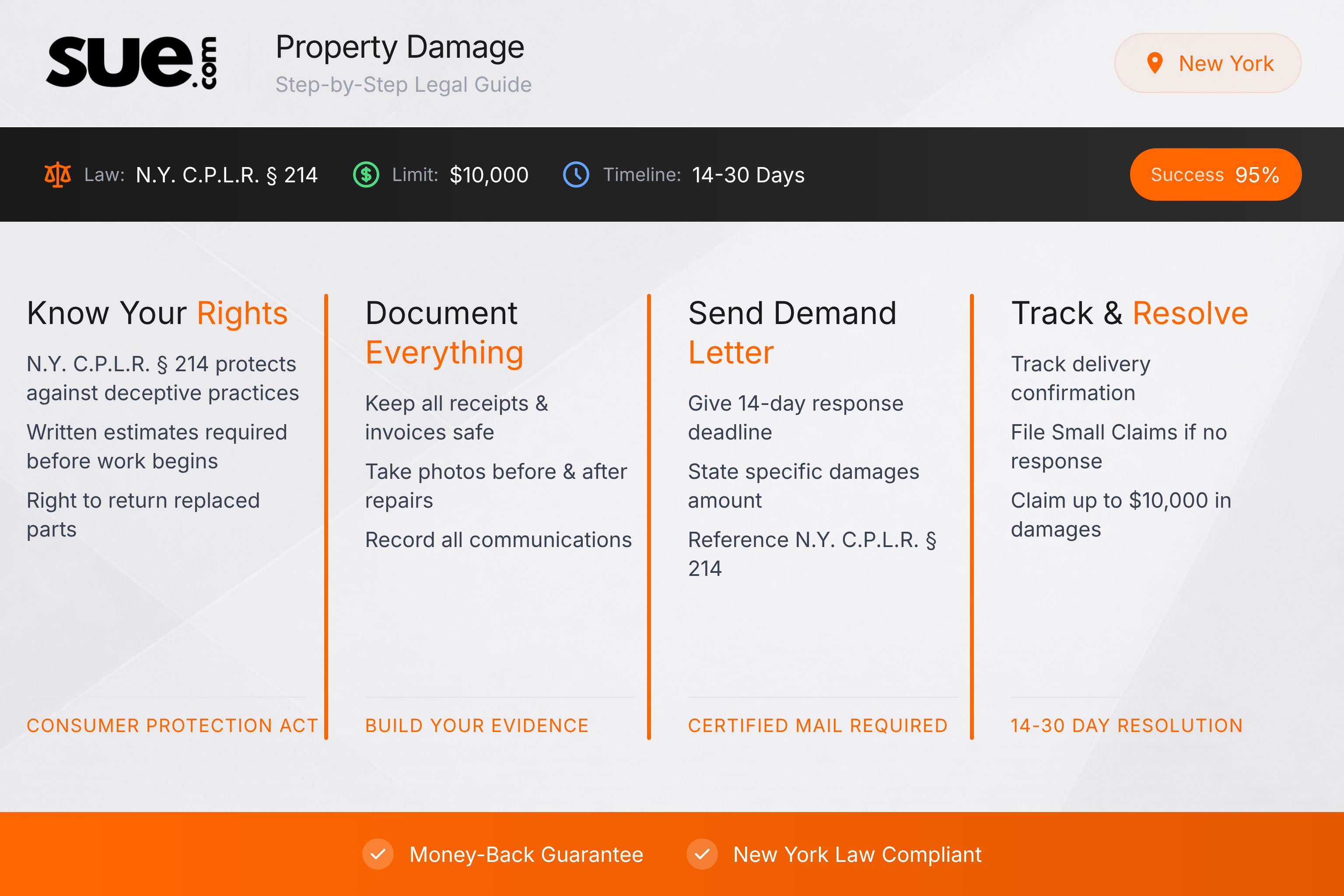
How to File a Property Damage Claim in New York
Filing your claim is simpler than it might seem at first, and we will walk through each step so you know exactly what to expect. The process follows a logical sequence, and once you understand it, you will feel much more confident moving forward.
- First: Get the right forms from your local Small Claims Court clerk’s office. In New York City, this is the Civil Court. Outside the city, you will file in your local District Court, City Court, or Justice Court. The clerk can provide you with the Statement of Claim form.
- Next: Fill in your claim details carefully. You will need the defendant’s full legal name and address, a clear description of how they damaged your property, the date the damage occurred, and the dollar amount you are claiming.
- Then: File your claim and pay the filing fee. In New York, filing fees typically range from $15 to $20 for claims up to $1,000, and $20 to $25 for claims over $1,000. Some courts accept filings through NYSCEF (New York State Courts Electronic Filing).
- After that: The court handles notifying the defendant through a process called service. In most cases, the court will mail the notice, though you may need to arrange for personal service in some situations.
- Finally: Attend your hearing on the scheduled date, present your evidence, and tell your story to the judge.
One important detail to keep in mind involves Legal action for New York contract breach cases that may overlap with property damage. If someone violated a contract and that violation resulted in damage to your property, you may be able to pursue both theories in the same small claims case. The filing process remains the same, but you will want to mention both the contract breach and the resulting property damage in your Statement of Claim. With your paperwork filed, you are ready to focus on building your case.
Building Your Property Damage Case in New York
Gathering the right evidence is where your case really comes together, and this step is more straightforward than you might think. The goal is to create a clear picture for the judge showing what happened, who caused it, and exactly how much it cost you.
Your Evidence Checklist:
- Photographs and videos: Take pictures of the damage from multiple angles, with timestamps if possible. Before and after photos are especially powerful because they show exactly what changed.
- Repair estimates: Get at least two written estimates from licensed contractors or repair professionals. These establish the fair market value of repairs.
- Receipts and invoices: If you already paid for repairs, keep every receipt. These prove your actual out-of-pocket losses.
- Witness statements: If anyone saw the incident happen or can describe the damage, ask them to write a brief statement or be available to testify.
- Communication records: Save all texts, emails, or letters between you and the defendant, especially any messages where they acknowledge responsibility.
Calculating your damages involves adding up everything the defendant’s actions cost you. Here is an example of how this might look:
| What You’re Claiming | Amount |
|---|---|
| Fence repair (contractor estimate) | $2,400 |
| Landscaping restoration | $850 |
| Time off work to meet contractors (4 hours at $35/hour) | $140 |
| Your total claim | $3,390 |
Understanding Legal notice requirements for New York can also strengthen your case. Before filing, consider sending the defendant a written demand letter explaining the damage and requesting payment. This shows the judge you tried to resolve the matter reasonably before going to court. Many defendants settle after receiving a formal demand letter, which could save you the time and effort of a court appearance. When you do go to court, the judge will ask you to explain what happened in your own words. Speak clearly, stick to the facts, and let your evidence do the heavy lifting. With your documentation organized, you are well prepared to present a compelling case.
How Sue.com Walks You Through Your New York Property Damage Case
You do not have to figure this out alone. The Sue.com New York legal filing dashboard provides everything you need to pursue your property damage claim with confidence. For $249, you get a complete toolkit designed specifically for New York Small Claims Court cases.
- A professionally drafted demand letter to send before filing, giving the defendant a chance to pay without court involvement
- A step-by-step filing guide customized for Small Claims Court procedures
- All the forms you need, pre-identified and explained so you know exactly what to fill out
- An evidence checklist tailored specifically to property damage cases
- A damages calculation breakdown to ensure you claim everything you are entitled to
- A hearing preparation guide so you walk into court feeling ready
Starting with a demand letter often resolves cases before they ever reach the courtroom. Our attorneys ghostwrite your Sue for house damage New York demand letter, which adds credibility and shows the defendant you are serious about pursuing your claim. If the demand letter does not produce results, you will have everything you need to move forward with filing. We are here to support you through each phase of the process.
Step 1
Answer a Few Simple Questions
Tell us what happened — who owes you, how much, and why. Our system guides you step-by-step with no legal jargon.
Step 2
We Draft Your New York Demand Letter
Step 3
We Mail It for You

Ready to Send Your New York Demand Letter?
Need Assistance?
Need help?
Find answers
Got questions about how Sue.com works, what’s included in each package, or what happens after your letter is sent? We’ve got you covered — quick, clear answers to help you move forward with confidence.
1. What is the small claims limit for Property Damage in New York?
In most New York courts, you can claim up to $10,000 for property damage in Small Claims Court. Town and Village Courts have a lower limit of $5,000. If your damages exceed these limits, you can still file in small claims for the maximum amount, though you would be waiving the excess.
2. What evidence do I need for a Property Damage case in New York?
The strongest property damage cases include photographs of the damage, written repair estimates from professionals, receipts for any repairs you have already paid for, and any communications with the defendant. Witness statements can also help if someone saw what happened or can describe the condition of your property before and after.
3. How long does a Property Damage case take in New York?
Most New York small claims cases are scheduled for a hearing within 30 to 60 days after filing. The hearing itself typically takes 15 to 30 minutes, and judges often announce their decision the same day or mail it within a few weeks. The entire process from filing to judgment usually takes two to three months.
4. Do I need a lawyer for Property Damage small claims in New York?
No, and in fact, Small Claims Court is specifically designed for people to represent themselves. The procedures are simplified, and judges are accustomed to working with people who do not have legal training. Many successful claimants handle their cases entirely on their own with good preparation and organized evidence.
5. What happens if I win but they don't pay?
If the defendant does not pay voluntarily after you win, New York provides several collection tools. You can file for an income execution to garnish their wages, place a property lien, or request a bank account restraint. The court clerk can provide information about these enforcement options, and persistence usually pays off.