
Home » New York » Demand Letters » Contractor Dispute
New York Contractor Dispute Demand Letter
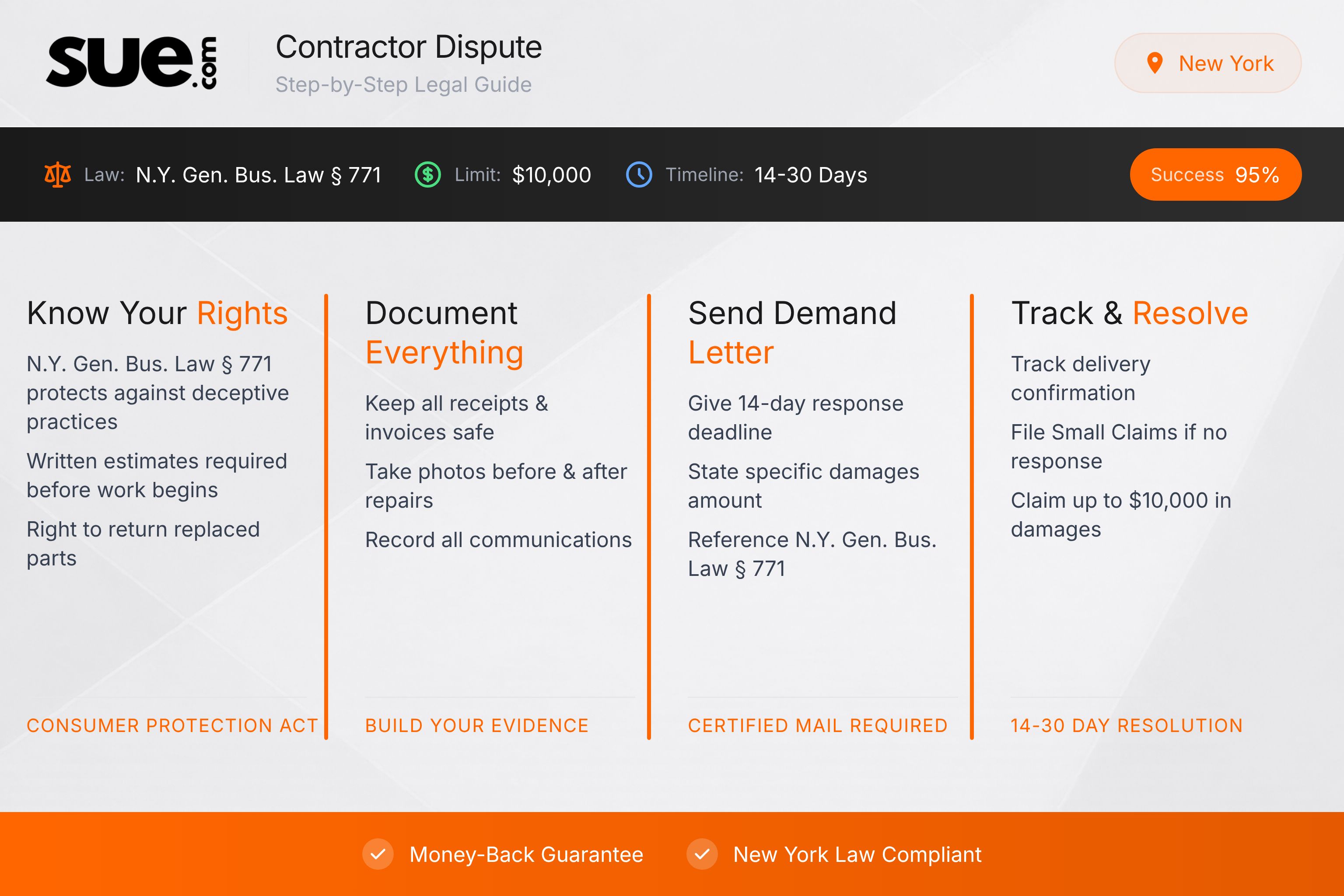
Pursuant to N.Y. Gen. Bus. Law § 771, licensed home improvement contractors in New York are required to perform work in a skillful manner and in accordance with the terms of the written contract. When a contractor fails to complete work, performs defective construction, or abandons a project, the aggrieved party maintains statutory rights to recover damages through formal demand. A New York contractor demand letter constitutes the initial step in asserting these rights and establishing a documented record of the dispute. The demand shall cite applicable New York statutes and specify the remedies sought under state law.
Statutory Framework: Contractor Dispute Under New York Law
Under N.Y. Gen. Bus. Law § 771, home improvement contractors are prohibited from making false or misleading statements, abandoning projects without justification, or deviating substantially from contract specifications without written authorization. This statute forms the foundation of most residential contractor disputes in New York and provides both civil remedies and potential criminal penalties for willful violations.
| Code Section | Requirement | Deadline | Penalty |
|---|---|---|---|
| N.Y. Gen. Bus. Law § 771 | Prohibition on fraudulent practices and abandonment | Upon breach | Civil damages plus potential misdemeanor charges |
| N.Y. Gen. Bus. Law § 770 | Written contract required for work exceeding $500 | Before work begins | Contract voidable at homeowner option |
| N.Y. Gen. Bus. Law § 772 | Contractor registration with county clerk | Prior to solicitation | Unenforceable contract; treble damages available |
| N.Y. Lien Law § 39-a | Trust fund doctrine for construction payments | Upon receipt of funds | Personal liability; potential larceny charges |
The statutory framework establishes that contractors who receive payment but fail to apply those funds toward project completion may be held personally liable under N.Y. Lien Law § 39-a. This provision treats construction funds as trust assets, meaning diversion of payments constitutes a breach of fiduciary duty. Homeowners seeking to dispute a contractor bill in New York should document all payments made and work completed to establish the extent of non-performance.
Additionally, N.Y. Gen. Bus. Law § 772 requires contractors to register with the county clerk in counties where registration is mandated. Failure to register renders the contract voidable at the homeowner’s election and may entitle the claimant to treble damages in certain jurisdictions.
Legal Basis for a Formal Contractor Dispute Demand in New York
The issuance of a formal demand letter serves multiple legal purposes under New York law. First, it establishes a clear record of the claimant’s attempt to resolve the dispute without litigation, which may be considered by the court when awarding attorney fees or costs. Second, it provides the contractor with a final opportunity to cure defects or complete performance before legal action is initiated.
Consider the following: A homeowner in Nassau County contracted for a $15,000 kitchen renovation. The contractor completed demolition and rough plumbing but abandoned the project after receiving $10,000 in progress payments. The homeowner issued a formal demand letter citing N.Y. Gen. Bus. Law § 771 and demanding return of $6,500 representing the difference between payments made and work completed. Within 14 days of receipt, the contractor tendered payment to avoid the statutory penalties and potential criminal liability referenced in the demand.
New York courts have consistently held that pre-suit demands demonstrate good faith and may influence the award of consequential damages. Claimants who wish to Recover New York debt with demand letter should ensure the demand specifies a reasonable response period and clearly articulates the statutory basis for the claim.
Procedural Requirements for a New York Contractor Dispute Demand Letter
The preparation and service of a contractor dispute demand letter in New York shall comply with the following procedural requirements:
1. Documentation Assembly
All contracts, change orders, payment receipts, photographs of defective work, and correspondence with the contractor must be compiled. Under New York law, the written contract governs the scope of work, and any modifications must be documented pursuant to N.Y. Gen. Bus. Law § 770.
2. Statutory Research
The demand must cite the specific New York statutes violated. For residential projects, N.Y. Gen. Bus. Law Article 36-A provides the primary framework. Commercial disputes may fall under N.Y. U.C.C. Article 2 for materials or general contract law principles.
3. Damages Calculation
Recoverable damages include the cost to complete unfinished work, the cost to repair defective work, and any consequential damages such as temporary housing expenses. A detailed accounting shall be prepared.
4. Letter Drafting
The demand letter must be drafted in formal legal language, specifying the factual basis, statutory violations, damages sought, and deadline for response.
Dear [Contractor Name]: Pursuant to N.Y. Gen. Bus. Law § 771, this letter constitutes formal demand for the sum of $8,500. Under New York law, you are obligated to complete contracted work in a skillful manner or return payments for unperformed services within 14 days of this demand. Failure to comply may result in civil litigation and referral to the New York Department of State for license review.
5. Service via Certified Mail
The demand shall be transmitted via certified mail with return receipt requested to establish proof of delivery. Claimants should verify Where to mail a New York demand letter by confirming the contractor’s registered business address with the county clerk or Department of State.
Professional Contractor Dispute Demand Letter Services for New York
For claimants seeking professional assistance with contractor dispute demands, the Sue.com New York legal suite provides attorney-drafted correspondence for $199. This service ensures statutory compliance and maximizes the likelihood of pre-litigation resolution.
- Attorney-drafted correspondence citing applicable New York statutes including N.Y. Gen. Bus. Law § 771 and related provisions
- Certified mail delivery with return receipt establishing proof of service
- Statutory compliance review ensuring all procedural requirements are satisfied
- Escalation path to Small Claims Court for claims up to $10,000
Should the contractor fail to respond to the demand, claimants may sue a contractor in New York small claims without retaining private counsel. The Small Claims Court provides an accessible forum for contractor disputes within the jurisdictional limit. Claims exceeding $10,000 must be filed in Civil Court or Supreme Court depending on the amount in controversy.
Step 1
Answer a Few Simple Questions
Tell us what happened — who owes you, how much, and why. Our system guides you step-by-step with no legal jargon.
Step 2
We Draft Your New York Demand Letter
Step 3
We Mail It for You

Ready to Send Your New York Demand Letter?
Need Assistance?
Need help?
Find answers
Got questions about how Sue.com works, what’s included in each package, or what happens after your letter is sent? We’ve got you covered — quick, clear answers to help you move forward with confidence.
1. Is a formal demand letter a legal prerequisite to filing a Contractor Dispute claim in New York?
New York law does not mandate a pre-suit demand letter for contractor disputes. However, issuance of a formal demand establishes good faith and creates a documented record that may influence the court’s award of costs and damages.
2. Which New York statutes should be cited in a Contractor Dispute demand letter?
The primary statute is N.Y. Gen. Bus. Law § 771, which prohibits fraudulent practices and project abandonment. Additional citations may include N.Y. Gen. Bus. Law § 770 for contract requirements and N.Y. Lien Law § 39-a for trust fund violations.
3. What constitutes a reasonable response period under New York law?
A response period of 14 to 30 days is considered reasonable for contractor dispute demands. The specific timeframe should account for the complexity of the dispute and the remedial action requested.
4. What legal remedies are available if the demand is not honored in New York?
Claimants may file suit in Small Claims Court for amounts up to $10,000, or in Civil Court for larger claims. Remedies include compensatory damages, consequential damages, and in cases involving unregistered contractors, potential treble damages.
5. What is the maximum recoverable amount for Contractor Dispute claims in New York?
The Small Claims Court jurisdictional limit is $10,000. Claims exceeding this amount must be filed in Civil Court (up to $25,000) or Supreme Court (unlimited jurisdiction). Statutory damages under N.Y. Gen. Bus. Law § 772 may provide additional recovery for contracts with unregistered contractors.