
New York Small Claims Court Guide:
How to File and Win Your Case
If you’re dealing with an unpaid debt, a security deposit dispute, or damage to your property, New York’s Small Claims Court offers a straightforward path to justice. You can sue for up to $10,000 without hiring an attorney, and the process is designed to be accessible for everyday people. Whether you’re considering a Small claims court New York lawsuit or just exploring your options, this guide walks you through everything you need to know. We’ll cover the filing process, court procedures, evidence preparation, and how to actually collect your money if you win. By the end, you’ll feel confident about taking your case forward.
Get Started in Your State
We provide state-specific demand letter services across the country. Find your state below to see our tailored guides and packages for your exact dispute.
New York Small Claims Court Guide: How to File and Win Your Case
If you’re dealing with an unpaid debt, a security deposit dispute, or damage to your property, New York’s Small Claims Court offers a straightforward path to justice. You can sue for up to $10,000 without hiring an attorney, and the process is designed to be accessible for everyday people. Whether you’re considering a Small claims court New York lawsuit or just exploring your options, this guide walks you through everything you need to know. We’ll cover the filing process, court procedures, evidence preparation, and how to actually collect your money if you win. By the end, you’ll feel confident about taking your case forward.
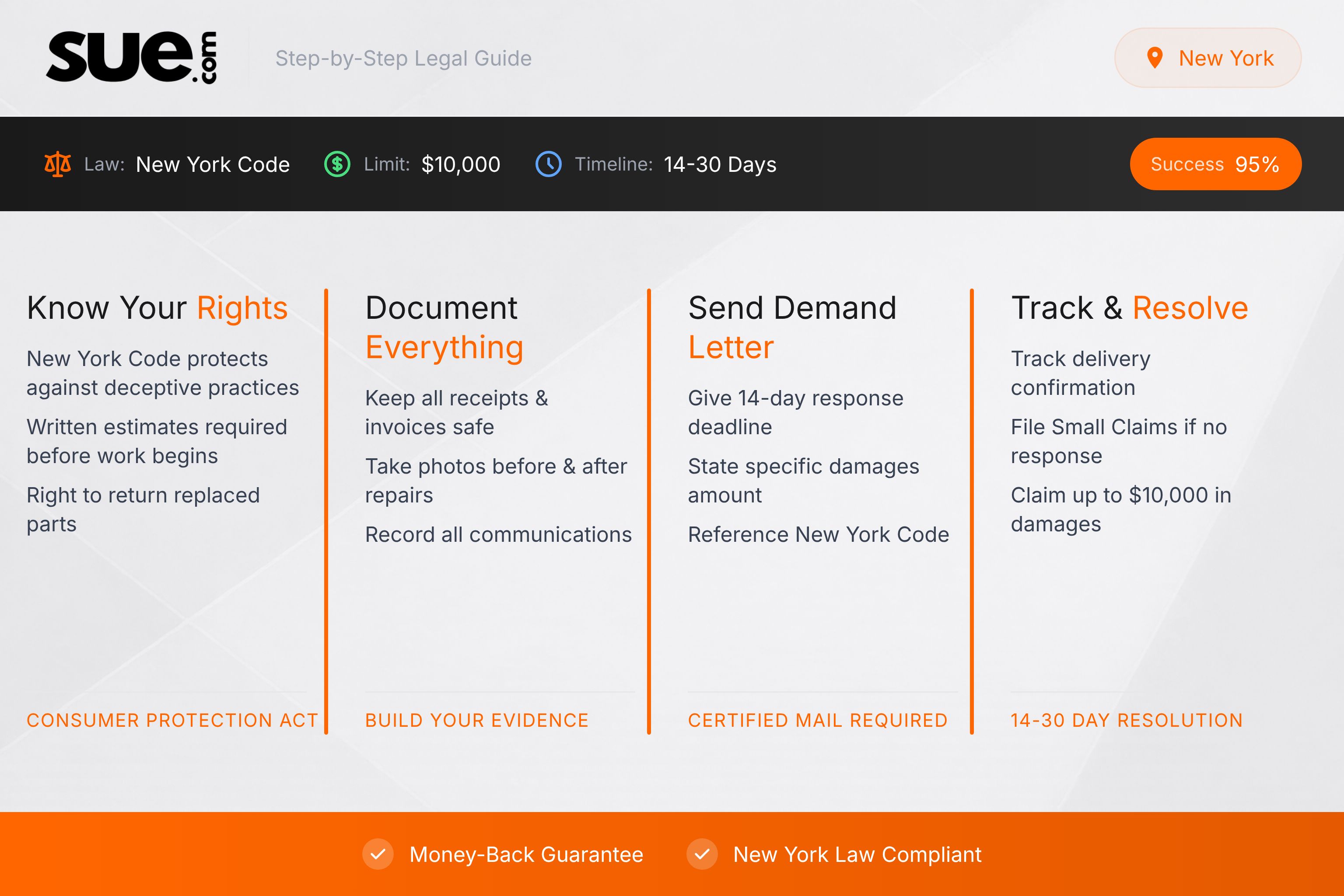
New York Small Claims Court Overview
Here’s what you need to know about how Small Claims Court works in New York. The official name is the Small Claims Part of either the New York City Civil Court (in the five boroughs) or the City, Town, or Village Court in areas outside NYC. You can sue for up to $10,000 in these courts, which covers most everyday disputes.
To file a claim, you must be at least 18 years old and either an individual or a sole proprietor. Corporations, partnerships, and associations must use the Commercial Small Claims Part instead. You can sue individuals, businesses, corporations, or government entities, though special rules apply when suing municipalities.
The types of cases you can bring include breach of contract, property damage, unpaid debts, security deposit disputes, defective products, and personal injury claims. Essentially, if someone owes you money or damaged something of yours, Small Claims Court is likely the right venue.
You’ll file your case in the county where the defendant lives, works, or has a place of business. Alternatively, you can file where the transaction or incident occurred. For How to sue in New York small claims cases, choosing the right location matters because it affects whether the defendant actually shows up.
Unlike regular civil court, attorneys are allowed but not required in New York Small Claims Court. Most people represent themselves successfully. The judge’s decision is final for the plaintiff, meaning you cannot appeal if you lose. However, defendants can appeal within 30 days. This makes preparation especially important, since you get one shot to present your case effectively.
New York Laws That Help You Win
New York has several consumer protection laws that can strengthen your small claims case. Understanding which statutes apply to your situation helps you calculate damages accurately and present a more compelling argument to the judge.
New York General Business Law Section 349 is one of the most powerful consumer protection statutes in the state. It prohibits deceptive acts and practices in consumer transactions. If a business misled you about a product, service, or contract terms, this law applies. The statute allows you to recover your actual damages or $50, whichever is greater, plus reasonable attorney’s fees. For intentional violations, courts can award treble damages (three times your actual loss) up to $1,000.
New York General Obligations Law Section 7-103 specifically addresses security deposits. Landlords must return your deposit within 14 days of lease termination, along with an itemized statement of any deductions. If your landlord fails to comply, you may be entitled to the full deposit amount regardless of any claimed damages. This statute provides clear protection for tenants in deposit disputes.
New York Uniform Commercial Code (UCC) Article 2 governs the sale of goods and provides remedies when products are defective or not as described. Under the UCC, you can recover the difference between the value of what you received and what you were promised. This applies to everything from used cars to electronics to furniture purchases.
New York Real Property Law Section 235-b establishes the warranty of habitability for residential tenants. Landlords must maintain apartments in livable condition, and tenants can sue for rent abatement when conditions fall below legal standards. This law covers issues like lack of heat, water damage, pest infestations, and other habitability problems.
Common New York Small Claims Cases
Small Claims Court handles a wide variety of disputes, and understanding how New York law applies to your specific situation helps you build a stronger case. Here’s an overview of the most common case types we see.
Security deposit disputes are among the most frequent small claims cases in New York. Under General Obligations Law Section 7-103, landlords face strict requirements for returning deposits. If your landlord kept your deposit without proper justification or failed to provide an itemized statement, you have strong legal grounds for recovery.
Breach of contract cases arise when someone fails to fulfill their end of an agreement. Whether it’s a contractor who didn’t complete work, a buyer who didn’t pay, or a service provider who didn’t deliver, New York courts enforce both written and oral contracts.
Property damage claims cover situations where someone damaged your belongings, vehicle, or real property. You can recover the cost of repair or the fair market value of the item, whichever is less.
Unpaid debts and loans represent straightforward cases where someone borrowed money and didn’t repay it. Documentation like promissory notes, text messages, or bank transfers strengthens these claims significantly.
Defective products fall under UCC Article 2, which requires goods to meet reasonable quality standards. If you purchased something that didn’t work as advertised, you can sue for a refund or replacement value.
Auto repair disputes occur when mechanics overcharge, perform unauthorized work, or fail to fix the problem. New York’s consumer protection laws provide remedies for these situations.
Neighbor disputes involving property damage, noise complaints, or boundary issues can be resolved through small claims when monetary damages are involved.
Professional service disputes cover situations where contractors, cleaners, movers, or other service providers failed to deliver acceptable work.
Consumer fraud cases involving deceptive business practices fall under General Business Law Section 349, which provides enhanced damages for proven violations.
Personal injury claims for minor injuries can be brought in small claims court, though more serious injuries typically require regular civil court due to higher damage amounts.
The New York Small Claims Court Process
The small claims process in New York follows a predictable path, and understanding each step helps you feel prepared. We’ll walk through this together so you know exactly what to expect.
Step 1: Send a demand letter first. Before filing your case, sending a formal demand letter serves several important purposes. It puts the defendant on notice, creates documentation of your attempt to resolve the dispute, and sometimes leads to settlement without court involvement. Many judges look favorably on plaintiffs who tried to resolve matters before filing. Your demand letter should clearly state the amount owed, the basis for your claim, and a deadline for payment.
Step 2: File your petition. Once the deadline passes without resolution, you’re ready to file. Visit the clerk’s office at the appropriate court and complete the small claims petition form. You’ll need the defendant’s full legal name and address, a brief description of your claim, and the amount you’re seeking. Filing fees range from $15 to $20 for claims up to $1,000, and $20 to $25 for claims over $1,000. The clerk will assign a hearing date, typically 30 to 60 days out.
Step 3: Serve the defendant. The court handles service by certified mail in most cases, which simplifies this step considerably. If mail service fails, you may need to arrange personal service through a process server. The defendant must receive notice at least 5 days before the hearing date for in-person service, or 8 days for mail service.
Step 4: Prepare your evidence. This step is where cases are won or lost. Gather all relevant documents including contracts, receipts, photographs, text messages, emails, and any written communications. Organize everything chronologically and make copies for the court and defendant. If witnesses can support your case, arrange for them to attend or obtain written statements.
Step 5: Attend your hearing. Arrive early, dress appropriately, and bring all your evidence. When your case is called, you’ll present your side first. Speak directly to the judge, stick to the facts, and reference your evidence. The defendant then responds, and you may have a chance for rebuttal. Hearings typically last 15 to 30 minutes.
Step 6: Collect your judgment. If you win, the defendant has 30 days to pay or appeal. If they don’t pay voluntarily, New York provides several collection tools. You can garnish wages, place liens on property, or levy bank accounts through the court’s enforcement procedures. Judgments remain valid for 20 years in New York, giving you time to collect.
How Sue.com's New York Small Claims Court Package Works
Taking someone to small claims court doesn’t have to feel overwhelming, and that’s exactly why we created our comprehensive New York Small Claims Court Package. For $249, you get everything you need to file confidently and maximize your chances of winning.
Your package starts with a professionally written demand letter, because under Formal demand for payment New York requirements, this first step often resolves disputes before you ever set foot in court. Our attorneys ghostwrite your letter to ensure it’s legally sound and persuasive.
Beyond the demand letter, you receive a complete filing guide customized for your specific court location, a list of all required forms, an evidence checklist tailored to your case type, and a damage calculation worksheet to ensure you’re claiming the full amount you’re entitled to. We also include a court preparation guide that walks you through what to say, what to bring, and how to present your evidence effectively.
With Sue.com’s New York legal tools, you’re never navigating this process alone. Our materials are designed by attorneys who understand New York small claims procedures inside and out. You get professional guidance at a fraction of what hiring a lawyer would cost, and you keep everything you win.
Step 1
Answer a Few Simple Questions
Tell us what happened — who owes you, how much, and why. Our system guides you step-by-step with no legal jargon.
Step 2
We Draft Your New York Demand Letter
Your answers are reviewed and used to create an attorney-drafted demand letter tailored to your case.
Step 3
We Mail It for You

Ready to Send Your New York Demand Letter?
Need Assistance?
Need help?
Find answers
Got questions about how Sue.com works, what’s included in each package, or what happens after your letter is sent? We’ve got you covered — quick, clear answers to help you move forward with confidence.
1. What is the small claims court limit in New York?
The maximum amount you can sue for in New York Small Claims Court is $10,000. If your claim exceeds this limit, you can either reduce your claim to $10,000 and waive the excess, or file in regular civil court where there’s no cap but procedures are more complex.
2. How much does it cost to file in New York Small Claims Court?
Filing fees are quite affordable. For claims up to $1,000, expect to pay between $15 and $20. For claims over $1,000 up to $10,000, fees range from $20 to $25. These fees vary slightly by court location and are paid when you file your petition.
3. Do I need a lawyer for New York Small Claims Court?
No, you don’t need a lawyer, and most people successfully represent themselves. Small Claims Court is specifically designed to be accessible without legal representation. Judges are accustomed to working with self-represented litigants and will help guide the hearing process.
4. How long does a New York small claims case take?
From filing to hearing, most cases take between 30 and 60 days. The judge typically announces a decision immediately after the hearing or mails it within a few days. Collection time varies depending on whether the defendant pays voluntarily.
5. What if the defendant doesn't show up to court?
If the defendant fails to appear, you can request a default judgment. You’ll still need to present basic evidence of your claim, but without opposition, judges typically rule in your favor. The defendant can sometimes ask the court to vacate a default judgment if they had a valid reason for missing the hearing.
6. What if I win but they refuse to pay?
New York provides several enforcement tools for collecting judgments. You can garnish the defendant’s wages, place a lien on their property, or levy their bank accounts. The court clerk can provide information about these procedures, and judgments remain enforceable for 20 years, giving you plenty of time to collect.