
Home » California » Small Claims Court » Auto Repair Dispute
Sue for Auto Repair in California Small Claims Court
When a mechanic overcharges you, performs unauthorized work, or damages your vehicle, you have every right to seek compensation through the court system. This guide walks you through the process of filing an official California auto repair lawsuit in the Superior Court Small Claims Division, where you can recover up to $12,500 without needing an attorney. California has some of the strongest consumer protection laws in the country when it comes to auto repair, and we’ll help you understand exactly how to use them. Together, we’ll cover the specific statutes that protect you, how to file your claim, what evidence you need, and how to prepare for your day in court.
Auto Repair Laws That Help You Win in California
California provides robust legal protections for vehicle owners, and understanding these laws is the foundation of building a winning case. The good news is that the law is designed to protect consumers like you, and mechanics who violate these rules face serious consequences.
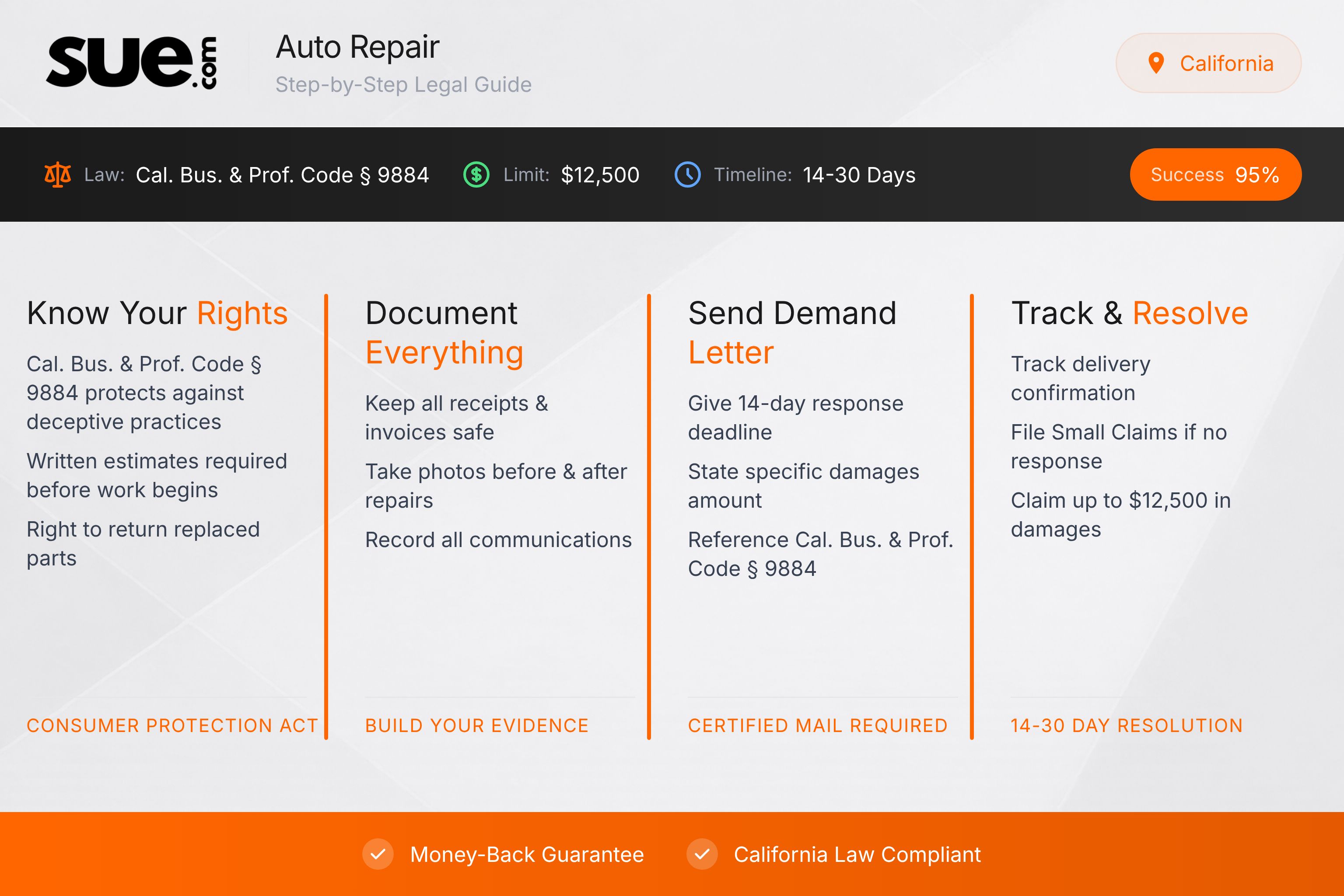
The primary statute you’ll rely on is Cal. Bus. & Prof. Code § 9884, which is part of California’s Automotive Repair Act. This law requires repair shops to provide a written estimate before performing any work, obtain your authorization before exceeding that estimate, and return replaced parts to you upon request. When a shop violates these requirements, you have grounds for a claim.
Here’s what you’ll need to prove in court:
- The repair shop performed work without your authorization
- The shop charged more than the written estimate without approval
- The repairs were performed negligently or incompetently
- The shop misrepresented the need for certain repairs
When filing an auto repair claim in California, judges look for clear documentation showing the shop violated its legal obligations. The Bureau of Automotive Repair (BAR) regulates licensed shops, and any violations of BAR regulations strengthen your case significantly. With this foundation in place, you’re ready to understand the filing process itself.
How to File an Auto Repair Claim in California
Filing your claim in the Superior Court Small Claims Division is more straightforward than you might expect. We’ll walk you through each step so you know exactly what to do and why.
First, you’ll need to determine where to file. In California, you generally file in the county where the repair shop is located, where the repairs were performed, or where you signed the repair contract. Most people file where the shop is located since that’s typically the same place the work was done.
The main form you’ll complete is called SC-100, which is the Plaintiff’s Claim and ORDER to Go to Small Claims Court. This form asks for basic information: your name and address, the repair shop’s name and address, the amount you’re claiming, and a brief description of what happened. Don’t worry about using legal language. Judges appreciate clear, straightforward explanations.
Filing fees in California range from $30 to $75 depending on your claim amount. If you’re suing for $1,500 or less, the fee is $30. For claims between $1,500 and $5,000, it’s $50. Claims over $5,000 cost $75 to file. These fees are recoverable if you win your case.
Unfortunately, e-filing is not available for small claims in California, so you’ll need to file in person or by mail at your local courthouse. Once your paperwork is submitted, the court will assign a hearing date, usually within 30 to 70 days. You’ll then need to File California court summons to officially notify the repair shop of the lawsuit. With your claim filed, the next step is gathering your evidence.
Building Your Auto Repair Case in California
This is where your case comes together, and taking time to organize your evidence makes all the difference on hearing day. Judges in small claims court appreciate well-prepared plaintiffs who present their facts clearly and chronologically.
Start by gathering every document related to your repair experience. This includes the original written estimate, the final invoice, any work orders or authorization forms, and all receipts. If the shop didn’t provide a written estimate, that’s actually helpful to your case since it’s a direct violation of Cal. Bus. & Prof. Code § 9884.
Photographs are powerful evidence in auto repair disputes. Take pictures of:
- The damage or faulty repairs
- Your vehicle’s current condition
- Any parts that were replaced unnecessarily
- The odometer reading before and after repairs
When calculating your damages, include the full amount you paid for unauthorized or defective repairs, the cost of corrective repairs at another shop, rental car expenses if applicable, and any towing costs. Keep all receipts and create a clear itemized list showing exactly how you arrived at your total.
Understanding Service of process rules for California is essential because improper service can delay your case. The repair shop must receive official notice of your lawsuit at least 15 days before the hearing (or 20 days if served outside your county). You cannot serve the papers yourself. Instead, use a friend over 18, a professional process server, or certified mail with return receipt requested. Once that’s done, you’re ready to prepare for your court appearance.
How Sue.com Helps You Win Auto Repair Cases in California
We understand that navigating the legal system can feel overwhelming, even in small claims court. That’s exactly why we created a comprehensive solution to guide you through every step of your auto repair dispute.
For $249, our Small Claims Court package includes everything you need to pursue your case with confidence. We start with a professionally written demand letter, which often resolves disputes before you ever set foot in a courtroom. Many repair shops prefer to settle once they receive a formal demand that demonstrates you understand your legal rights.
Your package also includes a complete filing guide customized for California Superior Court Small Claims Division, all necessary court forms with instructions, a detailed evidence checklist so you don’t miss anything important, a damage calculation worksheet to ensure you’re claiming everything you’re entitled to, and thorough court preparation materials.
Using Sue.com California court document tools, you’ll have access to everything organized in one place. Our attorneys ghostwrite your demand letter, ensuring it cites the relevant statutes and clearly articulates your legal position. To get started, you can request an official California mechanic demand letter that puts the repair shop on notice and demonstrates you mean business. With these resources in hand, you’ll walk into court prepared and confident.
Step 1
Answer a Few Simple Questions
Tell us what happened — who owes you, how much, and why. Our system guides you step-by-step with no legal jargon.
Step 2
We Draft Your California Demand Letter
Step 3
We Mail It for You

Ready to Send Your California Demand Letter?
Need Assistance?
Need help?
Find answers
Got questions about how Sue.com works, what’s included in each package, or what happens after your letter is sent? We’ve got you covered — quick, clear answers to help you move forward with confidence.
1. What is the small claims limit for auto repair in California?
In California, you can sue for up to $12,500 in small claims court. If your damages exceed this amount, you can either waive the excess and sue for $12,500, or file in a higher court where attorney representation is typically needed.
2. What evidence do I need for an auto repair case in California?
The most important evidence includes your written estimate, final invoice, photographs of the faulty work, and any second opinions from other mechanics. Text messages or emails with the shop also help establish what was discussed and agreed upon.
3. How long does an auto repair case take in California?
From filing to hearing, most cases take 30 to 70 days. The hearing itself typically lasts 15 to 30 minutes. If you win, the defendant has 30 days to pay before you can begin collection efforts.
4. Do I need a lawyer for auto repair small claims in California?
No, and in fact, attorneys generally cannot represent parties in California small claims court. The system is designed for regular people to present their own cases, and judges are accustomed to working with self-represented plaintiffs.
5. What happens if I win but they don't pay?
If the repair shop doesn’t pay within 30 days, California provides several collection tools. You can place a lien on their business property, garnish their bank accounts, or levy their business assets through the sheriff’s office. The court clerk can provide instructions for these collection methods.