
Home » California » Demand Letters » Auto Repair Dispute
California Auto Repair Demand Letter
When you’ve been overcharged, received shoddy workmanship, or had unauthorized repairs performed on your vehicle, a formal demand letter is often the most effective first step toward resolution. An auto shop demand letter California puts the repair shop on notice that you understand your rights and intend to pursue them. California has some of the strongest auto repair consumer protection laws in the country, particularly under the Automotive Repair Act (Cal. Bus. & Prof. Code § 9884), which requires written estimates, customer authorization, and proper invoicing. This guide will walk you through California’s specific protections, explain why a demand letter creates real leverage, and show you exactly how to craft one that gets results.
Auto Repair Laws in California
California’s Bureau of Automotive Repair (BAR) enforces robust consumer protections that give you significant leverage when disputing repair charges. Here’s why understanding these laws matters: when you cite specific statutes in your demand letter, repair shops recognize that you know your rights, and that makes them far more likely to negotiate.
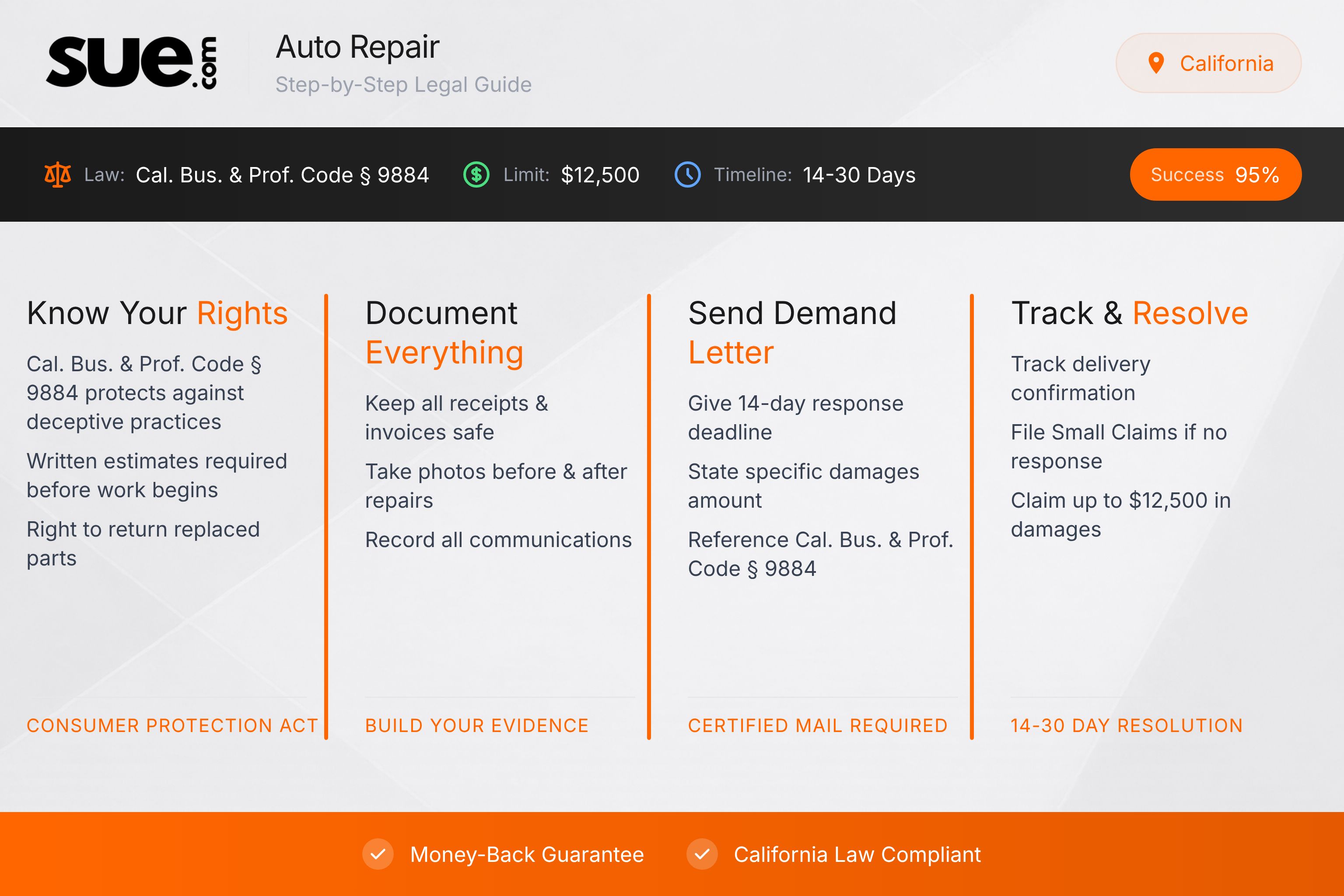
The cornerstone of California auto repair law is Cal. Bus. & Prof. Code § 9884.9, which requires repair shops to provide a written estimate before performing any work. If the shop didn’t give you a written estimate, or if they exceeded that estimate without your authorization, they’ve violated California law. Under this statute, shops cannot charge more than the estimate plus 10% without obtaining your explicit approval first.
California law also requires shops to return your old parts upon request under Cal. Bus. & Prof. Code § 9884.8. This protection exists so you can verify that repairs were actually performed. If a shop claims they replaced your brake pads but can’t produce the old ones, that’s a red flag, and potentially a violation you can cite.
The Automotive Repair Act also mandates that all repair invoices itemize parts and labor separately, list the odometer reading, and include the shop’s registration number. Missing any of these elements? That’s another violation that strengthens your position.
When shops violate these provisions, consumers can dispute an auto repair bill in California and seek full refunds, corrective repairs, or damages. The BAR can also take administrative action against the shop’s license, which gives your demand letter additional weight. Shops know that unresolved complaints can trigger BAR investigations, so they’re often motivated to settle privately.
Why Send an Auto Repair Demand Letter in California?
Before heading to court, a well-crafted demand letter accomplishes several important goals. Let’s walk through why this step is so valuable.
First, California judges in the Superior Court Small Claims Division expect parties to attempt resolution before filing suit. When you arrive in court with a copy of your demand letter and the certified mail receipt, you demonstrate that you acted reasonably and gave the shop a fair opportunity to make things right. Judges notice this, and it reflects well on your credibility.
Second, your demand letter creates an official paper trail. The letter documents your version of events, the specific violations you’ve identified, and the amount you’re claiming. If the shop later tries to change their story, you have written proof of what happened and when you notified them.
Third, most auto repair disputes actually resolve at the demand letter stage. Repair shops understand that fighting a small claims case costs them time, money, and potentially their reputation. When they receive a professional letter citing Cal. Bus. & Prof. Code § 9884 and requesting a specific dollar amount, settling often makes more business sense than litigating.
You can also Recover California tutoring fees via demand using similar principles. The approach works across many dispute types because the underlying logic is the same: a formal letter shows you’re serious, informed, and prepared to escalate.
Finally, California’s consumer protection framework means that citing the right statutes creates real pressure. Shops registered with the BAR risk license suspension for repeated violations. Your demand letter reminds them of those stakes.
How to Write an Auto Repair Demand Letter in California
Writing an effective demand letter doesn’t require a law degree, but it does require attention to detail. Here’s a step-by-step approach that covers everything you need.
Step 1: Gather your documentation. Before writing anything, collect all paperwork related to the repair: the original estimate, the final invoice, any authorization forms you signed (or didn’t sign), photographs of the work performed, and receipts for any corrective repairs you paid for elsewhere. This documentation forms the foundation of your claim.
Step 2: Research the specific violations. Review your paperwork against California’s requirements. Did the shop provide a written estimate? Did they exceed it without authorization? Did they return your old parts? Each violation you identify becomes a point you’ll cite in your letter. The more specific you are, the stronger your position.
Step 3: Calculate your damages precisely. Add up exactly what you’re owed: the overcharge amount, the cost of corrective repairs, towing fees, rental car expenses, and any other out-of-pocket costs directly caused by the shop’s conduct. California small claims courts can award up to $12,500, so ensure your total falls within that limit if you want to avoid regular civil court.
Step 4: Draft your letter with specific statute citations. Your letter should state the facts clearly, identify each California law the shop violated, specify the exact dollar amount you’re demanding, and set a response deadline (typically 15 to 30 days). A Demand letter for California lease disputes follows similar principles, and you can adapt the structure for any category.
Step 5: Send via certified mail with return receipt requested. This creates proof that the shop received your letter and when they received it. Keep copies of everything, including the green return receipt card when it comes back.
How Sue.com Helps with California Auto Repair Demand Letters
We understand that writing a demand letter can feel overwhelming, especially when you’re already frustrated by a bad repair experience. That’s where we come in.
For $199, the Sue.com California filing center connects you with attorneys who draft professional demand letters on your behalf. These aren’t templates: they’re customized letters written specifically for your situation, citing the exact California statutes that apply to your case, including Cal. Bus. & Prof. Code § 9884 and related provisions.
Your letter is then mailed via certified mail with return receipt, so you have documented proof of delivery. Most repair shops respond within the deadline when they receive a professionally written letter that demonstrates legal knowledge and preparation.
If the shop doesn’t respond or refuses to pay, you’re already positioned for the next step. Our California car repair filing service can help you escalate to the Superior Court Small Claims Division, where you can pursue claims up to $12,500. With your demand letter already sent, you’ll have the documentation judges expect to see.
Step 1
Answer a Few Simple Questions
Tell us what happened — who owes you, how much, and why. Our system guides you step-by-step with no legal jargon.
Step 2
We Draft Your California Demand Letter
Step 3
We Mail It for You

Ready to Send Your California Demand Letter?
Need Assistance?
Need help?
Find answers
Got questions about how Sue.com works, what’s included in each package, or what happens after your letter is sent? We’ve got you covered — quick, clear answers to help you move forward with confidence.
1. Is a demand letter required before suing for auto repair in California?
California doesn’t legally require a demand letter before filing in small claims court, but judges strongly favor plaintiffs who attempted resolution first. Sending a demand letter demonstrates good faith and often leads to settlement without the time and expense of court.
2. What California laws should I cite in my auto repair demand letter?
The most important statutes are Cal. Bus. & Prof. Code § 9884.9 (written estimate requirements), § 9884.8 (return of old parts), and § 9884 (general repair shop regulations). Citing these specific code sections shows the shop you understand your rights under the Automotive Repair Act.
3. How long should I give them to respond?
A response deadline of 15 to 30 days is standard and considered reasonable under California practice. This gives the shop adequate time to investigate your claim and respond, while also demonstrating that you expect timely action.
4. What if they ignore my auto repair demand letter?
If the shop doesn’t respond by your deadline, you can file a claim in the California Superior Court Small Claims Division. Filing fees range from approximately $30 to $75 depending on your claim amount, and you can file in person or by mail since e-filing is not available for small claims.
5. How much can I claim for auto repair in California?
In California small claims court, individuals can claim up to $12,500 per case. Your damages can include the overcharge amount, cost of corrective repairs, towing and rental expenses, and other direct costs caused by the shop’s violations.