
Home » California » Demand Letters » Security Deposit Dispute
California Security Deposit Demand Letter
Your landlord has your money. You want it back. A demand for security deposit return California is your first power move. California law is on your side. Cal. Civ. Code § 1950.5 gives landlords just 21 days to return your deposit or provide an itemized statement. Miss that deadline? They owe you. This guide shows you exactly how to demand what’s yours under California law.
Security Deposit Laws in California
California has some of the strongest tenant protections in the country. Know them. Use them.
The 21-Day Rule
Cal. Civ. Code § 1950.5 is your weapon. Landlords must return your deposit within 21 days of move-out. No exceptions. No excuses. They must also provide an itemized statement of any deductions. No statement? Those deductions are invalid.
Deposit Limits
California caps security deposits. Unfurnished units: two months’ rent maximum. Furnished units: three months’ rent. Your landlord cannot collect more. Period.
Bad Faith Penalties
Here’s where it gets good. If your landlord wrongfully withholds your deposit in bad faith, you can recover up to twice the deposit amount in statutory damages. That’s on top of your actual deposit. Cal. Civ. Code § 1950.5(l) makes this clear.
What Landlords Can Deduct
Only four things:
- Unpaid rent
- Cleaning (only to restore original condition)
- Repair of damages beyond normal wear and tear
- Restoration if lease allows and you didn’t
Documentation Requirements
Landlords must provide receipts for any repair over $126. No receipt? Challenge that deduction. You can write a deposit demand letter California citing these exact requirements. Make them prove every dollar they kept.
Don’t let your landlord hide behind vague “cleaning fees.” Demand specifics.
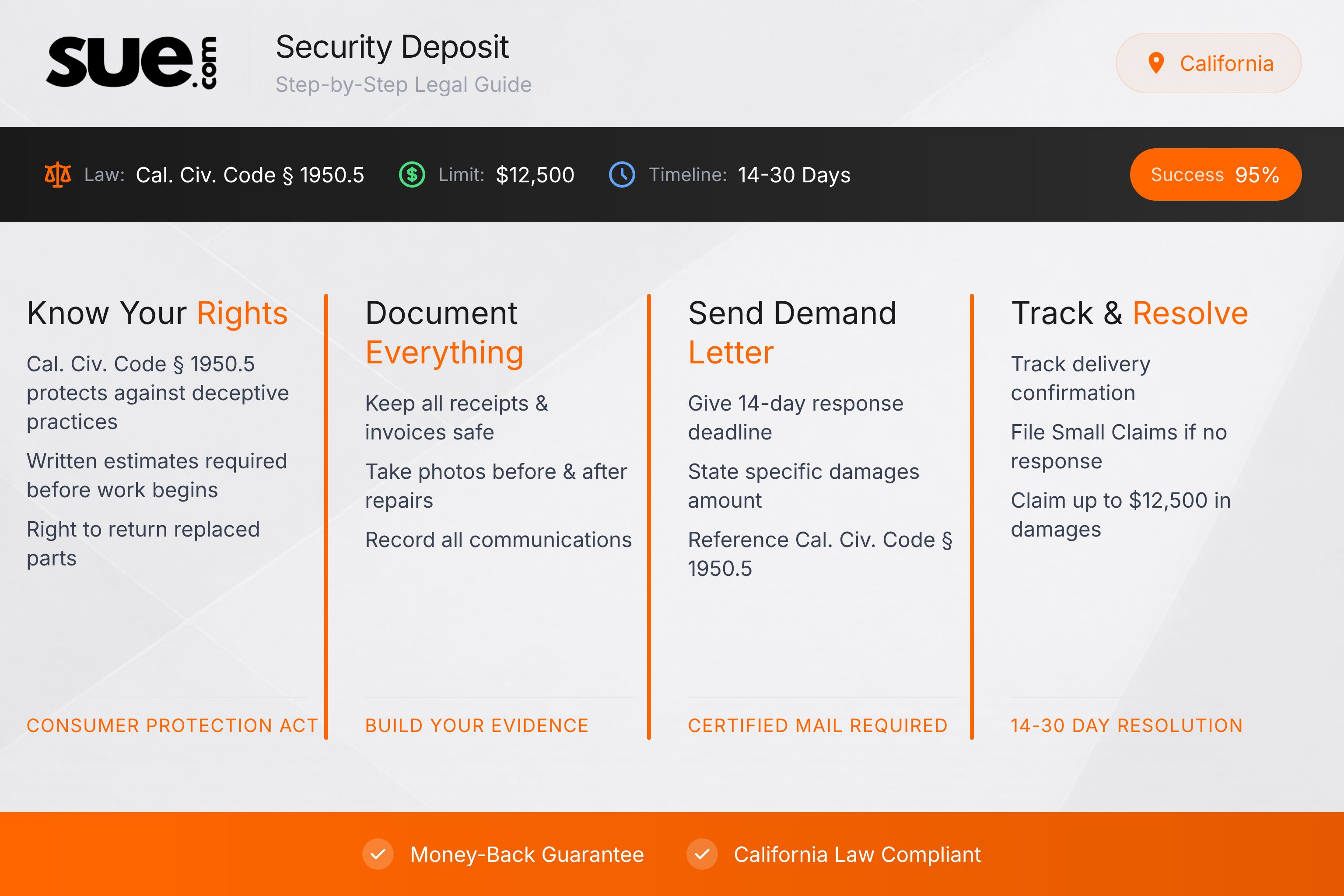
Why Send a Security Deposit Demand Letter in California?
A demand letter isn’t optional. It’s strategic.
California Courts Expect It
Judges in California Superior Court Small Claims Division want to see you tried to resolve this first. Walk in without a demand letter? You look unprepared. Walk in with certified mail receipts and a professional letter? You look serious.
Create Your Paper Trail
Your demand letter becomes evidence. It proves:
- You made a formal request
- You gave a reasonable deadline
- You cited specific California statutes
- They ignored you anyway
Most Disputes Settle
Here’s the truth. Most landlords fold when they receive a professional demand letter citing Cal. Civ. Code § 1950.5. They know the law. They know the penalties. They’d rather return your $2,000 deposit than face a $4,000 judgment plus court costs.
Leverage Through Specificity
Generic letters get ignored. Letters citing exact statute sections, specific deadlines, and precise penalty amounts get attention. Your landlord’s attorney will tell them to settle.
Send the letter. Create the pressure. Get your money.
How to Write a Security Deposit Demand Letter in California
Five steps. Follow them exactly.
Step 1: Gather Your Documentation
Pull everything together:
- Your lease agreement
- Move-in and move-out inspection reports
- Photos from move-in and move-out
- Any communication with your landlord
- The itemized statement (if they sent one)
- Receipts for cleaning you did
- Full deposit amount
- Interest (if your city requires it)
- Bad faith damages (up to 2x deposit)
- Security deposit: $3,000
- Bad faith penalty (2x): $6,000
- Total demand: $9,000
- Your name and forwarding address
- Property address and lease dates
- Deposit amount paid
- Move-out date
- Demand amount with calculation
- Citation to Cal. Civ. Code § 1950.5
- Response deadline (14-30 days)
- Statement that you’ll file in court if ignored
No move-in photos? Your landlord’s deductions become harder to justify. How to demand punitive damages in California cases often hinge on documentation quality.
Step 2: Research Your Specific Situation
Calculate exactly what they owe:
San Francisco, Los Angeles, and other cities have additional requirements. Check local ordinances.
Step 3: Calculate Your Total Claim
Be precise. Example:
California small claims limit is $12,500. Most deposit disputes fit easily.
Step 4: Draft Your Letter
Include these elements:
Certified mail with return receipt requested. This proves delivery. Keep copies of everything.
Your deadline is firm. Their excuses are not.
How Sue.com Helps with California Security Deposit Demand Letters
You have two choices. Write it yourself and hope you got the legal citations right. Or let professionals handle it.
For $199, Sue.com California filing platform delivers:
Attorney-Drafted Letters
Real California attorneys write your demand letter. They cite Cal. Civ. Code § 1950.5 correctly. They include the bad faith penalty language. They know what makes landlords pay attention.
Certified Mail Service
We handle printing, mailing, and tracking. You get proof of delivery without trips to the post office.
Escalation Path
Landlord ignores your letter? We help you take the next step. Our authorized California deposit lawsuit help guides you through filing in Superior Court Small Claims Division.
No Lawyer Meetings
Attorneys ghostwrite your letter. No consultations. No hourly billing. One flat fee. Done.
Your deposit is waiting. Go get it.
Step 1
Answer a Few Simple Questions
Tell us what happened — who owes you, how much, and why. Our system guides you step-by-step with no legal jargon.
Step 2
We Draft Your California Demand Letter
Step 3
We Mail It for You

Ready to Send Your California Demand Letter?
Need Assistance?
Need help?
Find answers
Got questions about how Sue.com works, what’s included in each package, or what happens after your letter is sent? We’ve got you covered — quick, clear answers to help you move forward with confidence.
1. Is a demand letter required before suing for security deposit in California?
Not legally required. But practically essential. California judges expect good faith resolution attempts. A demand letter shows you tried. It also often gets you paid without ever filing.
2. What California laws should I cite in my security deposit demand letter?
Cal. Civ. Code § 1950.5 is your primary statute. Cite subsection (g) for the 21-day return requirement. Cite subsection (l) for bad faith penalties up to twice the deposit. Include your city’s local ordinances if applicable.
3. How long should I give them to respond?
Give 14 to 30 days. California law doesn’t specify a response deadline for demand letters. But 14 days is reasonable and shows urgency. Courts view this timeframe favorably.
4. What if they ignore my security deposit demand letter?
File in California Superior Court Small Claims Division. The limit is $12,500. Filing fees are minimal. No attorney needed. Bring your demand letter as evidence of your good faith attempt.
5. How much can I claim for security deposit in California?
Your actual deposit plus up to twice the deposit amount in bad faith penalties under Cal. Civ. Code § 1950.5(l). If your landlord acted in bad faith, a $2,500 deposit becomes a $7,500 claim. Stay under the $12,500 small claims limit.