
Home » California » Small Claims Court
California Small Claims Court Guide:
How to File and Win Your Case
The California Superior Court Small Claims Division provides a streamlined judicial forum for resolving civil disputes involving claims up to $12,500 for individuals and $6,250 for corporations and limited liability companies, as established under California Code of Civil Procedure § 116.221. This court operates without attorneys, requiring parties to represent themselves and present evidence directly to a judicial officer. Those seeking to Recover California parking fees in court will find this division particularly accessible for consumer disputes, contract breaches, property damage claims, and security deposit recovery matters. This comprehensive guide details the procedural requirements, applicable statutes, evidentiary standards, and enforcement mechanisms necessary to successfully pursue and collect a small claims judgment in California.
Get Started in Your State
We provide state-specific demand letter services across the country. Find your state below to see our tailored guides and packages for your exact dispute.
California Small Claims Court Guide: How to File and Win Your Case
The California Superior Court Small Claims Division provides a streamlined judicial forum for resolving civil disputes involving claims up to $12,500 for individuals and $6,250 for corporations and limited liability companies, as established under California Code of Civil Procedure § 116.221. This court operates without attorneys, requiring parties to represent themselves and present evidence directly to a judicial officer. Those seeking to Recover California parking fees in court will find this division particularly accessible for consumer disputes, contract breaches, property damage claims, and security deposit recovery matters. This comprehensive guide details the procedural requirements, applicable statutes, evidentiary standards, and enforcement mechanisms necessary to successfully pursue and collect a small claims judgment in California.
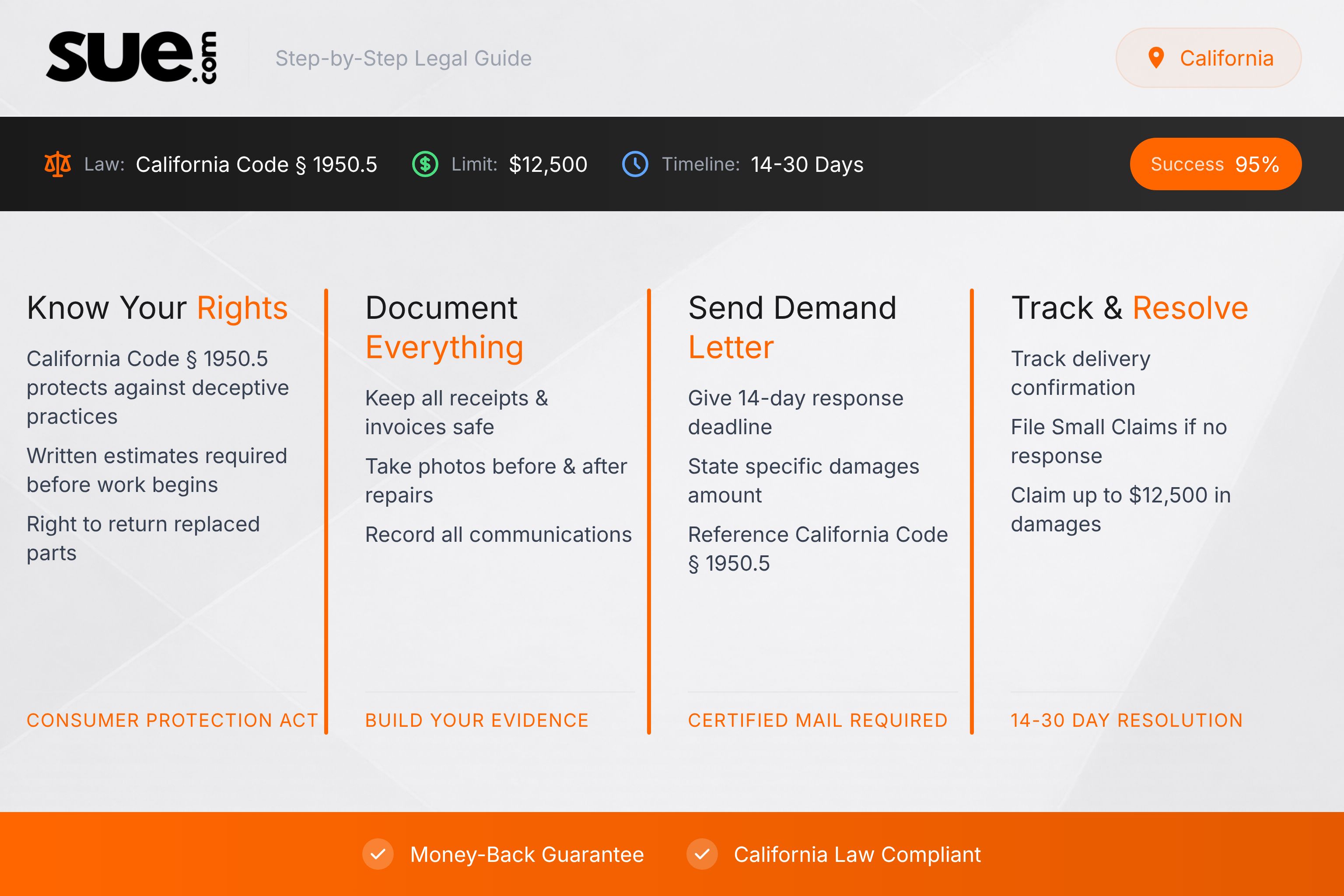
California Superior Court Small Claims Division Overview
Pursuant to California Code of Civil Procedure § 116.110 et seq., the Small Claims Division of the Superior Court maintains exclusive jurisdiction over civil matters where the amount in controversy does not exceed $12,500 for natural persons. Corporations, partnerships, and other legal entities are limited to claims of $6,250 or less under § 116.221(a). No party may file more than two claims exceeding $2,500 in any calendar year pursuant to § 116.231.
Jurisdiction and venue are governed by § 116.370, which requires that actions be filed in the county where the defendant resides, where the obligation was to be performed, or where the injury occurred. The filing fee ranges from $30 to $75 for claims under $1,500, and from $50 to $100 for claims between $1,500 and $5,000, with higher fees applicable to claims exceeding $5,000.
Natural persons eighteen years of age or older, emancipated minors, and legal entities may initiate small claims actions. Claims may be brought against individuals, businesses, corporations, government agencies, and other legal entities. Common case types include breach of contract, property damage, personal injury under the jurisdictional limit, security deposit disputes, consumer protection violations, and unpaid debts.
Attorneys are prohibited from representing parties at small claims hearings under § 116.530, though legal consultation prior to the hearing is permitted. The defendant may request transfer to regular civil court if represented by counsel becomes necessary. Those seeking information on How to object in California small claims court should note that appeals are available only to defendants in small claims matters, while plaintiffs waive their right to appeal upon filing.
California Laws That Help You Win
California statutory law provides robust protections for consumers, tenants, and parties to contracts. Understanding these provisions is essential for establishing liability and calculating damages in small claims proceedings.
California Civil Code § 1950.5 governs residential security deposits with specificity. Landlords must return the deposit within 21 days of the tenant vacating the premises, accompanied by an itemized statement of any deductions. Failure to comply entitles the tenant to recover the wrongfully withheld amount plus statutory damages up to twice the deposit amount if the retention was in bad faith. The landlord bears the burden of proving the reasonableness of any deductions claimed.
California Civil Code § 1770 (Consumer Legal Remedies Act) prohibits unfair and deceptive business practices in consumer transactions. Violations entitle the consumer to actual damages, punitive damages in cases of willful conduct, and attorney fees. The Act covers misrepresentations regarding the characteristics, uses, benefits, or quantities of goods and services. A demand letter providing 30 days to cure is required before filing suit under this statute.
California Business and Professions Code § 17200 addresses unfair competition and unlawful business practices. This statute permits recovery of restitution and injunctive relief for any unlawful, unfair, or fraudulent business act or practice. The four-year statute of limitations provides extended time to pursue claims.
California Civil Code § 3294 authorizes punitive damages where the defendant has been guilty of oppression, fraud, or malice. Such damages require clear and convincing evidence of intentional misconduct or conscious disregard for the rights and safety of others. While punitive damages are available in small claims court, the total recovery remains subject to the $12,500 jurisdictional limit.
Common California Small Claims Cases
The California Superior Court Small Claims Division adjudicates a broad range of civil disputes. The following categories represent the most frequently filed case types, each governed by specific statutory and common law provisions.
Security Deposit Disputes constitute a significant portion of small claims filings. Under Civil Code § 1950.5, tenants may recover wrongfully withheld deposits plus bad faith penalties. Documentation of the unit’s condition at move-in and move-out is essential evidence.
Vehicle Accident Claims for property damage under the jurisdictional limit are properly brought in small claims court. California’s comparative negligence standard under Civil Code § 1714 allocates fault proportionally between parties.
Breach of Contract Actions require proof of a valid agreement, performance by the plaintiff, breach by the defendant, and resulting damages. Both written and oral contracts are enforceable, though the statute of limitations differs: four years for written contracts under CCP § 337 and two years for oral agreements under CCP § 339.
Property Damage Claims arising from negligence, trespass, or nuisance are recoverable. The measure of damages is typically the reasonable cost of repair or the diminution in value, whichever is less.
Consumer Protection Violations under the Consumer Legal Remedies Act and Unfair Competition Law provide enhanced remedies including statutory damages and fee-shifting.
Unpaid Debts and Loans are recoverable through small claims proceedings. Promissory notes, invoices, and written acknowledgments of debt serve as primary evidence.
Defective Products and Services give rise to claims for breach of warranty under the Song-Beverly Consumer Warranty Act, Civil Code § 1790 et seq., which provides for recovery of the purchase price plus incidental damages.
Neighbor Disputes involving property damage, nuisance, or boundary issues fall within small claims jurisdiction when damages are quantifiable and within the monetary limit.
Professional Services Disputes with contractors, mechanics, or service providers are common filings. The Contractors State License Board provides additional remedies for unlicensed contractor violations.
Personal Injury Claims under the jurisdictional limit may be pursued, though medical documentation and proof of causation are required elements.
The California Small Claims Court Process
The procedural requirements for initiating and prosecuting a small claims action in California are established by statute and local court rules. Compliance with each step is mandatory.
Step One: Demand Letter Requirement. Prior to filing suit, a written demand must be sent to the prospective defendant specifying the amount owed and the factual basis for the claim. Certain statutes, including the Consumer Legal Remedies Act, impose mandatory pre-suit notice periods of 30 days. The demand letter establishes the claimant’s good faith effort to resolve the dispute and may be admitted as evidence at trial.
Step Two: Filing the Claim. The plaintiff must complete and file Form SC-100 (Plaintiff’s Claim and ORDER to Go to Small Claims Court) with the clerk of the Superior Court in the appropriate venue. Filing fees range from $30 to $100 depending on the claim amount. The clerk will assign a hearing date, typically 30 to 70 days from filing.
Step Three: Service of Process. The defendant must be served with the claim and hearing notice at least 15 days before the hearing date if served within California, or 20 days if served outside the state, pursuant to CCP § 116.340. Service must be accomplished by a person over 18 years of age who is not a party to the action. Acceptable methods include personal service, substituted service, or service by certified mail with return receipt.
Step Four: Evidence Preparation. Admissible evidence includes contracts, receipts, photographs, correspondence, repair estimates, and witness testimony. All documentary evidence should be organized chronologically and copies prepared for the court and opposing party. Witnesses may testify in person or provide written declarations under penalty of perjury.
Step Five: Court Hearing. The judicial officer will hear testimony from both parties, examine evidence, and render a decision. Hearings typically last 15 to 30 minutes. The plaintiff bears the burden of proving each element of the claim by a preponderance of the evidence. The judgment may be announced at the hearing or mailed within 10 days.
Step Six: Judgment Collection. A prevailing plaintiff must wait 30 days after judgment before initiating collection efforts, allowing time for the defendant to pay voluntarily or file an appeal. Collection remedies include wage garnishment under CCP § 706.010, bank levies, and property liens. Judgments remain enforceable for 10 years and may be renewed for an additional 10 years under CCP § 683.020.
How Sue.com's California Small Claims Court Package Works
The Sue.com California Small Claims Court Package provides comprehensive legal documentation and procedural guidance for $249. This package includes all materials necessary to pursue a claim from initial demand through judgment collection.
Under Recover California parking fees via demand, sending a formal demand letter is a powerful first step, and it is included in this package. The demand letter is drafted by licensed attorneys to comply with statutory notice requirements and maximize settlement potential before litigation becomes necessary.
The package includes identification of the correct California Superior Court location and department for filing, a complete list of required forms with instructions for completion, an evidence checklist tailored to the specific claim type, a damage calculation worksheet citing applicable statutory provisions, and a court preparation guide detailing hearing procedures and presentation strategies.
According to the Sue.com California legal guide, this package eliminates the procedural uncertainty that causes many valid claims to fail. All documents are prepared by California-licensed attorneys who remain available to answer procedural questions throughout the process. The flat fee covers all documentation regardless of claim complexity or the number of defendants named.
Step 1
Answer a Few Simple Questions
Tell us what happened — who owes you, how much, and why. Our system guides you step-by-step with no legal jargon.
Step 2
We Draft Your California Demand Letter
Your answers are reviewed and used to create an attorney-drafted demand letter tailored to your case.
Step 3
We Mail It for You

Ready to Send Your California Demand Letter?
Need Assistance?
Need help?
Find answers
Got questions about how Sue.com works, what’s included in each package, or what happens after your letter is sent? We’ve got you covered — quick, clear answers to help you move forward with confidence.
1. What is the small claims court limit in California?
Pursuant to California Code of Civil Procedure § 116.221, the jurisdictional limit for natural persons is $12,500. Corporations, partnerships, limited liability companies, and other legal entities are limited to claims not exceeding $6,250.
2. How much does it cost to file in California Superior Court Small Claims Division?
Filing fees are established by Government Code § 70613 and range from $30 to $75 for claims of $1,500 or less, $50 to $100 for claims between $1,500 and $5,000, and $75 to $100 for claims exceeding $5,000. Fee waivers are available for qualifying low-income litigants.
3. Do I need a lawyer for California Superior Court Small Claims Division?
Attorneys are prohibited from appearing at small claims hearings under CCP § 116.530. Parties must represent themselves, though pre-hearing legal consultation is permitted. This prohibition ensures an accessible forum where procedural formality does not disadvantage unrepresented litigants.
4. How long does a California small claims case take?
The hearing is typically scheduled 30 to 70 days from the filing date. The judicial officer may announce the decision at the hearing or mail it within 10 days. The entire process from filing to judgment generally requires six to ten weeks.
5. What if the defendant does not show up to court?
Failure of the defendant to appear results in entry of a default judgment pursuant to CCP § 116.520. The plaintiff must still present sufficient evidence to establish the claim and prove damages. The court will not award more than the amount demanded in the complaint.
6. What if I win but they refuse to pay?
California law provides multiple enforcement mechanisms for judgment creditors. After the 30-day appeal period expires, the prevailing party may pursue wage garnishment, bank account levies, property liens, and debtor examinations. Judgments accrue interest at 10% annually under CCP § 685.010 and remain enforceable for 10 years with renewal rights.